Quick answer: Yes, you can checkmate with two bishops if they stand on opposite colors. Put the bishops side by side to build a wall, bring your king up, and shrink the box until the king reaches a corner. The final mate: your king on g6, one bishop checking on the long diagonal, the other covering g8.
Two bishops against a lone king looks like an easy win. Then the king slips along the edge, your bishops run out of checks, and 1 careless move gives stalemate.
So learn the final picture first, then the 4-step method that gets you there. Use the move players to step through each line, and pause before every White move to guess it. Need a refresher on how the pieces move? Start with our guide to chess pieces moves.
Can you checkmate with two bishops?
Yes, you can checkmate with two bishops. King and two bishops against a lone king is a forced win, as long as one bishop is light-squared and the other is dark-squared. But don’t leave your king at home. The bishops alone can’t cover enough squares.
How long does it take? At most 19 moves from any starting position (Wikipedia, Checkmate). Two bishops on the same color, though, can’t checkmate at all. More on that further down.
What does the two bishops checkmate look like?
The two bishops checkmate looks like this: Black’s king trapped in a corner on h8, White’s king on g6. One bishop gives check on the long a1-h8 diagonal. The other bishop covers g8.
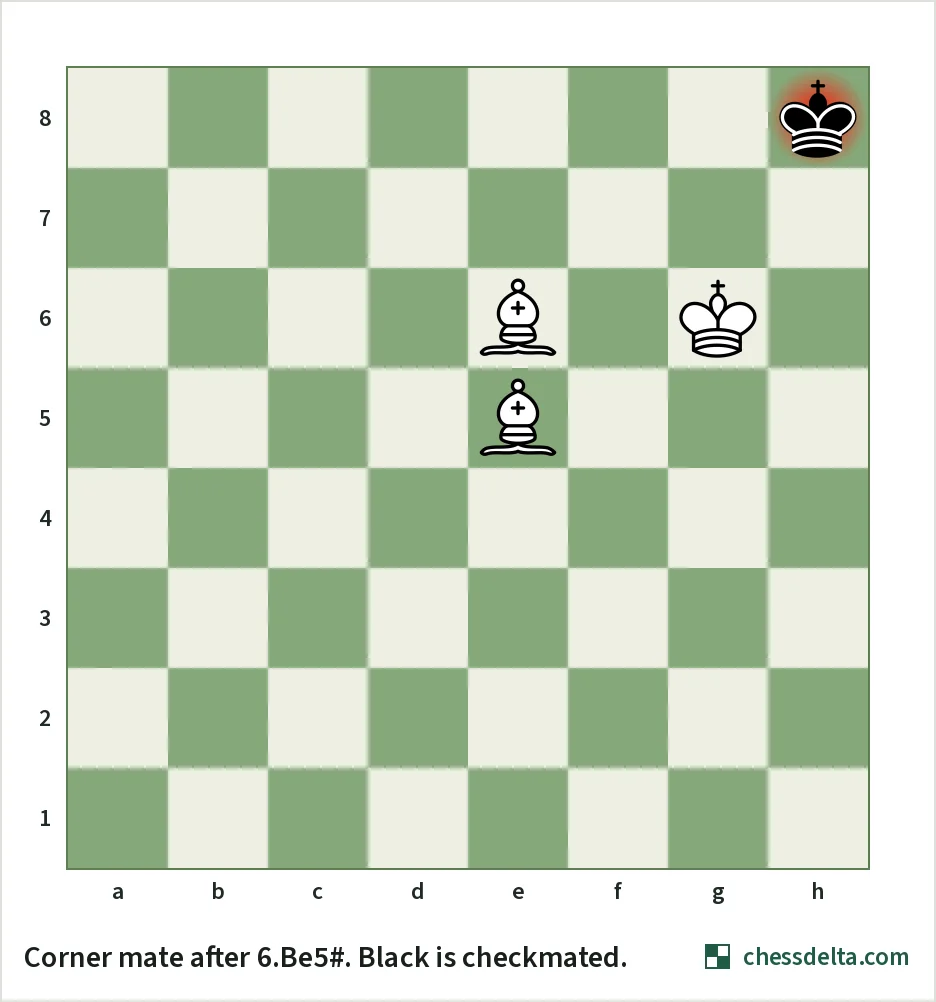
Look at how little each piece does. Each has 1 job:
- Bishop on e5: checks the king on h8 through f6 and g7.
- Bishop on e6: covers g8 through f7.
- King on g6: covers g7 and h7.
The bishops have some freedom along those diagonals. A bishop on c3 or d4 mates just as well as one on e5. The king on g6 is the fixed part, so that’s the square to remember.
Can you mate on other edge squares? Yes, and by our count there are 1,552 mating positions in all. But a good defender keeps the king away from the edge, so you’ll have to drive it into a corner.
How to checkmate with two bishops, step by step
To checkmate with two bishops, build a wall with the bishops and bring your king up to it. Then shrink the box 1 row at a time. These 4 steps work from any position.
Step 1: Put the bishops side by side
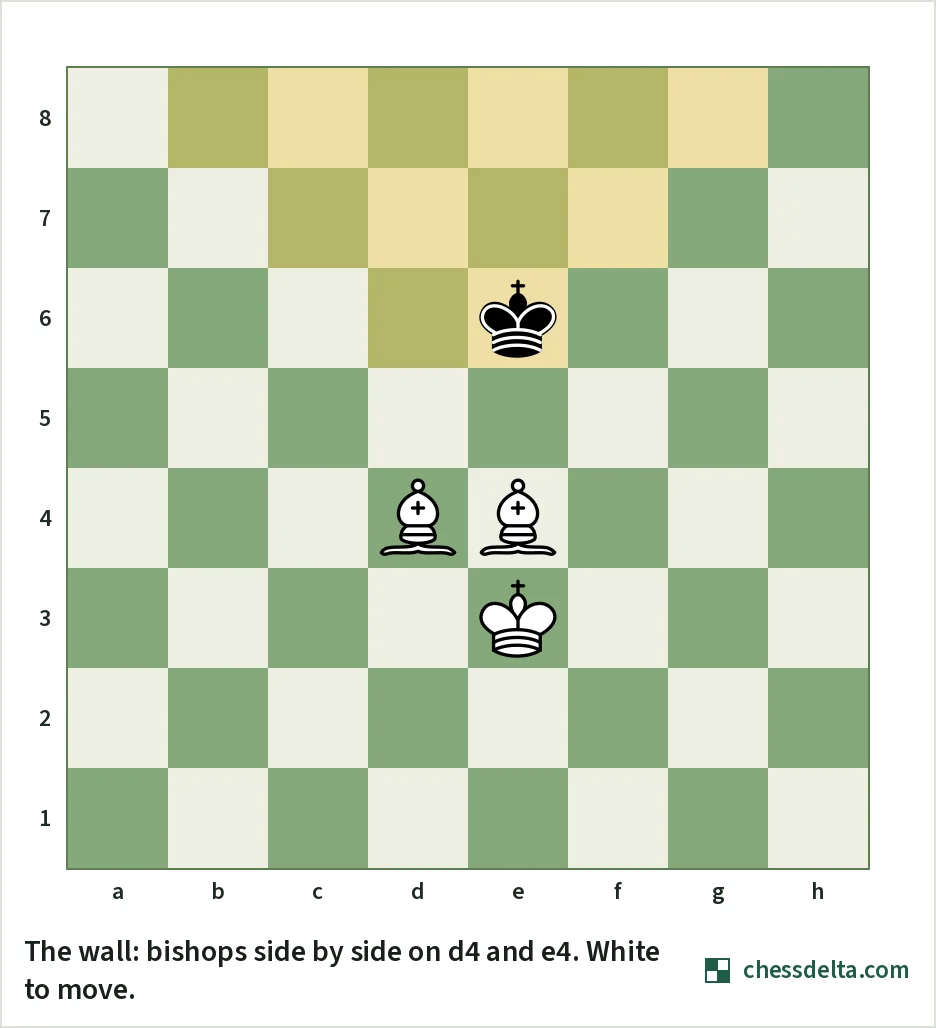
Place your bishops next to each other near the center, such as on d4 and e4. Together they cover 4 diagonals and form a wall the enemy king can’t cross.
See the shaded squares? Black’s king on e6 is stuck in those 12. It can’t cross the wall, and it can’t attack either bishop, because d5, e5 and f5 are all covered.
Step 2: Bring your king up to the wall
Why the king? Because the bishops can’t push the enemy king back alone. Walk your king up behind the bishops, then in front of them. It takes squares away and protects the bishops when they step forward.
Keep the bishops close to your king or to each other. Lose a loose bishop, and you’re left with king and bishop against king. That’s a draw.
Step 3: Shrink the box
Move 1 bishop forward at a time, so the wall moves up by a row. Each bishop move should take squares from the enemy king without letting it slip past the wall.
Stuck for a useful bishop move? Make a waiting move along the same diagonal. The enemy king then has to step back.
Step 4: Drive the king into a corner
Once the lone king is on the back rank, use checks to walk it toward a corner. Put your king on g6 (or the matching square near another corner: b6, b3 or g3). Then check from 1 bishop, then the other, until the king lands on h8 and the last check is mate.
Full example: from the wall to mate in 14
Now see all 4 steps in 1 game. From the wall position with White to move, White mates in 14 against the toughest defense: 1.Kf4 Kd6 2.Kf5 Ke7 3.Be5 Kd7 4.Bd5 Kc8 5.Ke6 Kd8 6.Bb7 Ke8 7.Bc3 Kd8 8.Ba5+ Ke8 9.Bc6+ Kf8 10.Kf6 Kg8 11.Kg6 Kf8 12.Bb4+ Kg8 13.Bd5+ Kh8 14.Bc3#.
Every White move here is the fastest win, and every Black move holds out the longest. As you step through, watch the pattern: king up first (moves 1 to 2), bishops forward (3 to 6), then checks toward the corner (8 to 14).
Can’t find moves this precise over the board? You don’t need to. You have 50 moves before a draw can be claimed (FIDE Laws, Article 9.3), and this mate needs at most 19.
How does the final phase of the two bishops mate work?
The final phase of the two bishops mate starts once the lone king is near the corner. This is where the stalemate traps are. Here the bishops on e5 and f5 already box Black’s king near g8, and White’s king is on f6.
After 1…Kf8, White mates in 5: 2.Bd7 Kg8 3.Kg6 Kf8 4.Bd6+ Kg8 5.Be6+ Kh8 6.Be5#.
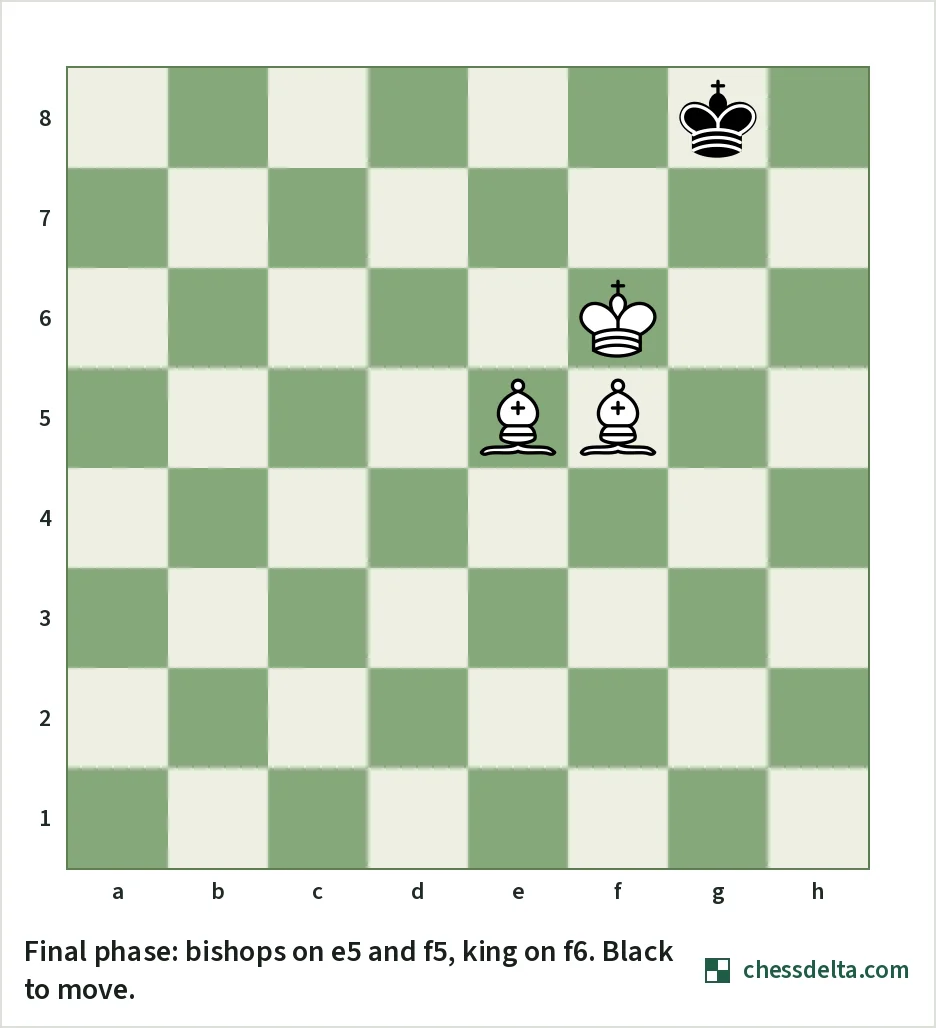
So how does it work? 2.Bd7 takes e8, so Black’s only move is 2…Kg8. 3.Kg6 puts the king on its mating square. The 2 checks, 4.Bd6+ and 5.Be6+, push the king from f8 to g8 to h8. Then 6.Be5# ends it.
What stalemate traps should you avoid?
The stalemate traps to avoid are everywhere near the end: almost every move has one. Stalemate means the player to move has no legal move and is not in check. The game is a draw (FIDE Laws, Article 5.2.1).
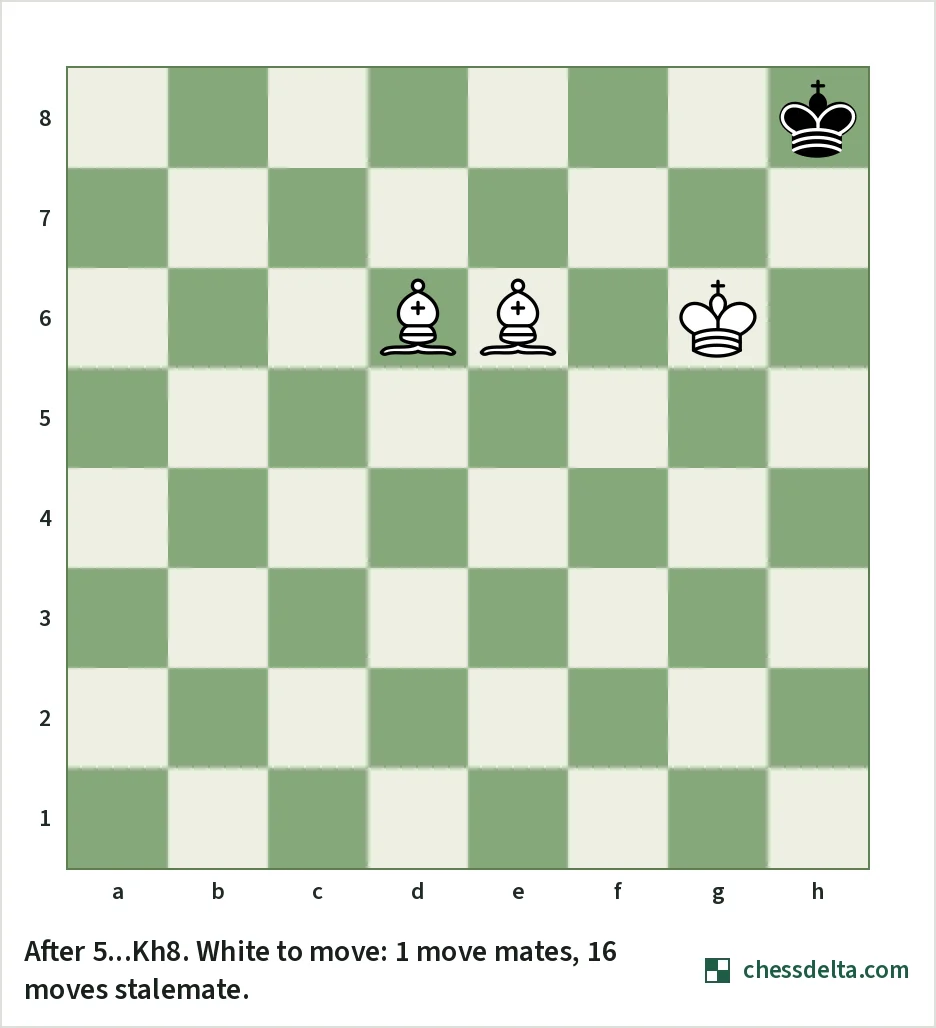
How bad can it get? Look at the position after 5…Kh8. White has 28 legal moves, and only 6.Be5# mates. 16 other moves, including 6.Kh6, 6.Bd5 and 6.Bc5, leave Black with no move and no check: stalemate.
So how do you stay safe? Build these habits:
- Count the king’s squares before every move. If your move leaves it 0 squares and gives no check, it’s stalemate.
- When the king has 1 or 2 squares, give check. A check can’t be stalemate.
- Don’t take the last free square with a quiet move. Leave the king a square to step into, then mate it there.
- Keep your king on g6, not h6, when the enemy king is on h8. In the trap position, 6.Kh6 is stalemate.
To learn more, read what is stalemate and stalemate vs checkmate, with more endings like this.
Why can’t two bishops on the same color checkmate?
Two bishops on the same color can’t checkmate because they never attack the other color. A king on a light square can’t be checked by 2 dark-squared bishops, and every king has light squares next to it.
Your own king would have to cover all those squares, and it can’t get close enough. We checked every placement of king and 2 same-colored bishops against a lone king. None of them is checkmate.
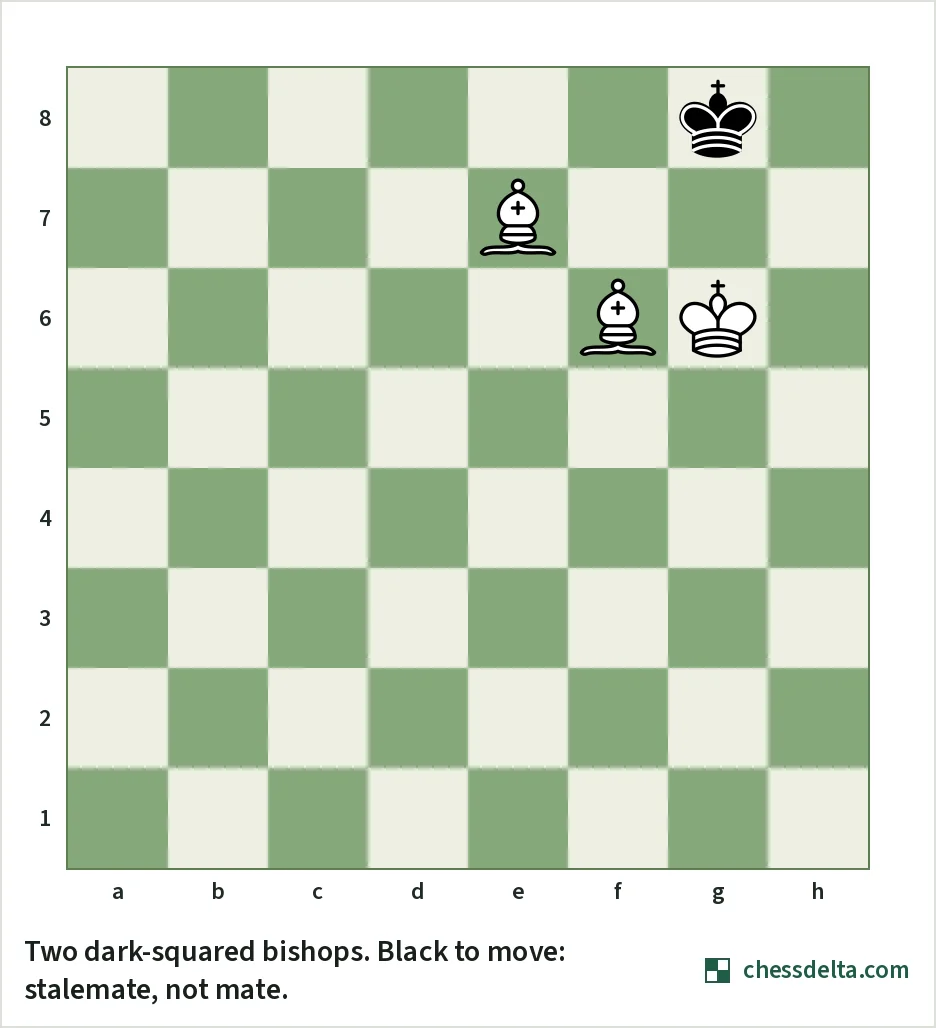
Since nobody can checkmate, the game is a draw as a dead position (FIDE Laws, Article 5.2.2). When would you even have 2 same-colored bishops? Only after a pawn promotes to a second bishop. To learn more, read what happens when a pawn reaches the other side.
Why do you need your king for the two bishops mate?
You need your king for the two bishops mate because the bishops can’t cover the squares right next to the enemy king on their own. They check and cut off diagonals. Your king covers the rest, like g7 and h7 in the corner mate.
And since kings can never stand next to each other, your king also pushes the enemy king back. To learn more, read how does the king move, with that rule explained.
FAQ
Can you checkmate with a king and one bishop?
No, you can’t checkmate with a king and one bishop against a lone king, by any series of legal moves. The game is drawn as a dead position (FIDE Laws, Article 5.2.2).
How many moves does the two bishops checkmate take?
The two bishops checkmate takes at most 19 moves from any position, with perfect play. From the wall position on this page, White mates in 14.
Does the 50-move rule matter in the two bishops checkmate?
The 50-move rule only matters in the two bishops checkmate if you wander. The player to move can claim a draw after 50 moves each with no capture or pawn move (FIDE Laws, Article 9.3). The method on this page mates well inside that limit.
Is bishop and knight checkmate harder than two bishops?
Yes, bishop and knight checkmate is harder than two bishops. It’s the hardest basic mate. It can take up to 33 moves, and you can only force it in a corner of the bishop’s color (Wikipedia, Checkmate).
Where can I practice the two bishops checkmate?
You can practice the two bishops checkmate by setting up the wall position on a board and playing it against an engine. Lichess also has a free drill in its practice section, under Piece Checkmates II.
Updated .