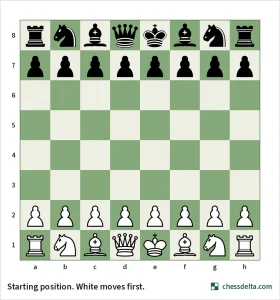
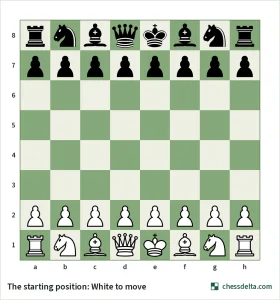
Ask a friend how many squares are on a chessboard and they’ll say 64. They’re right. But they’re also missing 140 squares hiding in plain sight.
There are 64 squares on a standard 8×8 chessboard. But if you count every square of every size, not just the single squares, the answer is 204 squares in all.
Want a coach to help you put those 64 squares to better use? You can find chess coaches here.
Why Are There 204 Squares On A Chessboard?
There are 204 squares on a chessboard because squares come in more than 1 size. A standard board is 8×8, which gives you the 64 small squares. But groups of those small squares also form bigger squares: 2×2, 3×3, and so on up to the whole 8×8 board.
Count every size from 1×1 to 8×8, add them up, and you get 204.
Notice the pattern in the table. Each count is a square number: 1, 4, 9, 16 and so on.
| Square Size: | Number of Squares: |
| 8×8 | 1 |
| 7×7 | 4 |
| 6×6 | 9 |
| 5×5 | 16 |
| 4×4 | 25 |
| 3×3 | 36 |
| 2×2 | 49 |
| 1×1 | 64 |
| Total | 204 |
Still not sure how 7×7 gives you 4 squares? This short video counts them on the board, and it makes the idea click.
Why Are There 64 Squares On A Chessboard?
There are 64 squares on a chessboard because an 8×8 board is a good size for the game. A bigger board, like 10×10, would make games much more tiring. A smaller one, like 6×6, would make them too quick.
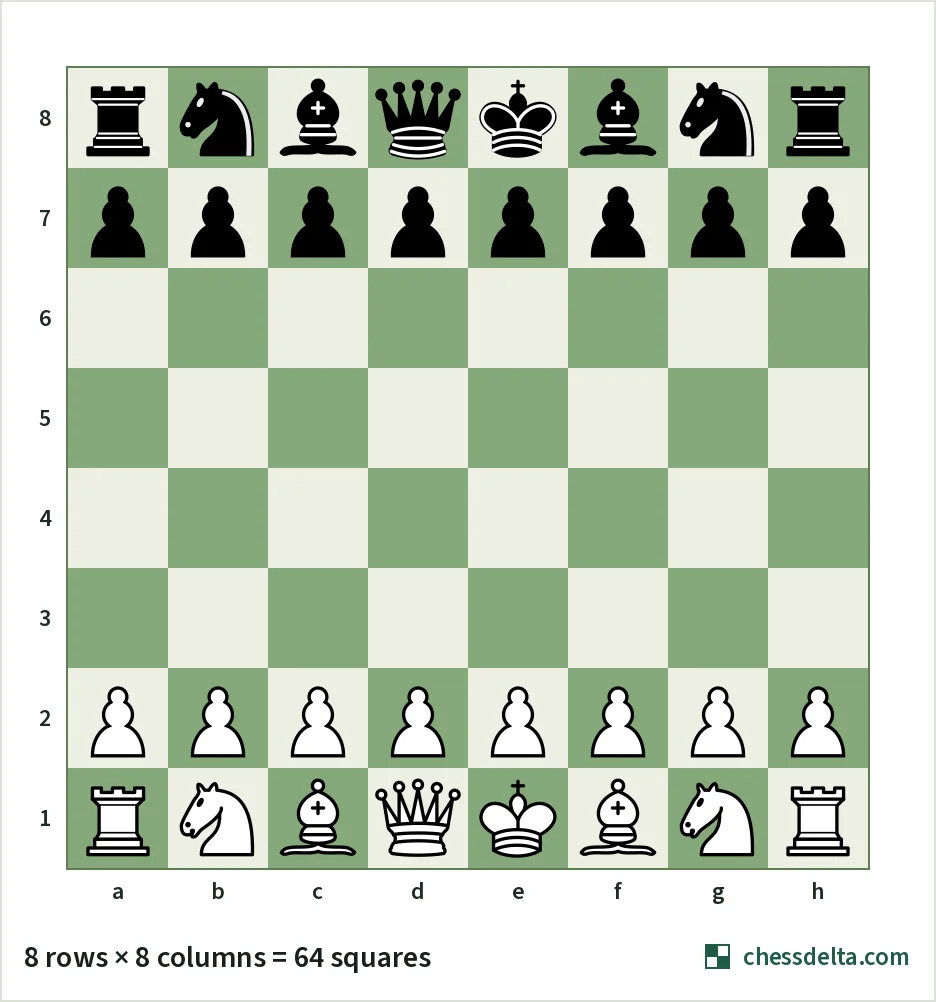
So why 8 exactly? Look at your back row. Leave out the pawns (they go on the 2nd row), and each side has 8 pieces. A board 8 squares wide fits them perfectly.
A square board then needs 8 rows too. And 8 by 8 gives you 64 squares.
The second reason goes back to game length. 64 squares is a sweet spot: the game isn’t too boring, and it isn’t too short.
A bigger board would also mean more possible moves. And chess is complex enough already.
Just how complex? Read our guide to how many chess games are possible. The number is bigger than you’d guess.
You can learn the basics of chess quickly. Mastering chess is another story. People spend a long time becoming a chess master.
That mix is the point. Easy to start, and deeper the more you learn: it’s a big part of what makes chess so fun.
History Of Chessboards & Its Transformation From Time To Time
The 8×8 board is older than chess itself. The earliest form of chess, ‘Chaturanga’, borrowed its board from another ancient game, ‘Ashtapada’.
According to Wikipedia, that board was a single color and divided into 8 columns by 8 rows. No light and dark squares yet.
Centuries later, players in Persia and Central Asia tried bigger boards, with more rows and columns.
One 14th-century variant, Tamerlane chess, used a board of 11 columns by 10 rows. It even had 2 extra squares, called citadels, sticking out from the sides of the board.
So when did the board get its light and dark squares? Later, once chess reached Europe.
A book from that time, ‘Libro de los juegos’ (Book of games), describes the chessboard. It calls an 8-by-8 board the ideal size.
Curious who started it all? Read Who Invented Chess?
Over time, many new kinds of chessboards came along. There are even 3-dimensional boards, where the third dimension is another 2-dimensional chessboard.
But the 8 by 8 board with 64 squares became the standard. It’s the one you play on today.
Conclusion
So a chessboard has 64 squares. Count every square of every size, though, and there are 204.
Next time you set up the pieces, try it yourself. Pick any 2×2 block and you’ll see 1 of the 49.
Know someone who still says 64? Send them this page and see if they can find the other 140.
Also Read: