To become a chess grandmaster, most players need a FIDE rating of at least 2500 and 3 GM norms. Below you’ll see what that means, step by step, plus the few results that can earn the title directly.
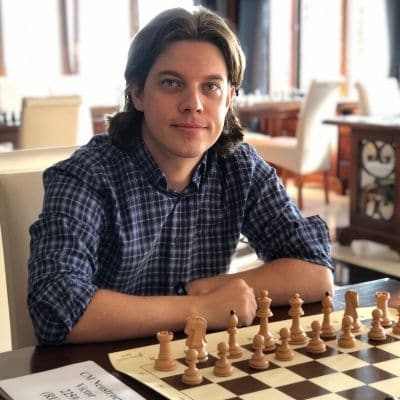
But rules only tell you half the story. So we asked FIDE Master Viktor Neustroev, from the Tricks of Chess YouTube Channel, what it really takes. He coached his daughter, the Chess Champion of Siberia among girls under 9.
How To Get The Chess Grandmaster Title?
To get the chess grandmaster title, you start with FIDE.
FIDE, the World Chess Federation, is the international body that governs chess. It’s also the one that rates you based on your results.
FIDE awards the Grandmaster title. Apart from World Champion, it’s the highest title in chess. And once you earn it, it’s yours for life, except in cases of cheating.
So step 1 is getting a FIDE rating. For that, you need to play in FIDE-rated tournaments.
Not rated yet? To learn more, read our full guide on how to get a FIDE rating in chess, with every step to your first rating.
From there, you earn each title as you reach its rating, and for the top 2 titles, its norms too. More on norms in a moment.
Here are the chess titles in order, with the minimum rating for each:
| Chess Titles | Minimum Ratings |
| Candidate Master (CM) | 2200 |
| FIDE Master (FM) | 2300 |
| International Master (IM) | 2400 |
| Grandmaster (GM) | 2500 |
Here’s the catch: for the Grandmaster and International Master titles, the rating alone isn’t enough. You also need norms.
So what is a norm? It’s a very strong performance in a single tournament, against strong enough opposition.
For the grandmaster title, you need 3 GM norms on top of a FIDE rating of at least 2500.
How Do You Get A GM Norm?
To get a GM norm, a player needs to meet these criteria:
- Play at least 9 games in the tournament.
- Face opponents from at least 2 federations other than your own.
- At least 1/3 with a minimum of 3 of the opponents must be Grandmasters.
- At least half of the opponents must be titleholders, excluding CM and WCM.
- The performance rating of the player must be at least 2600.
- The opponent’s minimum average rating must be 2380.
Hit all of these in 1 tournament, and you have 1 GM norm. You need 3 for the title.
These are the main criteria, but there are a few others and some exceptions. For the full detail, check the FIDE Title Regulations – FIDE Handbook.
So, how do you become a chess grandmaster? In general, you need a FIDE rating of at least 2500 at any point, plus 3 GM norms. But there’s a shortcut: certain results in certain events give you the title directly, as long as your FIDE rating has reached at least 2300.
FIDE’s current table for direct titles lists the events that give the GM title with no norms. They include winning the World Junior (U20), a World Senior or a continental championship, or the Women’s World Cup. You still need a FIDE rating of at least 2300 at some point.
Here are the events that can give you the GM title directly. Again, you need a FIDE rating of at least 2300:
| Event Type | Result | Title Type |
| World Cup | Reaching last 16 | GM |
| World Senior Championship (both in 65+ and 50+ division) | Gold | GM |
| World Junior Championship (Under 20) | Gold | GM |
| Continental Individual (e.g. European, Asian) | Gold | GM |
| Women’s World Cup | Winner | GM |
Title rules have exceptions and they change from time to time. So before you plan around them, check the FIDE Title Regulations handbook for the latest version.
Interviewing FIDE Master Viktor Neustroev On How To Become A Chess Grandmaster
That’s the rulebook. But what does the road to GM actually feel like, and how long does it take?
For that, you want someone who has walked part of it.
So we interviewed FIDE Master Viktor Neustroev. He’s a chess coach and the author of educational chess courses, and he holds the FIDE Master title.
He has also coached his daughter, the Siberian Chess Champion among girls under 9.
Here are his answers to our questions about becoming a chess grandmaster, in his own words:
How Long Does It Take To Become A Chess Grandmaster?
“You cannot set an exact timing for that.”
“A lot of chess players could not become GMs, because they do not have enough skills.”
“Any coach could lead a student to a level up to 1800 if a student is actually eager to study. It is harder to get a level higher than that, but possible.”
“You need to begin studying from childhood. I would say, if you are not yet a Grandmaster by 14 years old, you might get this title later, but it’s unlikely that you will become the world’s champion.”
“You still might be able to travel and take part in European tournaments, and earn some money, but it’s probably not going to be big amounts.”
“Of course, you can be a coach and train other players even if you have a level of 1850.”
“For example, it took a year for me to go from a level of 2200 to 2300.”
“I think it would take around 4-5 years to reach a level of 2000-2200 for an adult, though that depends on the person, of course.”
“I started playing chess when I was 5 and taking part in tournaments at the age of 8. I was a Candidate Master at the age of 12 (this is when I reached 2200 level), I had been playing with that title for 5 years, then I stopped, and after a break, I decided to reach the FIDE master level. It took me a year of intensive studying.”
How Hard Is It To Become A Chess Grandmaster?
“It seems to me that it is really hard. Some people dedicate their whole life to it.”
“For example, my friend, Arseniy Korgin, an International Master, has a rating of 2400, and in order to become a Grandmaster, you need 2500 and 3 GM norms.”
“He only has 2 norms. Right now he is 41 years old and he is trying to get the title, but he could not even though he has the skills.”
“He tries hard, he is smart and has a good memory, and his experience is pretty good, but it doesn’t work out for now.”
“Usually, if a chess player reaches a level of 2000, it is already considered a great result.”
“After that, it is more complicated and serious. You need to study with titled players and Grandmasters. And of course, you need to dedicate all of your time to it.”
“Probably, it is possible when you’re at school. But when you do that, you start traveling, take part in tournaments in Europe, and there is not much time for school.”
“There should be an agreement with teachers so that they give you good grades because you’re a good chess player.”
“The same applies to universities, but not every university might agree to do that.”
“It is not really possible to concentrate on university studies and play chess professionally at the same time.”
“You will have to sacrifice school and university a little bit, and no chance of a job during that time. Otherwise, you wouldn’t be able to make it, it is hard.”
“Parents have to be able to afford such a lifestyle for their child to become a GM.”
“On the other hand, if you are an adult with some savings, and you are ready to dedicate your time to becoming a grandmaster – 5-7 years for that, it should work. But usually, people at that age do not put it as a priority – they have a family, children, etc.”
How Much Do Grandmaster Chess Players Actually Make?
“It depends: in my city Novosibirsk, I would say I make the most among other chess players.”
“But, for example, chess players in the USA or the UK definitely earn more. It is not enough for an average GM to make a living only by taking part in tournaments.”
“A GM can earn on streaming, helping other talented GMs by assisting them or coaching others, signing contracts with companies that promote chess, or selling educational courses. You can create articles or develop software.”
“So it is not very profitable, but it is possible to build a business around it.”
“But also, you don’t need to become a GM to make a business around it! So in order to earn money, you just need to love chess and do something that is useful and interesting for other people.”
“When it comes to GMs that only earn money in tournaments, only the first 20 players earn enough. They also usually have sponsors: for example, Daniil Dubov signed a contract with the World of Chess.”
“Without it, they would have to have a job besides playing. Some of the coaches at the same time.”
“Based on my experience, I would say an average GM earns around 3000 $ per month, not more. And when they get a family and have some extra expenses, this is not enough.”
Can You Become A Chess Grandmaster Without A Coach?
“There are a lot of online resources for studying right now that are more affordable than hiring a coach.”
“As I said, it’s better to start early in childhood, and perhaps when a child is regularly studying at a chess school, offline or online, he could achieve good results.”
“I myself offer online courses and free webinars that provide a lot of theoretical knowledge in combination with practical exercises. I have also released a free guide on self-studying chess with a lot of tips on that topic.”
“So if a person is dedicated, self-studying tools would be helpful for him on his way to the title.”
“I mentioned that becoming a GM as an adult is harder, so in that case, I think you need a coach or another titled player to train you.”
Can You Become A Chess Grandmaster If You Start Late?
“As I said, there are not many people that have such a goal in their adulthood because of different priorities. But if you’re ready to dedicate several years to it, have some savings and you’re free from everyday work, it should work out.”
What Should Be The Training Process For Becoming A Chess Grandmaster?
“It’s different for everyone, but mostly you have to study with GMs around 3 times per week for 3 hours, a lot of self-studying.”
“You should study openings, take part in tournaments regularly, and watch the games of GMs.”
“All in all, you should practice a lot, like really, a lot! You should focus on studying openings preparation. Get a strong coach that could prepare a good study plan.”
What Would You Advice Aspiring Chess Grandmasters?
“Do what you love – and if you love chess, which is probably true – study for the title as long as it actually motivates you and gives you pleasure.”
“There are so many ways to connect your life with chess without a GM norm, as I said, you don’t have to be a GM to earn money with chess. Just keep that in mind.”
That’s the end of the interview.
Author’s Final Words
So, should you go for it? If you’re determined, believe you can do it and have the right resources, then yes.
Viktor’s answers show it takes years of hard, disciplined work. But passion for the game is what keeps you going.
Find a good chess coach, improve your chess-playing skills, study, research, and develop your knowledge.
Pick the next step that makes you a better player today. Each one brings the GM title a little closer.
Also Read: