Quick answer: The Traxler Counterattack is 1.e4 e5 2.Nf3 Nc6 3.Bc4 Nf6 4.Ng5 Bc5. Black ignores the threat to f7 and counterattacks f2. If White grabs the rook with 5.Nxf7, Black gets a wild attack that holds the balance. White’s best reply is 5.Bxf7+!, after which Stockfish rates White clearly better. It’s a fun surprise weapon, not a sound main line.
What is the Traxler Counterattack?
It’s named after Karel Traxler, a Czech priest and chess problem composer, who won a famous game with it in 1890. In the United States it’s also called the Wilkes-Barre Variation, after the Pennsylvania city where local players analyzed it.
It arises from the Two Knights Defense. Instead of blocking White’s attack on f7 with 4…d5, Black develops the bishop to c5 and lets White take on f7. The point is that Black’s bishop and knights then hit f2 and e4, and White’s king can end up just as exposed as Black’s.
The move order
1.e4 e5 2.Nf3 Nc6 3.Bc4 Nf6 4.Ng5 Bc5
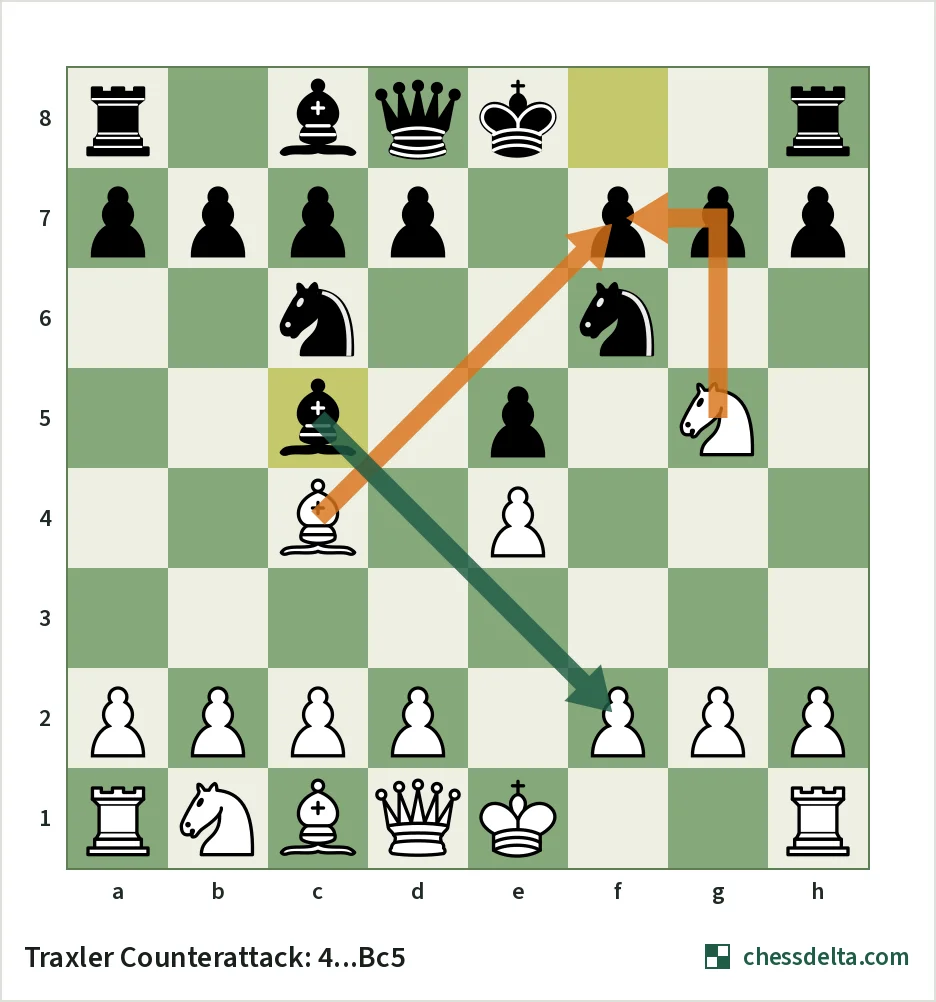
What happens after 5.Nxf7
This is the line Black is hoping for. White forks the queen and rook, but Black strikes first: 5…Bxf2+! 6.Kxf2 Nxe4+.
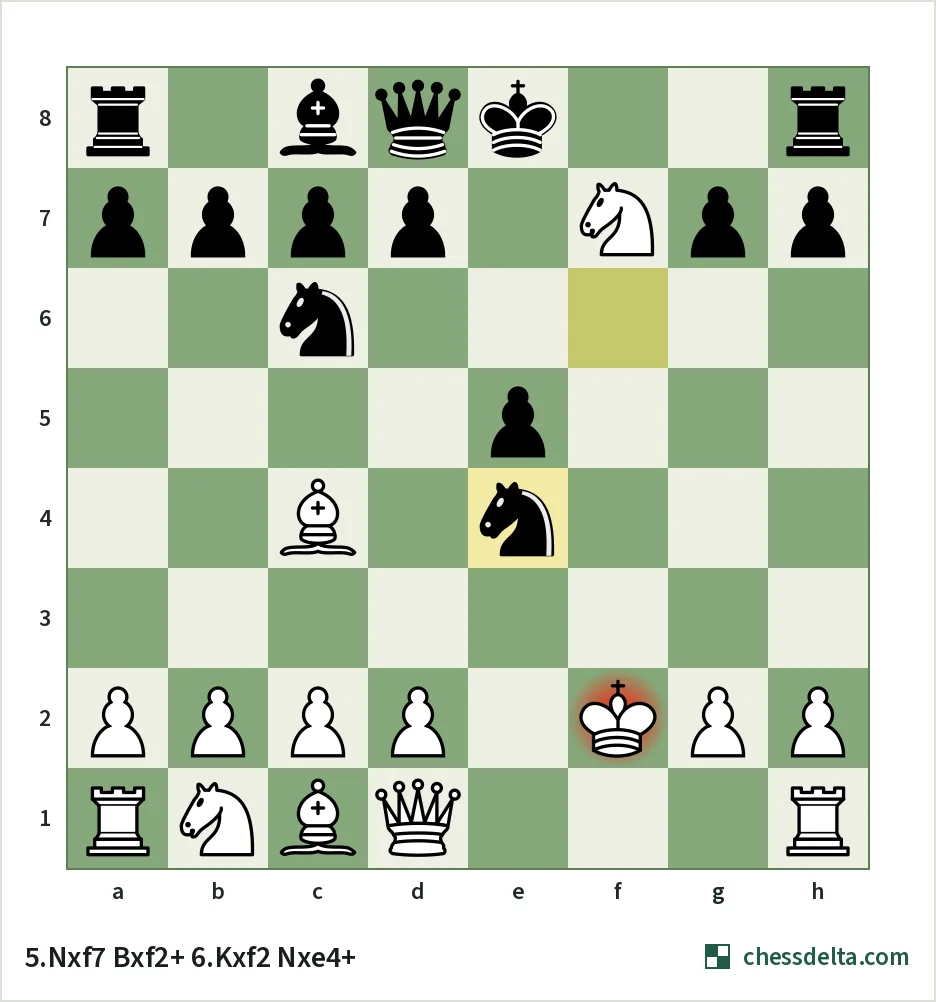
White’s king has to move, and only two squares hold:
- 7.Kg1 Qh4 8.g3 Nxg3 9.hxg3 Qxg3+ 10.Kf1 Rf8. Black has given up two pieces, but the queen and rook are bearing down on White’s king. White’s only good move is 11.Nc3, and the position is level. The natural 11.Qh5? is a mistake: 11…d5! and Black is winning.
- 7.Ke3 Qh4 8.g3 Nxg3 9.hxg3 Qd4+ 10.Kf3. White’s king walks forward. Again Stockfish says the position is equal, but one slip on either side decides the game.
The other king moves lose:
- 7.Ke1? Qh4+ and Black wins.
- 7.Kf1? Qh4 and Black is much better.
White can also decline the bishop with 6.Kf1, but after 6…Qe7 7.Nxh8 d5 the position is still a mess, with equal chances.
White’s best: 5.Bxf7+!
The bishop takes on f7 instead of the knight, with check.
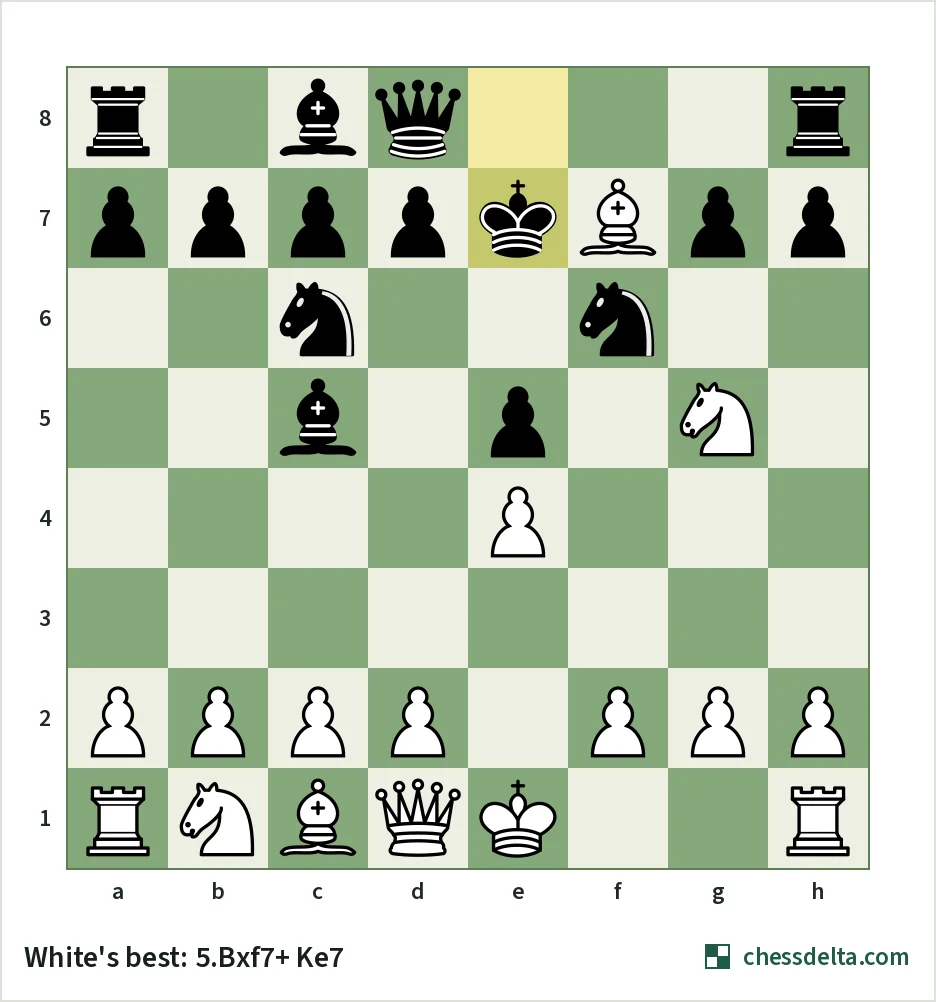
After 5…Ke7 Black’s king has lost the right to castle and White is a pawn up. The bishop retreats with 6.Bc4, 6.Bb3 or 6.Bd5, and Stockfish gives White an advantage of about a pawn in all three. Black has some activity for the pawn, but not enough.
5.d4 is another good reply. After 5…d5 6.Bxd5 Nxd4 7.Bxf7+ Ke7, White is better too, though the play is sharper.
What to play
As White
- Play 5.Bxf7+! and retreat the bishop. It’s the simplest way to get a clear advantage.
- If you do play 5.Nxf7, know that after 5…Bxf2+ 6.Kxf2 Nxe4+ only 7.Kg1 and 7.Ke3 hold, and then you must find the only moves.
- Or avoid it entirely: 4.d3 against the Two Knights rules out the Traxler.
As Black
- Play it as a surprise in quick games against opponents who’ll grab on f7 with the knight.
- Know the 5.Nxf7 lines by heart. If you don’t, you’ll be a rook down with no attack.
- Against 5.Bxf7+, don’t panic: play 5…Ke7, then …Rf8, …d6 and …Qe8, and look for activity. You’re worse, not lost.
- For a sound alternative, play the main line 4…d5 5.exd5 Na5 (see the Two Knights Defense).
[Event "Traxler Counterattack: 5.Nxf7 Kg1 line"]
[Result "*"]
1. e4 e5 2. Nf3 Nc6 3. Bc4 Nf6 4. Ng5 Bc5 5. Nxf7 Bxf2+ 6. Kxf2 Nxe4+ 7. Kg1 Qh4 8. g3 Nxg3 9. hxg3 Qxg3+ 10. Kf1 Rf8 11. Nc3 *
Related pages
FAQ
Is the Traxler Counterattack sound?
Not quite. Against 5.Bxf7+ Stockfish gives White about a one-pawn advantage. It’s playable in practice, especially in blitz, but it isn’t a sound main line.
What is the best response to the Traxler?
5.Bxf7+ Ke7 followed by a bishop retreat (6.Bc4, 6.Bb3 or 6.Bd5). White keeps an extra pawn and Black’s king can’t castle.
What’s the difference between the Traxler and the Wilkes-Barre?
Nothing. They’re two names for the same line, 4.Ng5 Bc5. “Traxler” is used in most of the world; “Wilkes-Barre” mainly in the United States.
Should beginners play the Traxler?
As Black, only if you enjoy sharp tactics and are willing to learn the 5.Nxf7 lines move by move. As White, every beginner should know 5.Bxf7+, because the Traxler is common in online games.