Quick answer: The Two Knights Defense is 1.e4 e5 2.Nf3 Nc6 3.Bc4 Nf6. Black counterattacks e4 instead of playing 3…Bc5. White’s main choices are 4.d3 (solid), 4.Ng5 (attacking f7, leading to the Fried Liver if Black goes wrong) and 4.d4 (open play). With correct play Black is fine in all of them.
What is the Two Knights Defense?
Black develops the second knight with an attack on White’s e4 pawn. It’s more active than 3…Bc5, but it lets White play 4.Ng5 at once, hitting f7 with knight and bishop. That’s why this opening is home to the most famous traps in the Italian Game: the Fried Liver Attack and the Traxler Counterattack.
Giulio Cesare Polerio analyzed it in the late 1500s, and it has been popular at every level since.
The move order
1.e4 e5 2.Nf3 Nc6 3.Bc4 Nf6
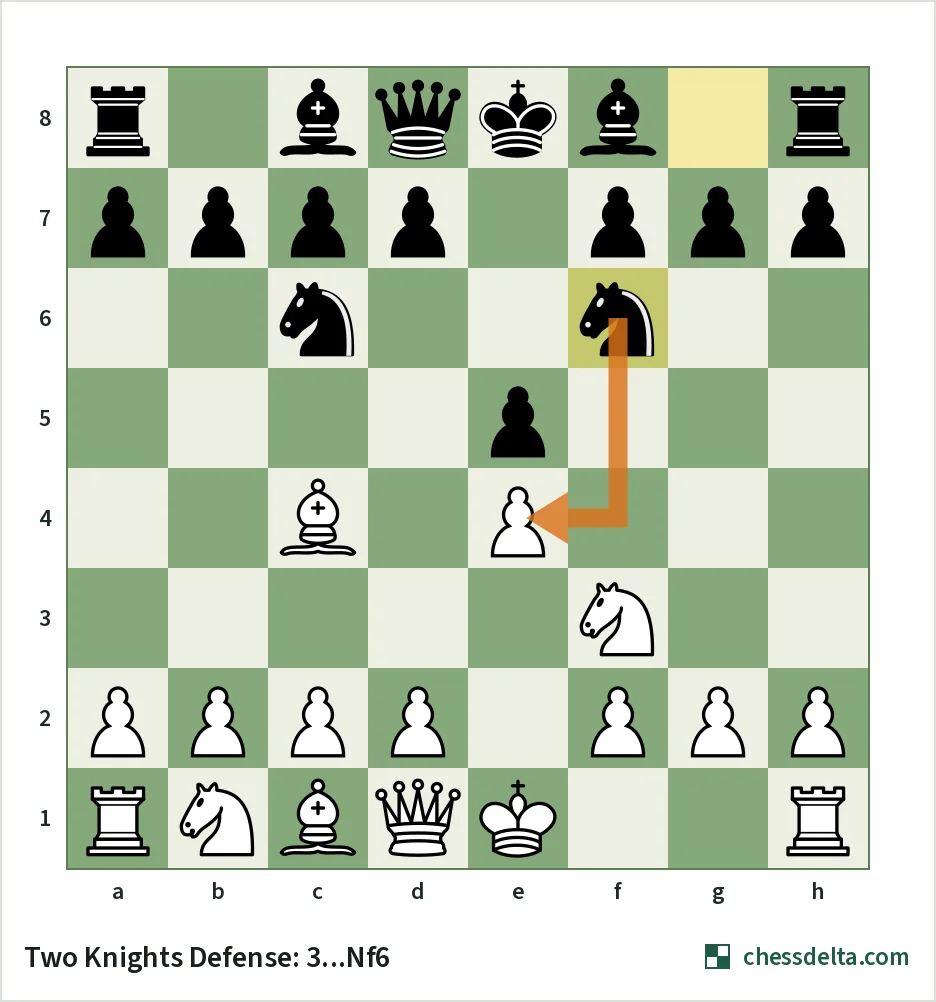
White has to decide what to do about e4. The main options are below, from quietest to sharpest.
4.d3: the solid choice
4.d3 just defends e4. Black usually replies 4…Be7 or 4…Bc5, and after 4…Bc5 the game turns into the Giuoco Pianissimo. It’s the most popular line at grandmaster level and the one we recommend for most White players.
A typical line: 4.d3 Be7 5.O-O O-O 6.Re1 d6 7.a4. Both sides maneuver; Stockfish gives White a small edge.
4.Ng5: the attack on f7
4.Ng5 attacks f7 twice. Black has no comfortable way to defend it, so the main answer is to block the bishop with 4…d5.
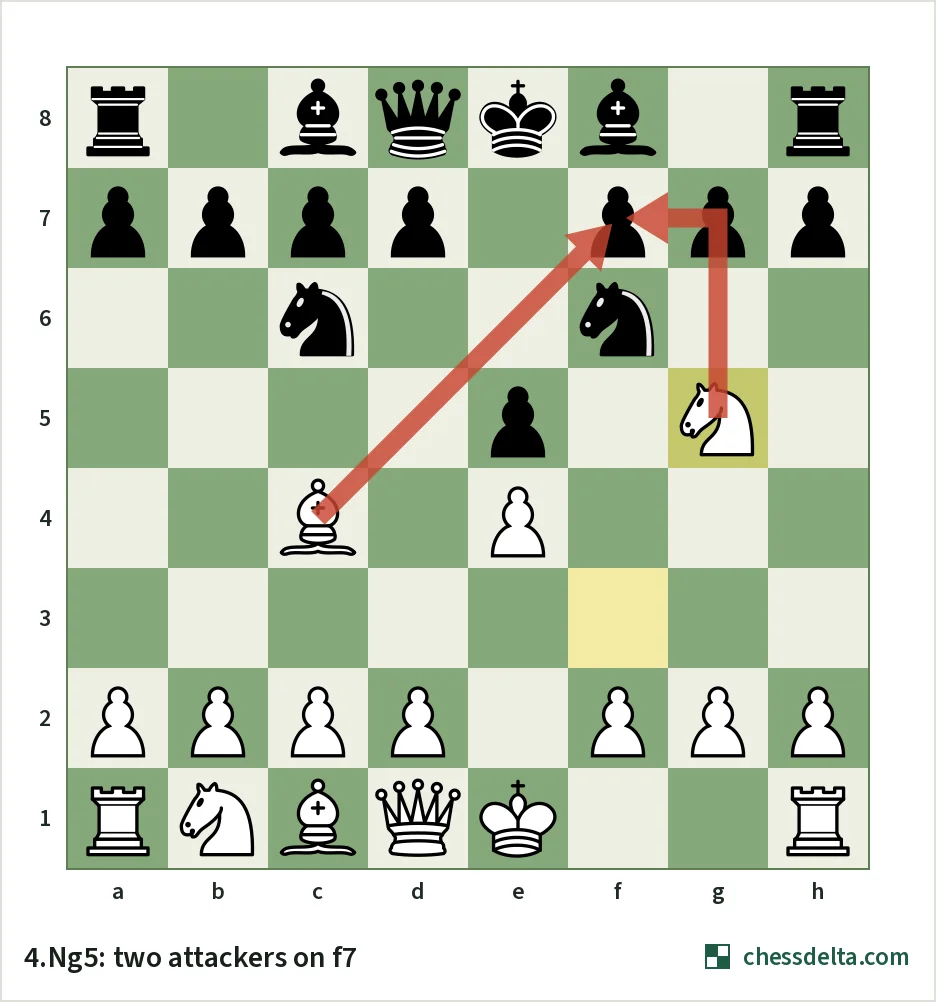
After 4…d5 5.exd5 Black has to choose how to recapture, and this is the moment that decides the game.
5…Na5: the main line
5…Na5! attacks the bishop and doesn’t recapture on d5 at all. Black gives up a pawn for fast development. The usual continuation is 6.Bb5+ c6 7.dxc6 bxc6 8.Be2 h6 9.Nf3 e4 10.Ne5.
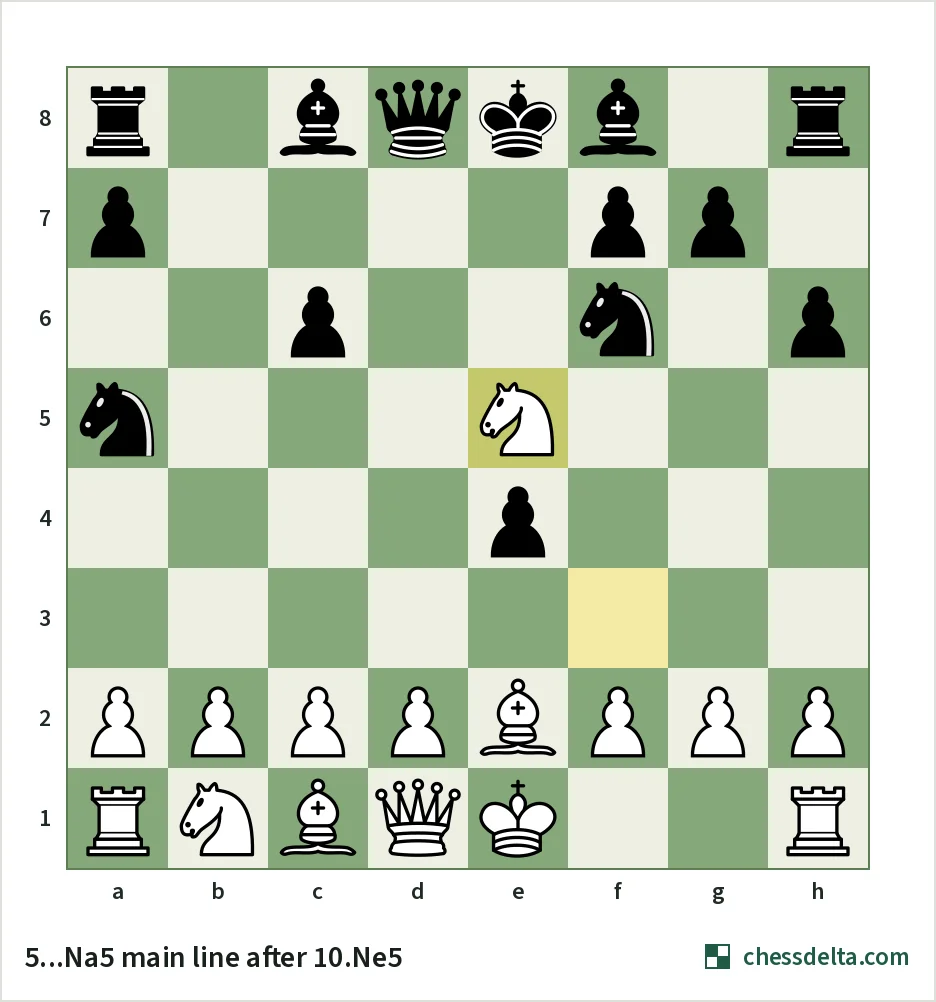
White is a pawn up, but Black has more space, quicker development and attacking chances. Stockfish calls it about equal. White can also play 8.Bd3 or 8.Qf3 instead of 8.Be2, with similar balanced positions.
5…Nxd5?: the Fried Liver
5…Nxd5? looks natural but lets White sacrifice with 6.Nxf7! Kxf7 7.Qf3+, or play 6.d4, the Lolli Attack. Stockfish gives White a clear advantage in both. The full lines are on the Fried Liver Attack page.
5…b5 and 5…Nd4
Two less common replies. 5…b5 (the Ulvestad Variation) and 5…Nd4 (the Fritz Variation) both try to deflect the c4 bishop. They’re playable, but White keeps a small edge with 6.Bf1 against 5…b5 and 6.c3 against 5…Nd4.
4…Bc5: the Traxler
Instead of 4…d5, Black can ignore the threat and counterattack f2 with 4…Bc5. It’s wild and risky; see the Traxler Counterattack guide.
4…Nxe4?
Taking the pawn is a mistake. 5.Bxf7+! Ke7 6.d4 drives Black’s king into the open, and White is close to winning.
4.d4: opening the center
4.d4 exd4 leads to open, tactical positions.
- 5.e5 (the Modern Attack). After 5…d5 6.Bb5 Ne4 7.Nxd4 the position is level.
- 5.O-O. Black can take with 5…Nxe4 6.Re1 d5 7.Bxd5 Qxd5 8.Nc3, a well-known equal line. Or 5…Bc5 6.e5 d5 7.exf6 dxc4 8.Re1+ Be6 9.Ng5 Qd5 10.Nc3 Qf5 11.Nce4, the Max Lange Attack: very sharp, and close to equal with best play.
4.Nc3 and the fork trick
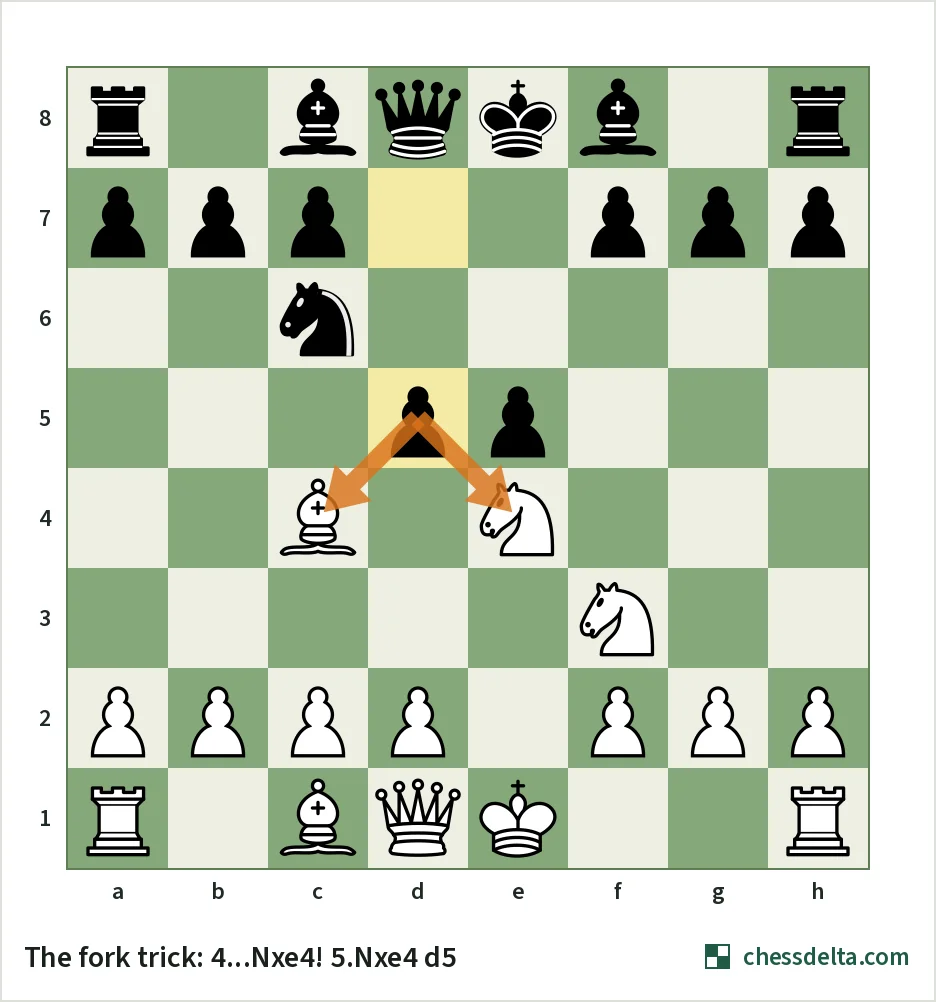
4.Nc3 is a natural move, but it allows 4…Nxe4! Black gives back the knight and wins it straight back with a pawn fork: 5.Nxe4 d5, attacking the bishop and the knight. After 6.Bd3 dxe4 7.Bxe4, the position is equal and Black has easy development.
What to play
As White
- Play 4.d3 if you want a safe, long game with a small edge.
- Play 4.Ng5 if you’ve studied the 5…Na5 lines; you’ll win quickly against players who don’t know them.
- Avoid 4.Nc3 unless you’re happy with the fork-trick positions.
As Black
- Against 4.Ng5, play 4…d5 5.exd5 Na5. Learn it to move 10.
- Against 4.d3, develop calmly with …Be7 or …Bc5, castle and play …d6.
- Against 4.Nc3, use the fork trick: 4…Nxe4 5.Nxe4 d5.
- Never recapture 5…Nxd5 after 4.Ng5 d5 5.exd5 unless you know the Fried Liver defense.
[Event "Two Knights Defense: 4.Ng5 main line"]
[Result "*"]
1. e4 e5 2. Nf3 Nc6 3. Bc4 Nf6 4. Ng5 d5 5. exd5 Na5 6. Bb5+ c6 7. dxc6 bxc6 8. Be2 h6 9. Nf3 e4 10. Ne5 *
Related pages
FAQ
Is the Two Knights Defense good for Black?
Yes. It’s sound, active and played at the highest level. The catch is that you must know how to meet 4.Ng5, because the natural-looking replies lose.
What is the best response to the Two Knights Defense?
For most players, 4.d3. It’s safe and gives White a small, lasting edge. 4.Ng5 is objectively fine too and more dangerous for unprepared opponents.
Is the Two Knights Defense the same as the Fried Liver?
No. The Two Knights is Black’s 3…Nf6. The Fried Liver is one line inside it, where Black plays 4…d5 5.exd5 Nxd5 and White sacrifices on f7.
How do you stop the Fried Liver Attack?
After 4.Ng5 d5 5.exd5, play 5…Na5 instead of 5…Nxd5. Or avoid the whole thing by answering 3.Bc4 with 3…Bc5.
Why is it called the Two Knights Defense?
Because Black’s first two piece moves are both knights (…Nc6 and …Nf6), and it’s a defense to White’s Italian Game setup.