Quick answer: The Italian Game starts 1.e4 e5 2.Nf3 Nc6 3.Bc4. White develops quickly and points the bishop at f7, the weakest square near Black’s king. Black’s two main replies are 3…Bc5 (the Giuoco Piano) and 3…Nf6 (the Two Knights Defense). It’s one of the best openings for beginners and is still played by world-class grandmasters.
At a glance
- Moves: 1.e4 e5 2.Nf3 Nc6 3.Bc4
- Type: Open game (1.e4 e5). ECO codes C50 to C59.
- White’s idea: fast development, castle, then prepare d4 to take the center.
- Black’s main replies: 3…Bc5 (Giuoco Piano) and 3…Nf6 (Two Knights Defense).
- Good for: beginners learning the opening principles, and players who want a lifelong 1.e4 weapon. The slow d3 lines are played at the top level.
The move order
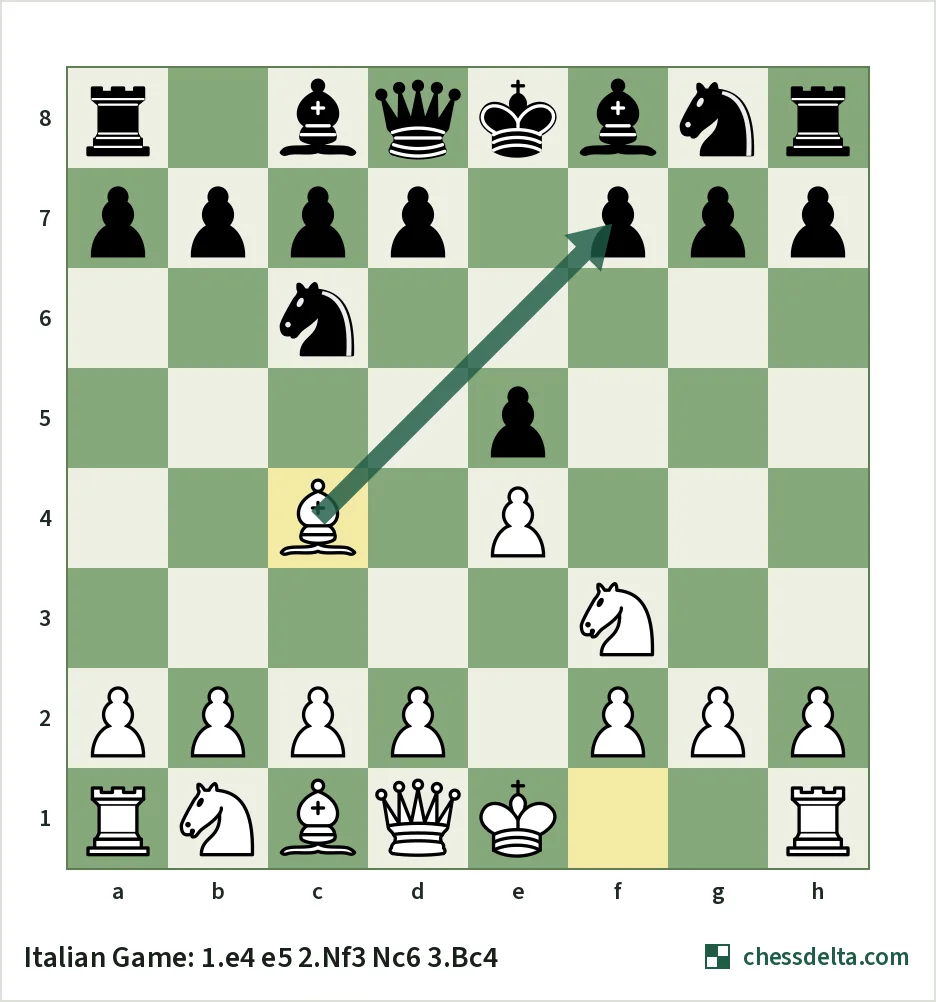
- 1.e4 e5. Both sides take a share of the center and open lines for the queen and the king’s bishop.
- 2.Nf3 Nc6. White develops with an attack on e5; Black defends it by developing too.
- 3.Bc4. The bishop goes to its most active square, aiming down the a2-g8 diagonal at f7. Only Black’s king defends f7, which is why so many early attacks in this opening land there.
If White plays 3.Bb5 instead, that’s the Ruy Lopez, a different opening. If White plays 3.d4, that’s the Scotch.
The ideas for both sides
White’s plan
- Castle kingside quickly. The bishop on c4 and knight on f3 have already cleared the way.
- Prepare d4 with c3. If White gets pawns on e4 and d4 without losing material, White has the better center.
- In the slow lines, play d3, c3, Nbd2-f1-g3 and sometimes a4 and b4 to gain space on the queenside.
- Watch f7. Ng5 and Bxf7+ ideas appear in many lines, especially when Black is careless.
Black’s plan
- Put a piece on f6 or c5 and get castled. Black’s development is just as quick as White’s.
- Hit back in the center with …d5 when White plays d4, or keep a solid pawn on e5 with …d6.
- Use the c5 bishop against f2, White’s own weak point.
- Don’t grab material that opens lines to your king. Most of the traps on this page punish Black for doing exactly that.
The main branches
Each branch has its own page with move orders, diagrams, traps and what to play as each side.
Giuoco Piano: 3…Bc5 4.c3
The classical main line. White prepares d4 straight away and Black must decide how to meet it. Leads to open play where both sides need to know a few sharp ideas. Read the Giuoco Piano guide.
Giuoco Pianissimo: 3…Bc5 4.d3
The slow, modern main line and the one top players use. Both sides build up behind their pawns and maneuver. This is the line most grandmasters choose. Read the Giuoco Pianissimo guide.
Evans Gambit: 3…Bc5 4.b4
White gives a pawn to gain time for c3 and d4. Fast attacking play, loved in the 1800s and still dangerous in quick games. Read the Evans Gambit guide.
Two Knights Defense: 3…Nf6
Black counterattacks e4 instead of developing the bishop. Sharper than 3…Bc5, and it allows 4.Ng5 straight away. Read the Two Knights Defense guide.
Fried Liver Attack: 4.Ng5 d5 5.exd5 Nxd5 6.Nxf7
White sacrifices a knight on f7 to drag Black’s king into the open. Very dangerous if Black doesn’t know it, and easy to avoid if Black does. Read the Fried Liver Attack guide.
Traxler Counterattack: 4.Ng5 Bc5
Black ignores the threat to f7 and attacks f2 instead. Wild, tactical and risky for both sides. Read the Traxler Counterattack guide.
Less common replies for Black
- Hungarian Defense, 3…Be7. Solid and passive. Black avoids all the sharp lines but gives White an easy game; after 4.d4 White has a comfortable edge.
- Semi-Italian, 3…d6. Holds e5 but shuts in the dark-squared bishop. 4.d4 or 4.c3 gives White more space.
- Blackburne Shilling Gambit, 3…Nd4. A trap, not a good move. White is clearly better after 4.Nxd4, but the natural 4.Nxe5? walks into trouble (see the traps below).
- Rousseau Gambit, 3…f5. An early counter-gambit. Playable in blitz, but White gets a clear advantage with calm development.
Typical plans in the middlegame
- Center break with d4. In the c3 and d4 lines White wants a big pawn center. If Black lets White keep pawns on e4 and d4, White’s pieces get more space.
- The slow buildup. In the d3 lines White often plays Re1, h3, Nbd2-f1-g3 and only then d4. Black mirrors with …d6, …h6, …a6 and …Ba7 to keep the bishop safe from b4 or d4.
- Queenside space. a4 and b4 for White, or …a5 for Black, to gain space or make the opponent’s bishop retreat.
- Kingside attacks. With the bishop on c4 (or b3) aiming at f7, White’s knights and queen often swing to the kingside. Black’s …Ng4 and …Qh4 ideas do the same against f2.
Common traps in the Italian Game
Legal’s Mate
This trap comes from an Italian-style setup where Black plays …d6 instead of …Nc6: 1.e4 e5 2.Nf3 d6 3.Bc4 Bg4 4.Nc3 g6? Now 5.Nxe5! looks like it gives up the queen.
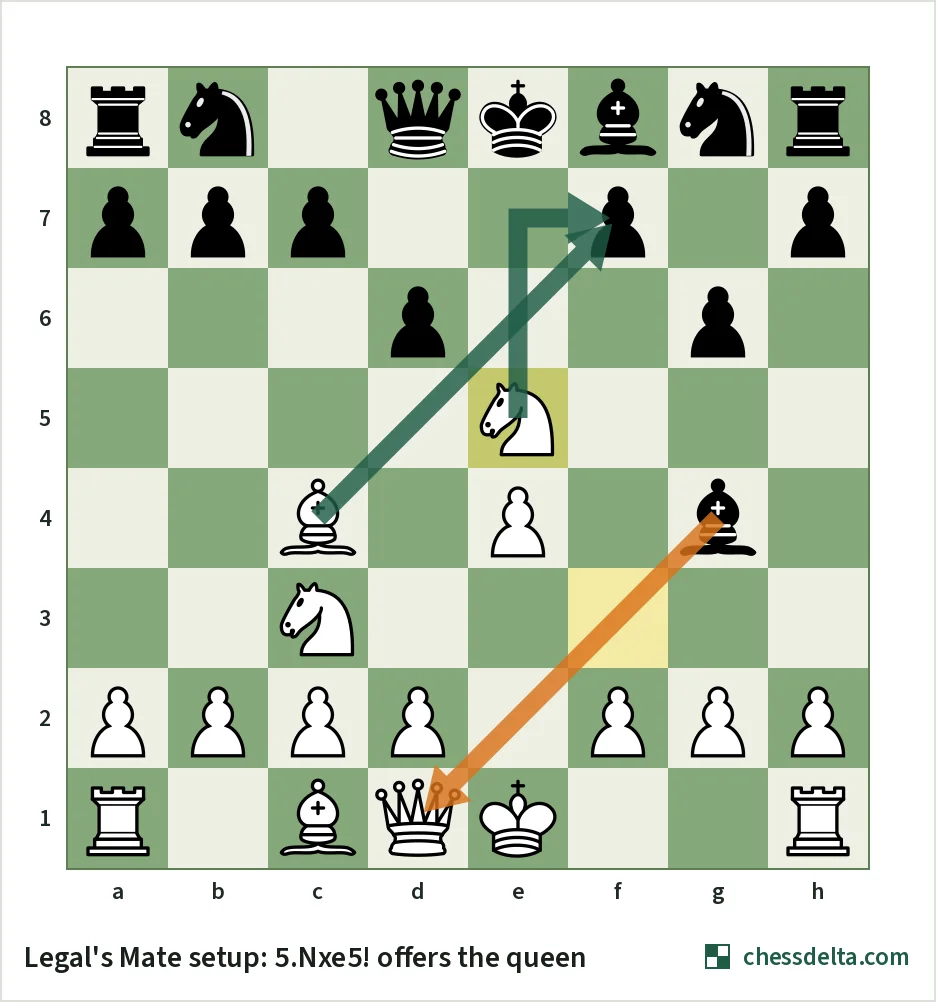
If Black grabs the queen with 5…Bxd1??, White mates: 6.Bxf7+ Ke7 7.Nd5#. Black’s best is to take the knight with 5…dxe5 and accept being a piece down, which is still much better for White. The lesson for Black: don’t pin a knight with …Bg4 if the pin can simply be broken.
The Blackburne Shilling Gambit
1.e4 e5 2.Nf3 Nc6 3.Bc4 Nd4!? leaves e5 apparently loose. 4.Nxe5? Qg5! attacks the knight and g2 at once. If White continues greedily with 5.Nxf7??, then 5…Qxg2 6.Rf1 Qxe4+ 7.Be2 Nf3 is checkmate.
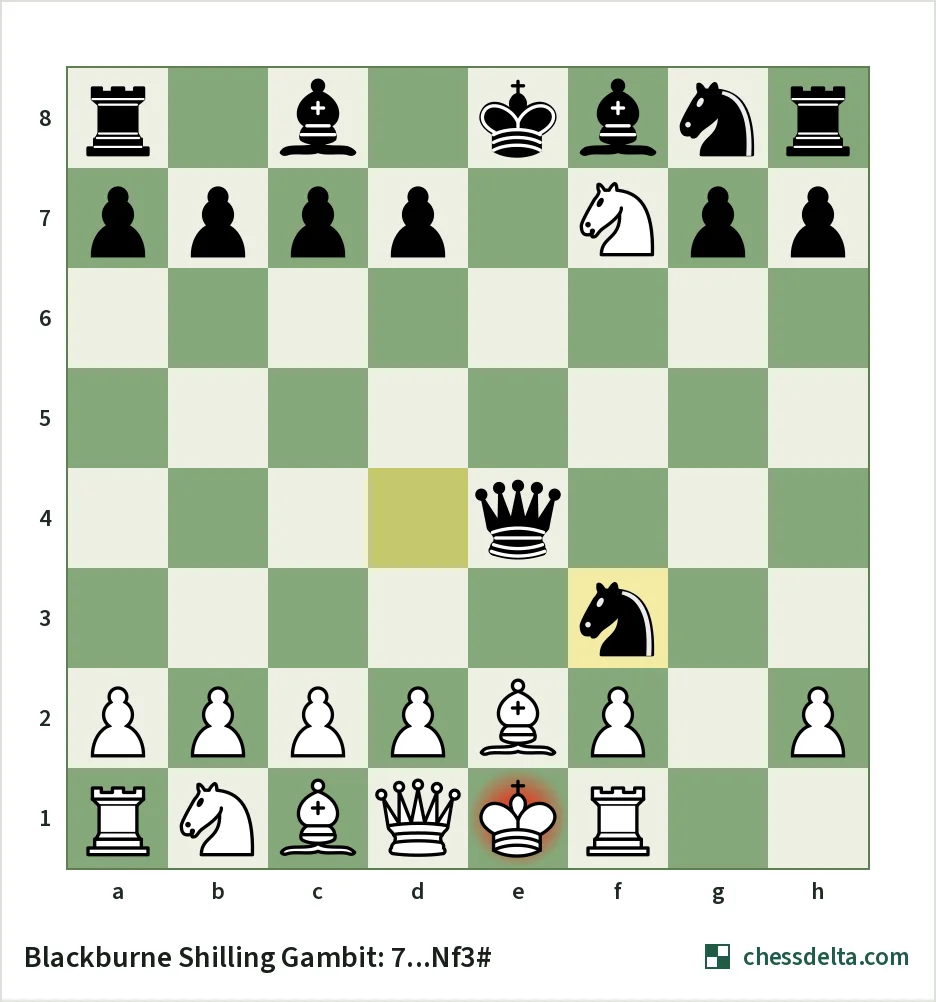
The fix for White is simple: 4.Nxd4 exd4 5.O-O (or 4.O-O) and White is clearly better because 3…Nd4 moved the same piece twice.
Greco’s trap in the Giuoco Piano
After 1.e4 e5 2.Nf3 Nc6 3.Bc4 Bc5 4.c3 Nf6 5.d4 exd4 6.cxd4 Bb4+ 7.Nc3 Nxe4 8.O-O Nxc3 9.bxc3, the greedy 9…Bxc3? is a mistake. 10.Qb3! attacks the bishop on c3 and lines up the queen behind the c4 bishop against f7. If Black takes the rook with 10…Bxa1?, White’s attack wins. Even after the best defense, 10…d5, White keeps a clear advantage. See the Giuoco Piano guide for the full line. Black should play 9…d5! instead.
The Fried Liver
If Black meets 4.Ng5 with 4…d5 5.exd5 Nxd5?, White can sacrifice with 6.Nxf7! Kxf7 7.Qf3+, and Black’s king has to walk into the middle of the board. Black avoids it with 5…Na5. The full line, and how both sides should play it, is in our Fried Liver Attack guide.
Learn the Italian Game in 5 moves
If you only remember five things:
- Learn the moves: 1.e4 e5 2.Nf3 Nc6 3.Bc4. That’s the whole opening.
- Against 3…Bc5, play 4.c3 and 5.d3 (the Pianissimo), castle, and prepare d4 later. Safe and good.
- Against 3…Nf6, play 4.d3. It keeps e4 defended. Save 4.Ng5 until you’ve studied the Two Knights page.
- Castle by move 6 or 7. Then think about d4.
- As Black, meet 4.Ng5 with 4…d5 5.exd5 Na5. Never 5…Nxd5 unless you know the Fried Liver lines.
[Event "Italian Game: Giuoco Pianissimo starter line"]
[Result "*"]
1. e4 e5 2. Nf3 Nc6 3. Bc4 Bc5 4. c3 Nf6 5. d3 d6 6. O-O O-O 7. Re1 a6 8. Bb3 Ba7 9. h3 h6 10. Nbd2 *
FAQ
Is the Italian Game good for beginners?
Yes. Every move follows the opening principles: take the center, develop, castle. You’ll also meet the most common traps early, which teaches you to look for tactics around f7 and f2.
Is the Italian Game aggressive?
It can be either. 4.b4 (the Evans Gambit) and 4.Ng5 against the Two Knights are aggressive. 4.d3 lines are slow and positional. You choose the style with your fourth move.
What is the difference between the Italian Game and the Giuoco Piano?
The Italian Game is the whole opening after 3.Bc4. The Giuoco Piano (“quiet game”) is the branch where Black replies 3…Bc5. Some books use the two names for the same thing, which causes the confusion.
What is the best defense against the Italian Game for Black?
3…Bc5 is the most reliable: you develop, castle quickly and copy White’s setup. 3…Nf6 is good too but asks you to know the 4.Ng5 lines. Avoid 3…Nd4 and 3…f5 in serious games.
Is the Italian Game better than the Ruy Lopez?
Neither is objectively better. The Ruy Lopez (3.Bb5) puts longer-term pressure on Black’s e5 pawn and has more theory. The Italian is easier to learn and its ideas are clearer, which is why most coaches teach it first.
Do grandmasters play the Italian Game?
Yes. The slow 4.d3 lines have been one of the most common ways to meet 1…e5 at elite level for over a decade.