Quick answer: The Evans Gambit is 1.e4 e5 2.Nf3 Nc6 3.Bc4 Bc5 4.b4. White gives up the b-pawn to gain time for c3 and d4, building a big center and opening lines toward Black’s king. Stockfish rates it as roughly equal, so it’s sound, and it’s far more dangerous over the board than its evaluation suggests.
What is the Evans Gambit?
It’s named after Captain William Davies Evans, a Welsh sea captain who played it in the 1820s. It was a favorite of the great attacking players of the 1800s, and Garry Kasparov famously revived it in the 1990s, including a quick win over Viswanathan Anand in 1995.
The idea is simple. After 4.b4 Bxb4 5.c3, White’s c-pawn hits the bishop and prepares d4 with gain of time. White is a pawn down but gets a lead in development, a strong center and open lines.
The move order
1.e4 e5 2.Nf3 Nc6 3.Bc4 Bc5 4.b4
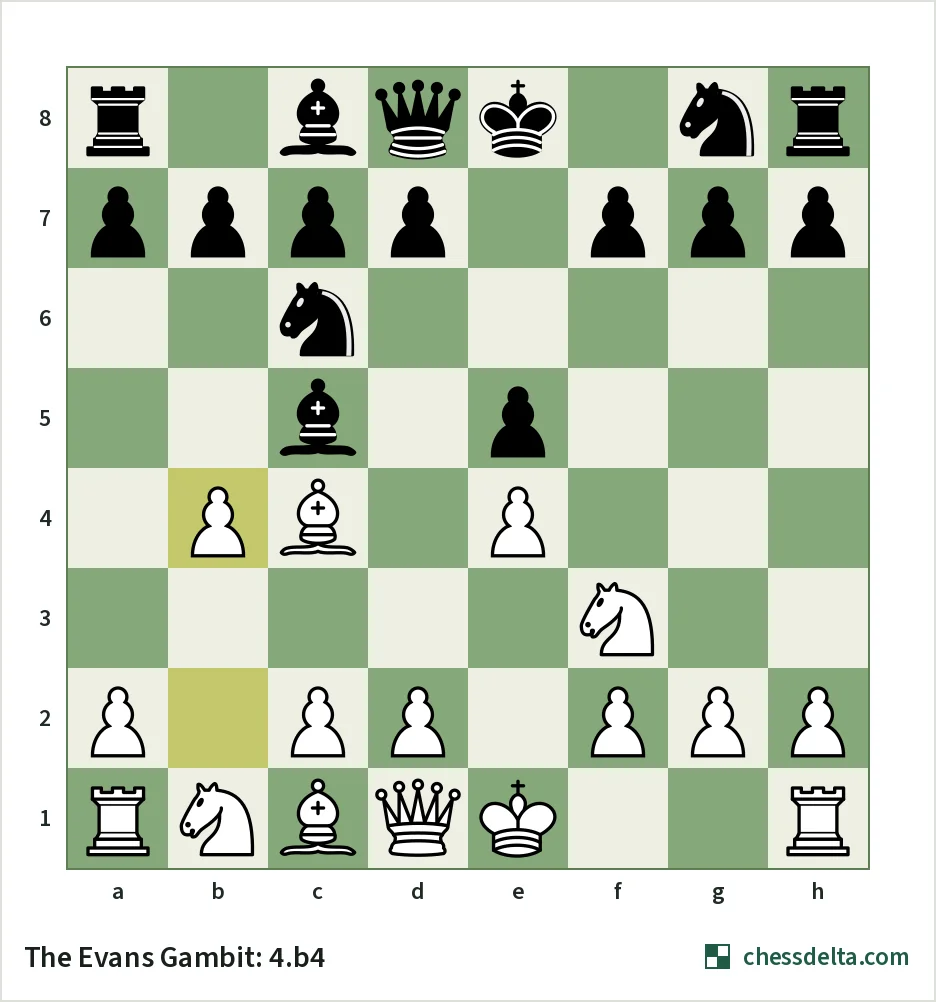
Black can take the pawn (the Evans Gambit Accepted) or retreat the bishop (the Evans Gambit Declined). Most players take.
Evans Gambit Accepted: 4…Bxb4 5.c3
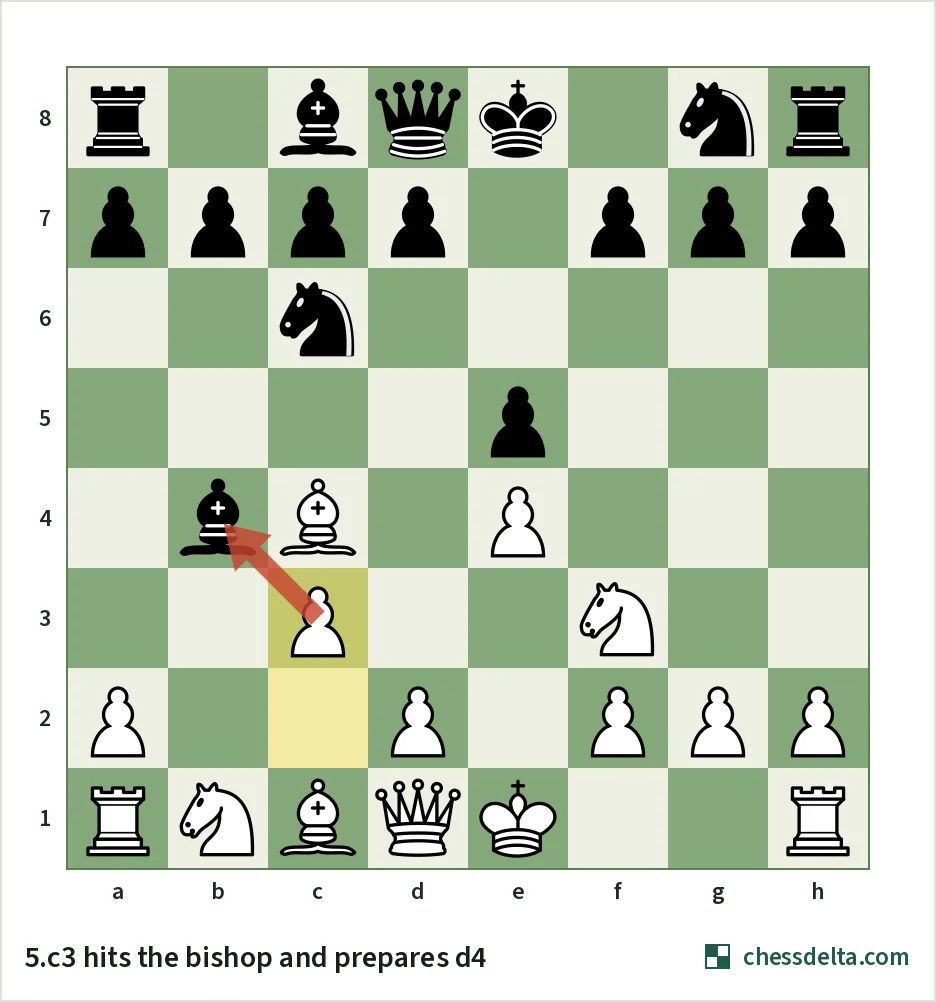
The bishop is attacked and has to choose a square. The two good ones are a5 and e7.
5…Ba5: the main line
5…Ba5 keeps the bishop on the a5-e1 diagonal, pinning the c3 pawn against White’s king later. Now 6.d4, and Black has two main choices.
6…exd4 7.O-O. Black grabs a second pawn and White keeps developing. This is the sharpest line. Black should develop with 7…Nge7 or 7…Nf6 and give material back when needed. Grabbing a third pawn with 7…dxc3?! lets White’s pieces flood in after 8.Qb3, and White is slightly better.
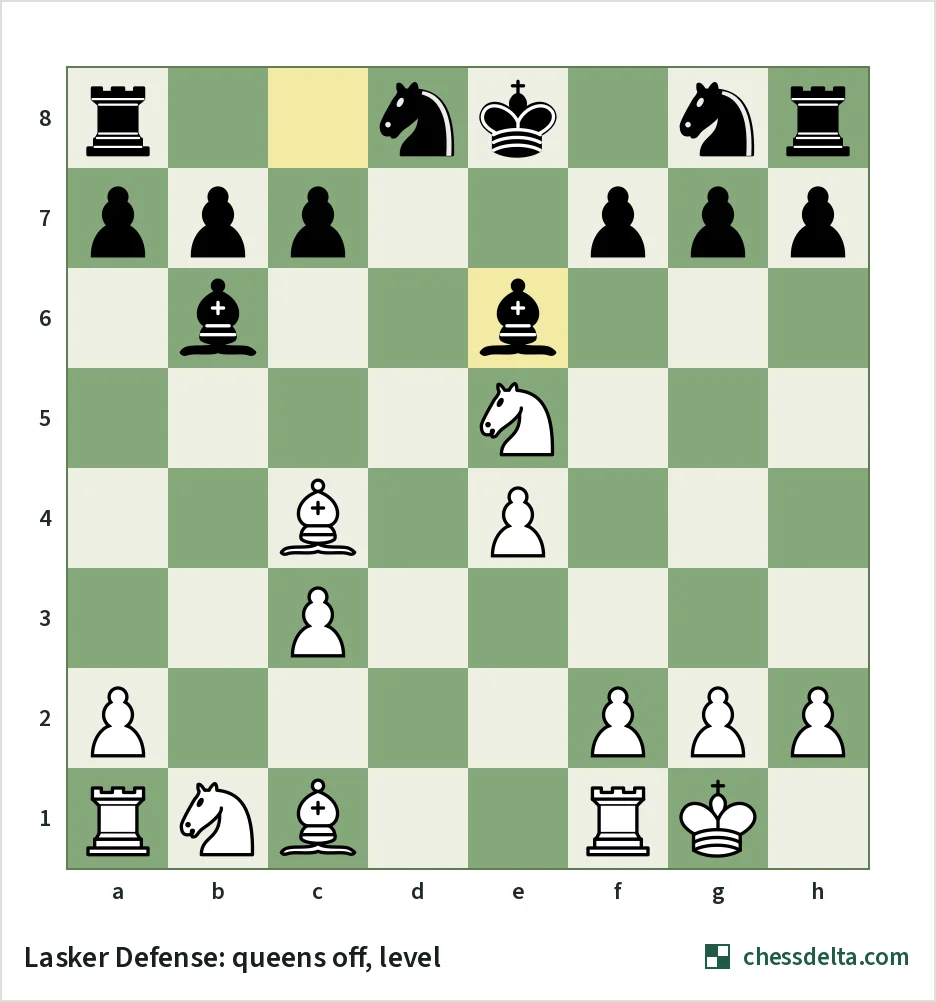
6…d6, the Lasker Defense. Black holds e5 and gives the pawn back to kill White’s initiative. After 7.O-O Bb6 8.dxe5 dxe5 9.Qxd8+ Nxd8 10.Nxe5 Be6, the queens are off and the material is level. Stockfish calls it equal, and many Evans players avoid it for exactly that reason. After 7.Qb3 instead, 7…Qd7 is Black’s safest reply.
5…Be7: the solid retreat
5…Be7 6.d4 Na5 is a modern favorite. Black plans to swap off White’s dangerous c4 bishop with …Nxc4. Stockfish rates it equal. It’s a good choice for Black players who want a quiet life.
5…Bc5
Retreating to c5 is playable but loses time to 6.d4, and White gets a pleasant edge.
Evans Gambit Declined: 4…Bb6
4…Bb6 keeps the bishop on its good diagonal and doesn’t take the pawn. White usually continues 5.a4 a6 6.O-O, gaining queenside space. White is slightly better, but Black avoids all the gambit theory. It suits Black players who’d rather not be attacked.
Traps in the Evans Gambit
The Bxf7+ trick after 7.Qb3
1.e4 e5 2.Nf3 Nc6 3.Bc4 Bc5 4.b4 Bxb4 5.c3 Ba5 6.d4 exd4 7.Qb3 d6?
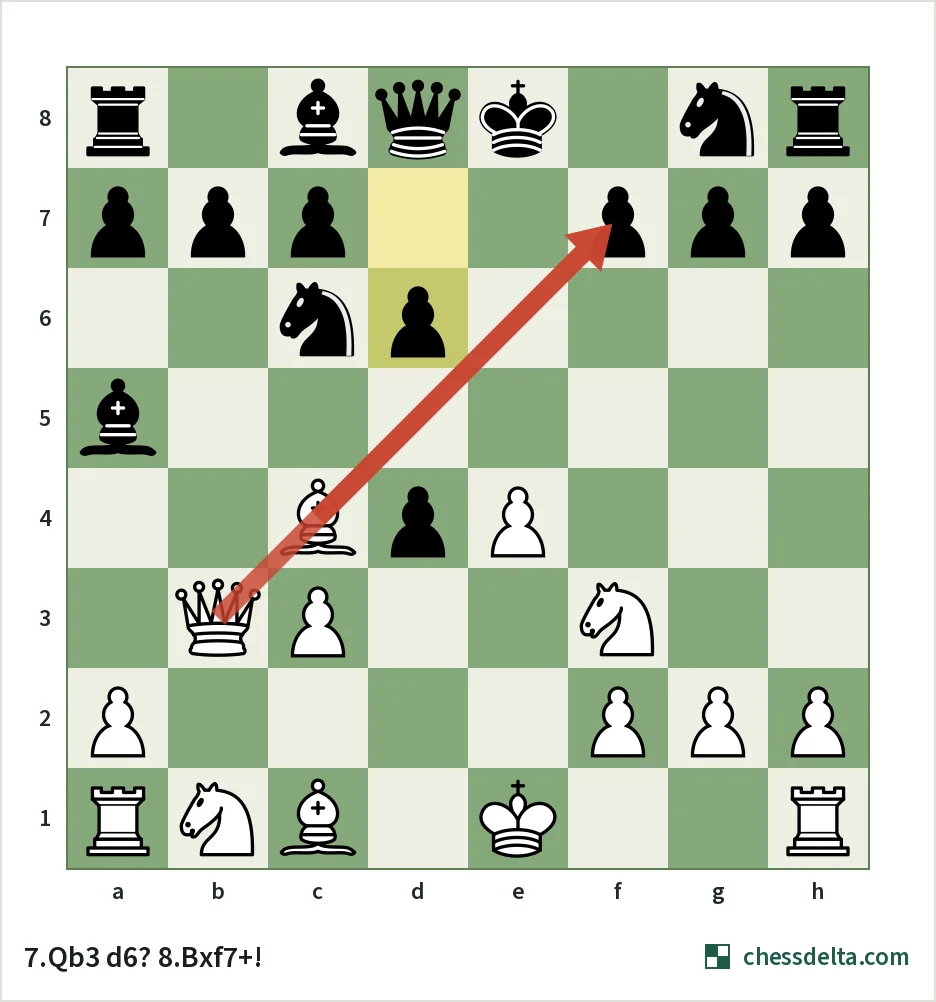
The queen and bishop are lined up on f7. 8.Bxf7+! wins a pawn and wrecks Black’s king position:
- 8…Kd7?? 9.Qe6 is checkmate.
- 8…Ke7? walks into a crushing attack.
- 8…Kf8 is forced, and after 9.O-O White is clearly better.
Black should meet 7.Qb3 with 7…Qe7 or 7…Qf6, protecting f7.
7.Qb3 Nf6? in the Lasker line
After 6…d6 7.Qb3, the natural 7…Nf6? is a mistake. 8.dxe5! opens lines, and if 8…Nxe4 then 9.Bxf7+ Kf8 and White is clearly better. Black needs 7…Qd7.
What to play
As White
- After 4…Bxb4 5.c3 Ba5, play 6.d4 and castle quickly. Development matters more than the pawn.
- Use the Qb3 and Bxf7+ ideas whenever Black leaves f7 weak.
- If Black declines with 4…Bb6, play 5.a4 and gain space.
- If you don’t want to face the Lasker Defense, prepare it; it’s Black’s most reliable line.
As Black
- If you want to keep it simple, take with 4…Bxb4 and retreat with 5…Be7, then 6…Na5.
- If you want the pawn and a fight, 5…Ba5 and 6…exd4, but know the Qb3 lines.
- If you just want to neutralize it, play 5…Ba5 6.d4 d6 and aim for the Lasker endgame.
- Never leave f7 under-protected while White’s queen is on b3.
[Event "Evans Gambit: Lasker Defense"]
[Result "*"]
1. e4 e5 2. Nf3 Nc6 3. Bc4 Bc5 4. b4 Bxb4 5. c3 Ba5 6. d4 d6 7. O-O Bb6 8. dxe5 dxe5 9. Qxd8+ Nxd8 10. Nxe5 Be6 *
Related pages
FAQ
Is the Evans Gambit sound?
Yes. Stockfish evaluates the main lines as roughly equal, so White gets enough for the pawn. It isn’t a refuted gambit like some trap openings.
How do you beat the Evans Gambit as Black?
You don’t need to beat it, just neutralize it. 5…Be7 followed by 6…Na5, or the Lasker Defense with 5…Ba5 6.d4 d6, both give Black a safe, equal game.
Should you accept the Evans Gambit?
Accepting is the most popular choice and perfectly good. Declining with 4…Bb6 is safe too but gives White a small edge in space.
Is the Evans Gambit good for beginners?
It’s great for learning attacking chess as White, because it rewards fast development and teaches you to use open lines. As Black, beginners should learn one safe line (5…Be7 or the Lasker Defense) rather than trying to hold on to the extra pawn.
Who invented the Evans Gambit?
Captain William Davies Evans, who first played it around 1827. It became one of the most popular openings of the 19th century.