Quick answer: The Giuoco Pianissimo is the slow Italian Game: 1.e4 e5 2.Nf3 Nc6 3.Bc4 Bc5 4.d3 (often with c3 first or next). White defends e4, castles and builds up before playing d4. It’s the most popular way to play the Italian at grandmaster level, and the easiest for beginners because there are few forcing lines to memorize.
What is the Giuoco Pianissimo?
Pianissimo means “very quiet”. Where the Giuoco Piano opens the center at once with c3 and d4, the Pianissimo plays d3 and keeps the tension. Both sides develop, castle and then fight for small advantages: a better pawn break, a better square for a knight, a weakness in the opponent’s kingside.
You’ll reach it from several move orders: 4.d3 Nf6 5.c3, or 4.c3 Nf6 5.d3, or even from the Two Knights after 3…Nf6 4.d3 Bc5. The plans are the same.
The move order
1.e4 e5 2.Nf3 Nc6 3.Bc4 Bc5 4.d3 Nf6 5.c3
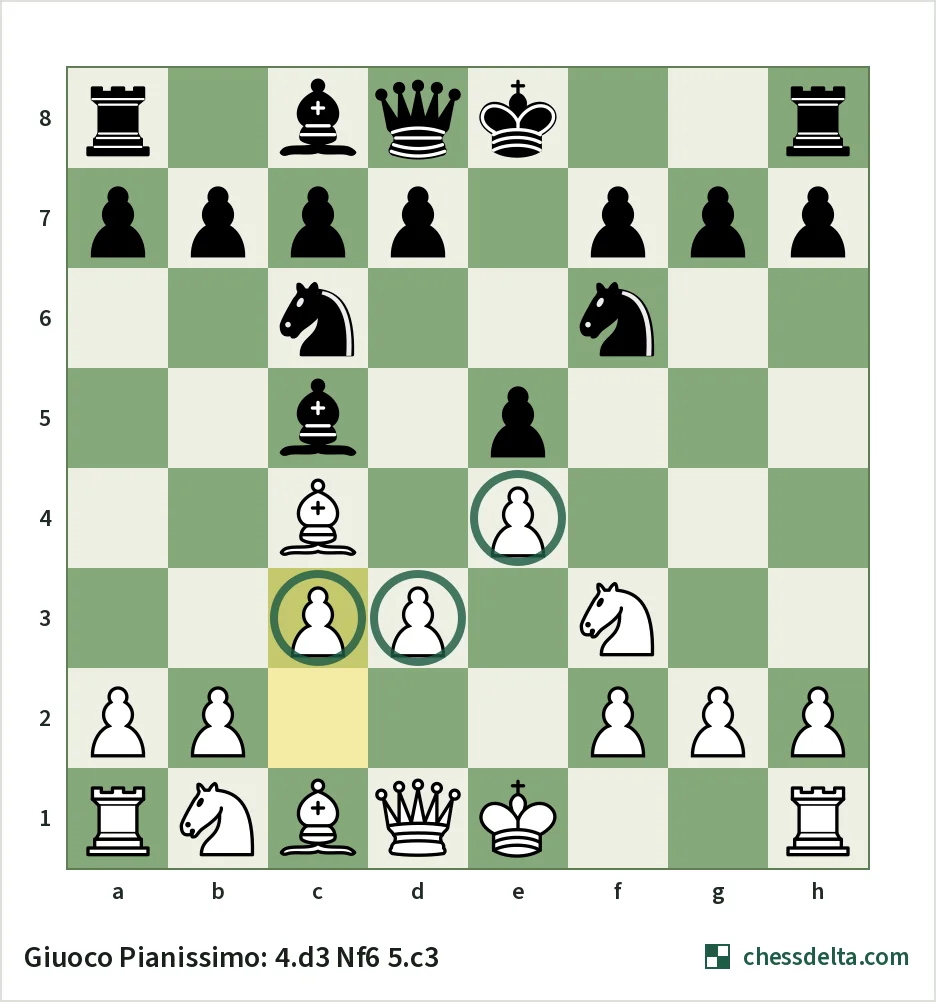
White’s pawns on c3, d3 and e4 make a solid triangle. The c3 pawn prepares d4 later and gives the bishop a retreat square on c2 if it’s ever chased.
Typical plans
White
- Castle, Re1, h3. h3 stops …Bg4 and …Ng4.
- Bb3 (or a4 first). The bishop steps back before Black can hit it with …Na5 or …d5.
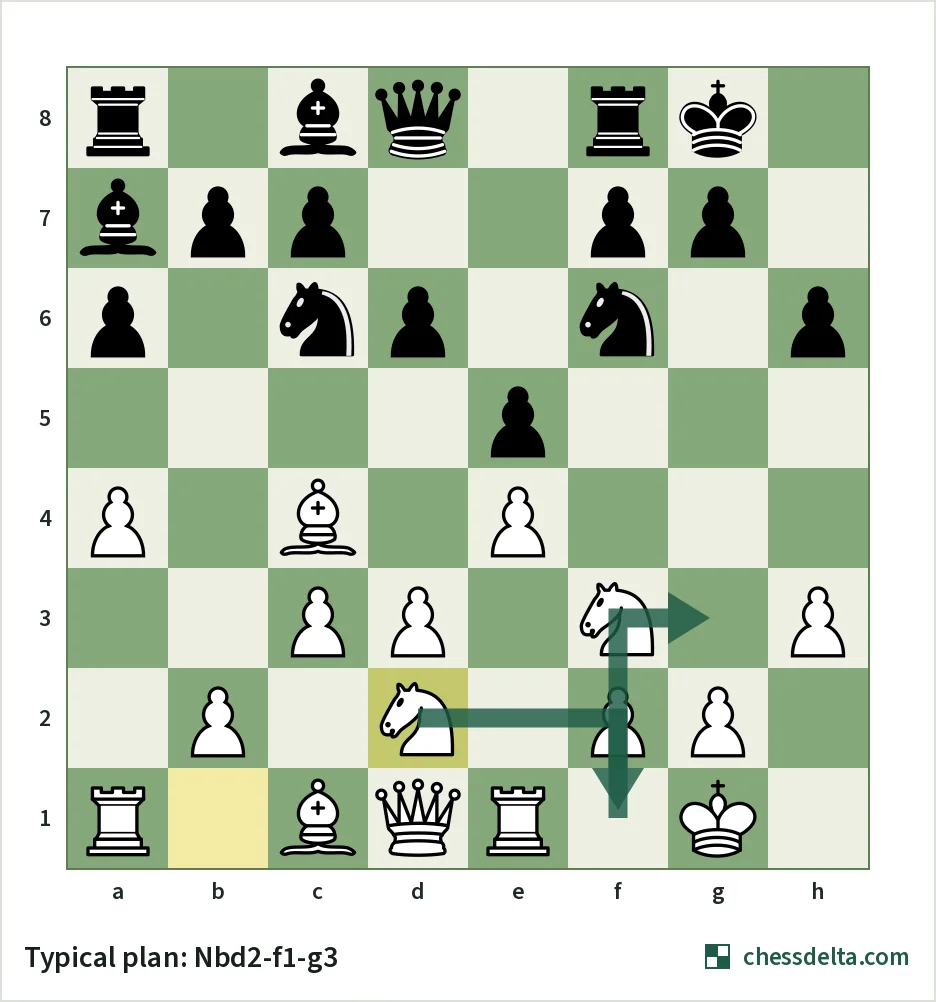
- Nbd2-f1-g3. The queen’s knight takes the long route to the kingside, where it supports f5 or h5 ideas.
- a4 and b4. Space on the queenside, and b4 can push Black’s bishop off c5.
- d4 at the right moment. Usually once everything else is in place.
Black
- …a6 and …Ba7. The bishop drops back to a7, where b4 and d4 can’t chase it.
- …d6, …h6 and …Re8. A mirror of White’s setup. …h6 stops Bg5 pins.
- …Be6. Challenges White’s light-squared bishop.
- …d5. The freeing break. If Black gets it in safely, the game is level.
Main lines
5…d6 with …a5
1.e4 e5 2.Nf3 Nc6 3.Bc4 Bc5 4.d3 Nf6 5.c3 d6 6.O-O O-O 7.Re1 a5 8.h3 h6. Black’s …a5 stops b4 and gives the bishop a5 or a7 later. White usually continues with Bb5, Nbd2-f1 and a slow buildup. Stockfish rates it close to equal with a small edge for White.
5…a6 with …Ba7
5…a6 6.O-O d6 7.a4 Ba7 8.Re1 O-O 9.h3 h6 10.Nbd2. Press ▶ on the board above to play through it. Next comes Nf1-g3 for White and …Be6 or …Re8 for Black. Balanced, and full of play for both sides.
Bb3 and the knight maneuver
5…d6 6.Bb3 a6 7.Nbd2 Ba7 8.Nf1. White delays castling to get the knight to g3 quickly. Black answers with …Be6 or …Bd7 and develops normally.
Traps and mistakes to avoid
5.Ng5?! O-O! (White’s mistake)
1.e4 e5 2.Nf3 Nc6 3.Bc4 Bc5 4.d3 Nf6 5.Ng5?! attacks f7 again, but Black simply castles: 5…O-O! The rook now defends f7.
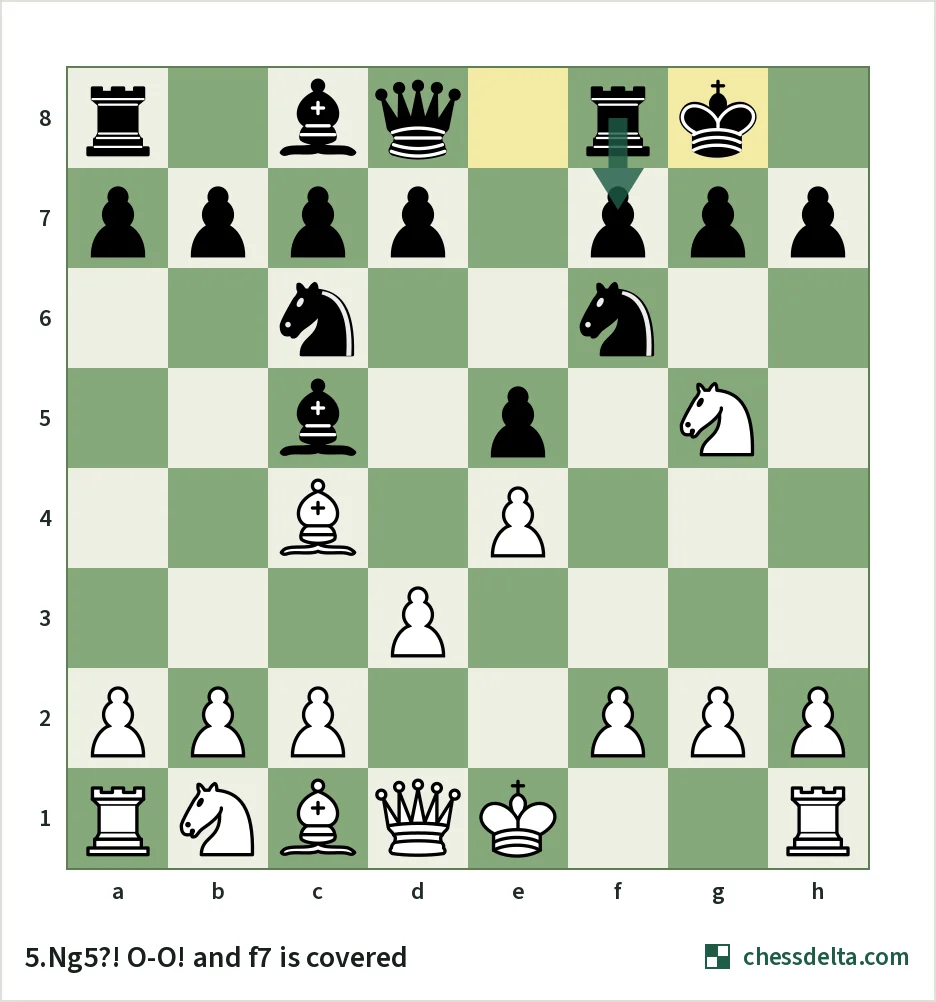
If White carries on with 6.Nxf7? Rxf7 7.Bxf7+ Kxf7, White has given a knight and bishop for a rook and pawn. Two minor pieces are worth more than a rook and a pawn in the middlegame, and Stockfish gives Black an advantage of about two and a half pawns. Even without 6.Nxf7, Black is already slightly better after 5…O-O because the knight on g5 is misplaced.
The …Ng4 and …h5 trick (Black’s gamble)
After 4.d3 Nf6 5.O-O, beginners sometimes play 5…Ng4?!, aiming at f2. White’s best is 6.Ng5!, but the natural reply is 6.h3. Then comes the trick: 6…h5!?
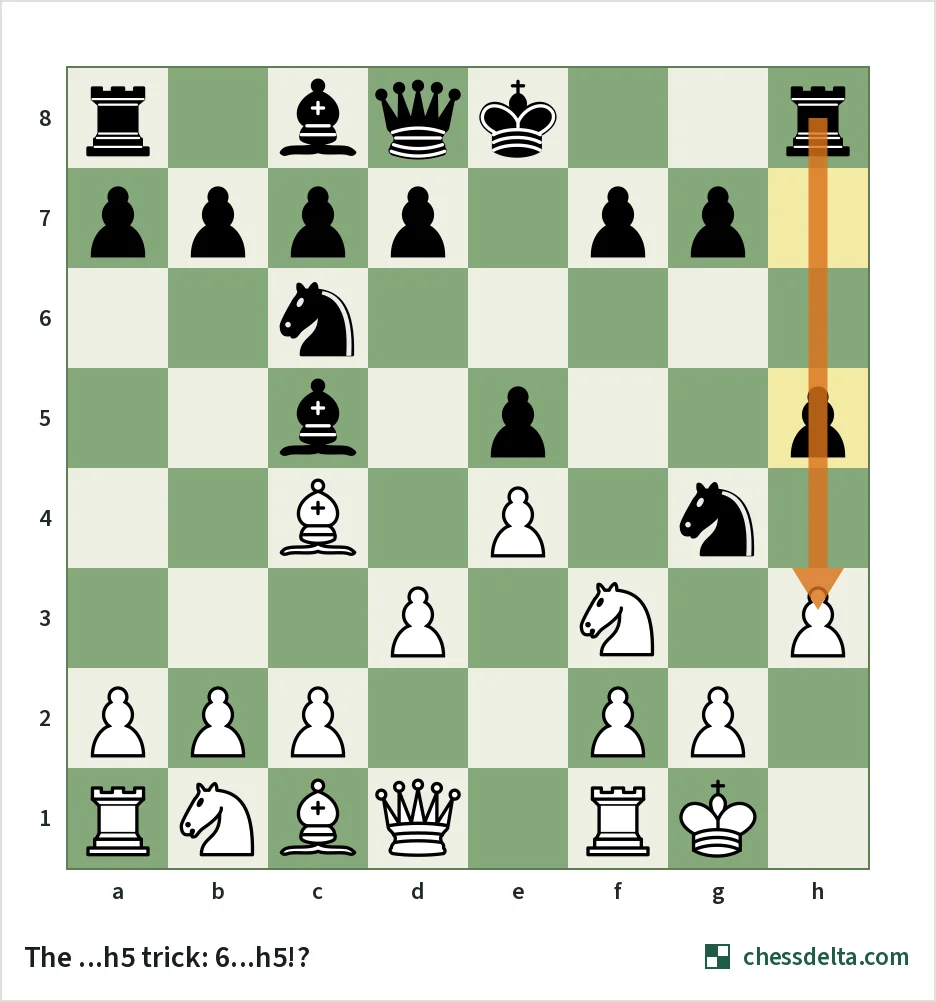
If White takes the knight with 7.hxg4 hxg4, the h-file is open and Black threatens …Qh4. The trap works if White panics:
- 8.Nh2?? Qh4 and Black mates within a few moves.
- 8.Nxe5?? Nxe5, and Black is winning.
But the trick fails against correct play. 8.Ng5! covers h3 and hits f7, and White is winning (Stockfish gives White about three pawns). 7.Ng5 straight away is just as strong. So don’t play 5…Ng4 as Black, and as White, remember Ng5 is the answer.
8.Nxg5? against …g5 (White’s mistake)
1.e4 e5 2.Nf3 Nc6 3.Bc4 Bc5 4.d3 Nf6 5.O-O d6 6.Bg5 h6 7.Bh4 g5. Black, with the king still in the center, kicks the bishop. The sacrifice 8.Nxg5? hxg5 9.Bxg5 doesn’t work here: Black’s rook uses the open h-file and g-file, and Black is winning. White should retreat with 8.Bg3, after which the game is level.
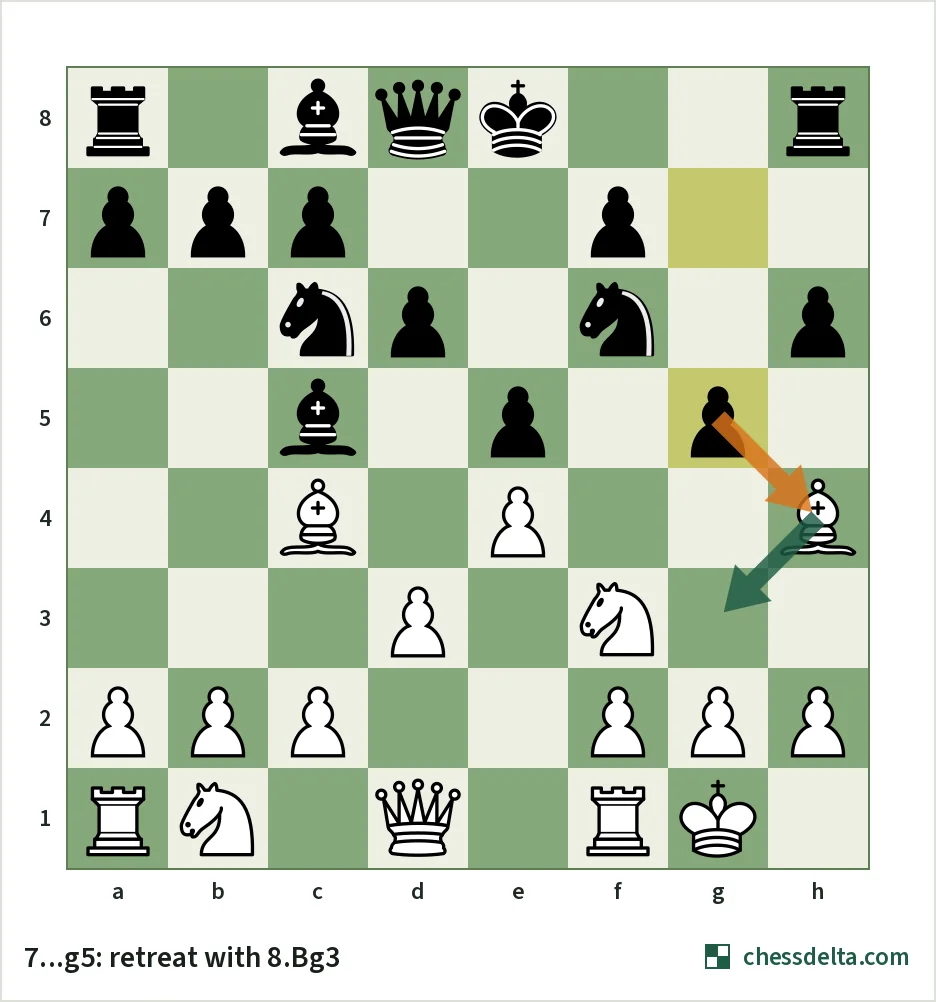
The rule of thumb: …g5 is much safer for Black before castling kingside, because the open g-file then doesn’t lead to Black’s own king. If Black has castled, the knight sacrifice becomes far more dangerous, although in this exact position it still falls short. Calculate before you sacrifice.
What to play
As White
- Play 4.d3 or 4.c3 and 5.d3, castle, then Re1, h3 and Bb3.
- Bring the b1 knight to g3 via d2 and f1.
- Push d4 only when e4 is well defended and your pieces are ready.
- Avoid early Ng5 unless it wins something concrete.
As Black
- Mirror the setup: …Nf6, …d6, …O-O, …h6, …a6 and …Ba7.
- Look for …d5 when White’s pieces aren’t ready to hit it.
- If White plays Ng5 before you castle, castle; don’t push …d5 in a hurry.
- Avoid 5…Ng4.
[Event "Giuoco Pianissimo: ...a6 and ...Ba7"]
[Result "*"]
1. e4 e5 2. Nf3 Nc6 3. Bc4 Bc5 4. d3 Nf6 5. c3 a6 6. O-O d6 7. a4 Ba7 8. Re1 O-O 9. h3 h6 10. Nbd2 *
Related pages
FAQ
What does Giuoco Pianissimo mean?
It’s Italian for “very quiet game”. The name describes the slow d3 setup, compared with the more open Giuoco Piano.
Is the Giuoco Pianissimo good?
Yes. It’s sound, flexible and played at every level, including by elite grandmasters. It gives White a small, safe edge with lots of play left in the position.
Is the Giuoco Pianissimo boring?
Only in the first ten moves. Because the center stays closed, the fight moves to the kingside and queenside, and the middlegames are often very rich. It suits players who like to outplay opponents slowly.
What is the difference between the Giuoco Piano and Pianissimo?
The Piano opens the center early with c3 and d4. The Pianissimo plays d3 and keeps the center closed, building up before any break.
How do you play against the Giuoco Pianissimo as Black?
Copy White’s setup, put your bishop on a7 so it can’t be chased, play …h6 to stop pins, and look for the …d5 break. Avoid early adventures like 5…Ng4.