Quick answer: The Giuoco Piano is the Italian Game with 3…Bc5: 1.e4 e5 2.Nf3 Nc6 3.Bc4 Bc5. Its classical main line is 4.c3 Nf6 5.d4, where White builds a big pawn center and Black hits back with …exd4 and …Bb4+. With accurate play it’s equal, but both sides have traps to know.
What is the Giuoco Piano?
Giuoco piano is Italian for “quiet game”. It’s one of the oldest openings in chess. Gioachino Greco was publishing analysis of it in the early 1600s, including a trap that still catches players today.
The name causes some confusion. Some books use “Giuoco Piano” for every position after 3…Bc5. On chessdelta we use it for the classical lines with 4.c3 and an early d4, and cover the slow 4.d3 lines separately in the Giuoco Pianissimo guide.
The move order
1.e4 e5 2.Nf3 Nc6 3.Bc4 Bc5 4.c3
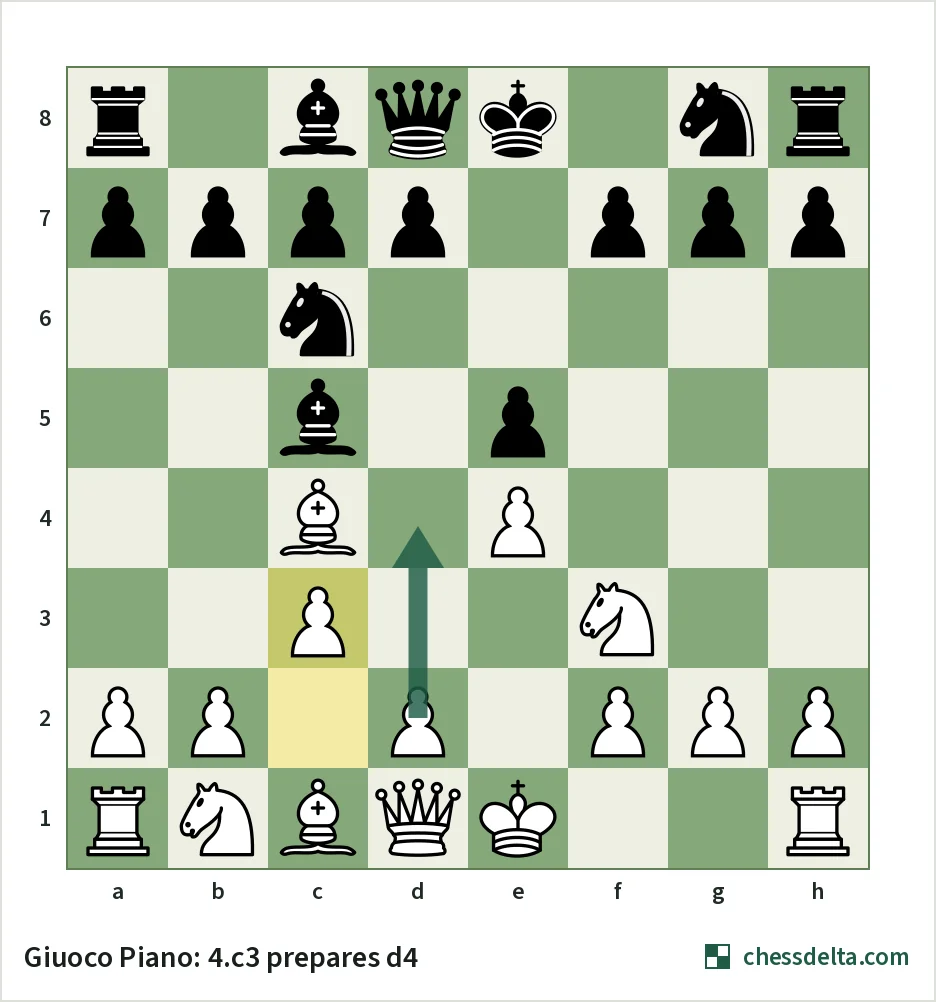
Both bishops aim at the opponent’s weakest square (f7 and f2). White’s 4.c3 prepares d4, which would attack the bishop on c5 and give White pawns on e4 and d4.
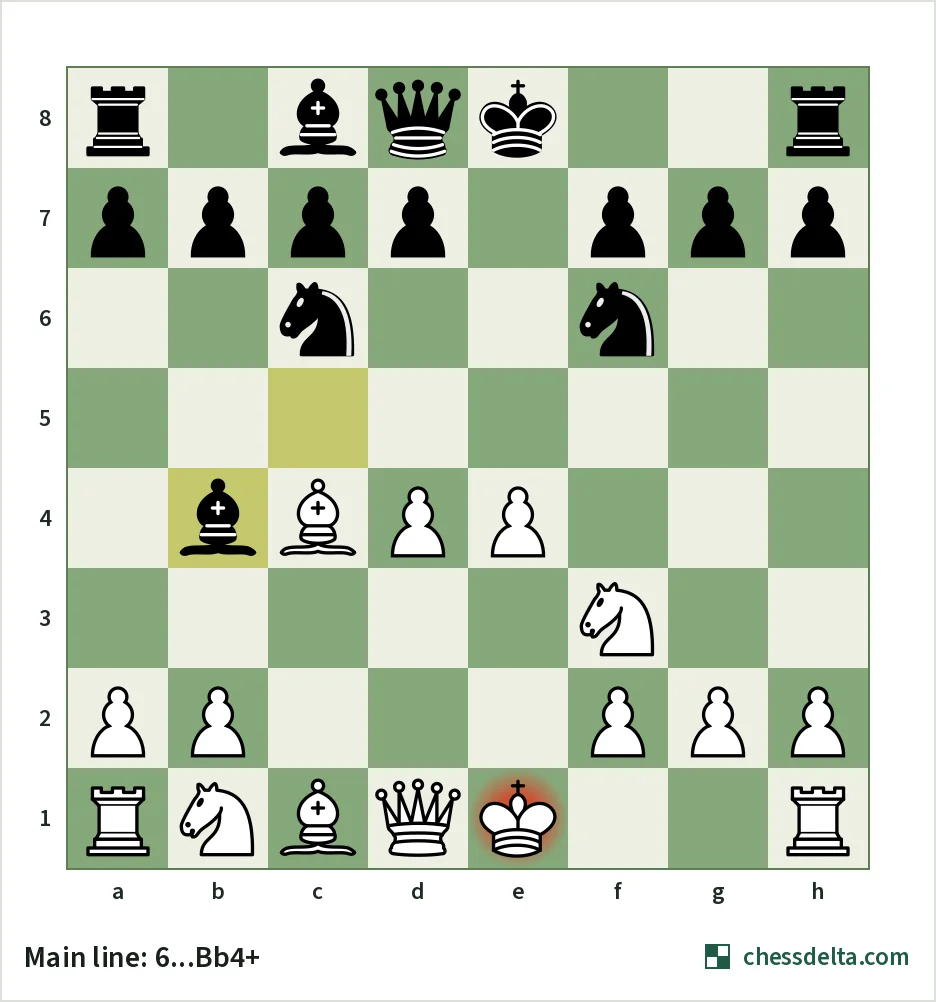
Black’s best reply is 4…Nf6, attacking e4 straight away. After 5.d4 exd4 6.cxd4 Black has to give a check, because the bishop is attacked and retreating lets White’s center roll forward.
Key ideas
For White
- Build the center with c3 and d4. Pawns on e4 and d4 give your pieces space and push Black’s pieces back.
- Develop with tempo. Every Black piece you can chase with d5 or e5 is a move you gain.
- Castle quickly. In the sharp lines White often gives up a pawn to get the king safe and the rooks into play first.
For Black
- Strike back at the center. …exd4, …Bb4+ and …d5 are the moves that stop White’s pawns from steamrolling.
- Don’t retreat passively. If White gets d4 and e4 unchallenged, Black is cramped.
- Watch for d5 and e5. Those pawn pushes are how White wins pieces in this opening.
Main lines
7.Bd2: the safe main line
1.e4 e5 2.Nf3 Nc6 3.Bc4 Bc5 4.c3 Nf6 5.d4 exd4 6.cxd4 Bb4+ 7.Bd2 Bxd2+ 8.Nbxd2 d5! 9.exd5 Nxd5 10.Qb3 Nce7 11.O-O O-O 12.Rfe1 c6
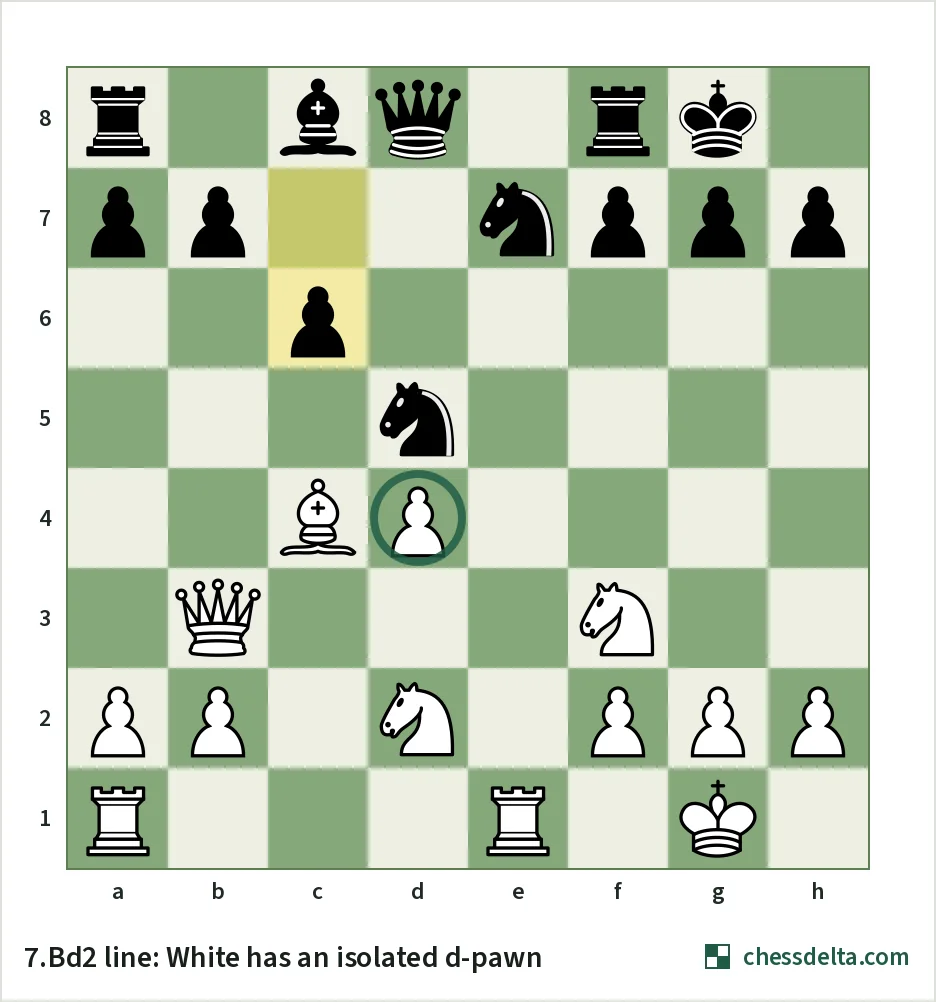
Black trades the dark-squared bishops and breaks with …d5, leaving White with an isolated pawn on d4. White has active pieces; Black has a solid knight on d5 and a long-term target. Stockfish rates it close to equal. This is the line to learn first as either color.
7.Nc3: the Møller Attack
7.Nc3 Nxe4 8.O-O. White gives up the e4 pawn for fast development and a lead in the race to open lines.
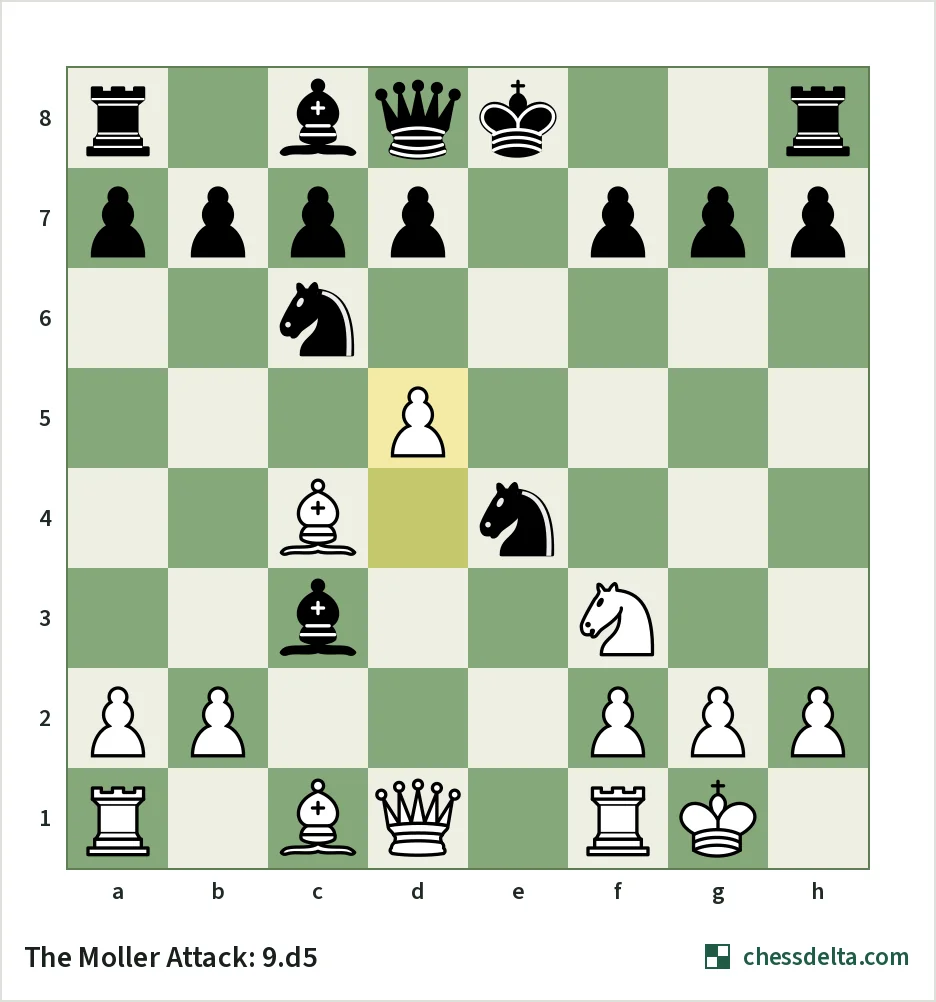
The sharpest try is 8…Bxc3 9.d5, the Møller Attack. After 9…Bf6 10.Re1 Ne7 11.Rxe4 d6 12.Bg5 Bxg5 13.Nxg5 O-O 14.Nxh7 Kxh7 15.Qh5+ Kg8 16.Rh4, Stockfish rates the position as level. White’s attack is strong enough to hold the balance but not to win by force.
Black’s calmer option is 8…Nxc3 9.bxc3 d5!, returning material to finish development. Stockfish rates that about equal. What Black must not do is 9…Bxc3?, which walks into Greco’s trap (below).
6.e5: the early push
Instead of 6.cxd4, White can play 6.e5. Black should answer 6…d5!, counterattacking the bishop on c4. After 7.Bb5 Ne4 8.cxd4 Bb6 the position is level.
Traps in the Giuoco Piano
Greco’s trap (for White)
1.e4 e5 2.Nf3 Nc6 3.Bc4 Bc5 4.c3 Nf6 5.d4 exd4 6.cxd4 Bb4+ 7.Nc3 Nxe4 8.O-O Nxc3 9.bxc3 Bxc3? 10.Qb3!
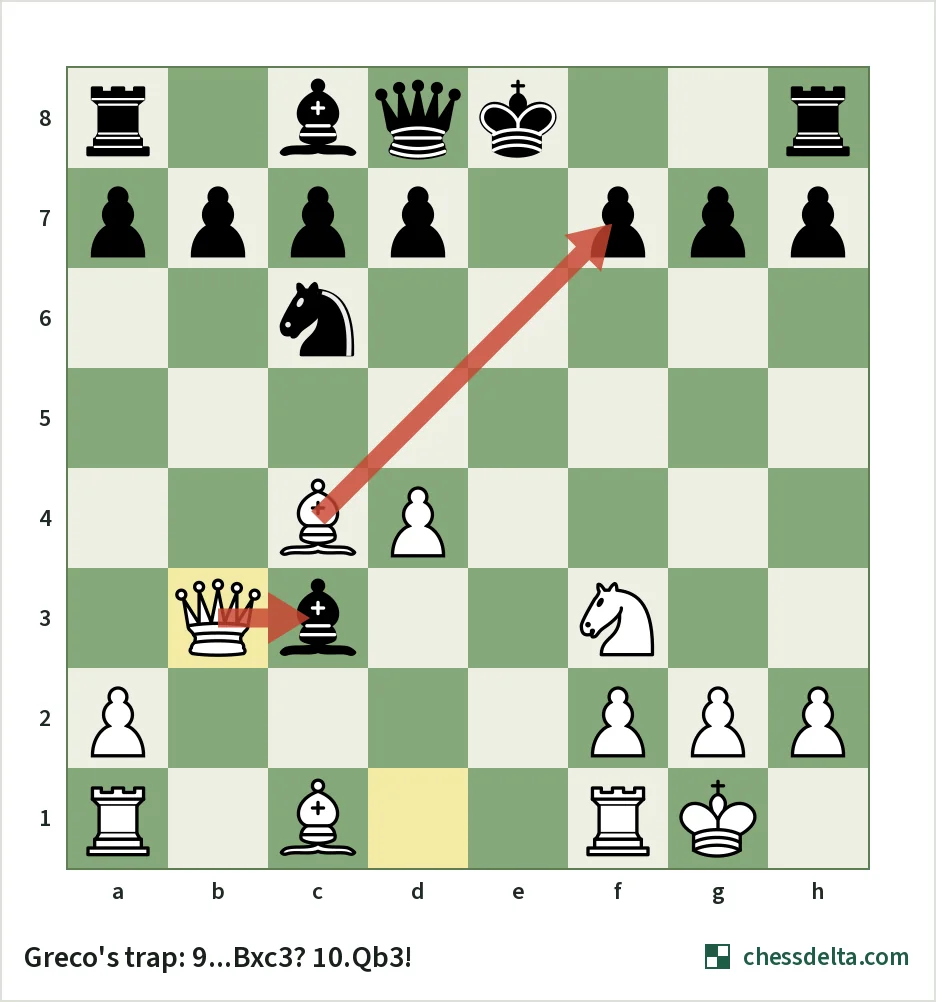
The queen attacks the bishop on c3 and lines up with the c4 bishop against f7. If Black grabs the rook with 10…Bxa1?, White wins with a mating attack. Greco’s 1620 line runs 11.Bxf7+ Kf8 12.Bg5 Ne7 13.Ne5 Bxd4 14.Bg6 d5 15.Qf3+ Bf5 16.Bxf5 Bxe5 17.Be6+ Bf6 18.Bxf6 gxf6 19.Qxf6+ Ke8 20.Qf7#. Press ▶ on the board above to play through it.
Black’s best after 10.Qb3 is 10…d5, but White is still clearly better. The real fix is to play 9…d5! instead of 9…Bxc3.
6…Bb6? and the d5 push (for White)
After 4.c3 Nf6 5.d4 exd4 6.cxd4, the natural retreat 6…Bb6? is a mistake. 7.d5! hits the knight on c6, and after 7…Ne7 8.e5 the other knight is attacked too. Black’s knights are pushed back and White’s center dominates. Stockfish gives White a winning advantage of more than two pawns.
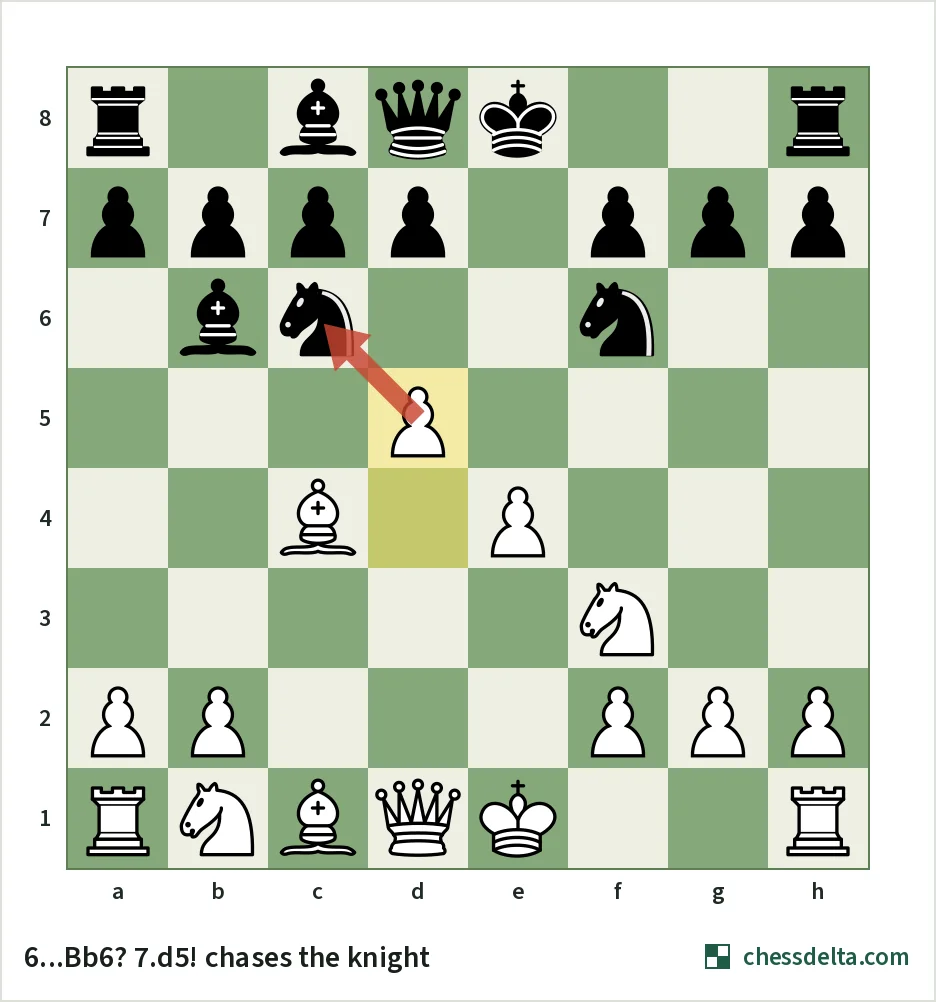
Black should always check with 6…Bb4+ here.
What to play
As White
- If you want the classical fight, play 4.c3, 5.d4 and 7.Bd2. It’s safe and you’ll get active pieces.
- If you like gambits, try 7.Nc3 and the Møller Attack, but know that best defense holds.
- If you’d rather avoid all of this, play 4.c3 and 5.d3 (or 4.d3), the Giuoco Pianissimo.
- For a pawn sacrifice one move earlier, see the Evans Gambit.
As Black
- Answer 4.c3 with 4…Nf6 and 5.d4 with 5…exd4.
- After 6.cxd4, always play 6…Bb4+.
- Against 7.Bd2, trade bishops and play …d5.
- Against 7.Nc3, take on e4 and know either the Møller line or 8…Nxc3 9.bxc3 d5.
- Against 6.e5, play 6…d5.
[Event "Giuoco Piano: 7.Bd2 main line"]
[Result "*"]
1. e4 e5 2. Nf3 Nc6 3. Bc4 Bc5 4. c3 Nf6 5. d4 exd4 6. cxd4 Bb4+ 7. Bd2 Bxd2+ 8. Nbxd2 d5 9. exd5 Nxd5 10. Qb3 Nce7 11. O-O O-O 12. Rfe1 c6 *
Related pages
FAQ
What does Giuoco Piano mean?
It’s Italian for “quiet game”. The name is older than modern theory: the 4.c3 and d4 lines are anything but quiet.
Is the Giuoco Piano good for beginners?
Yes, for both colors. It teaches center control and quick development, and the traps in it (Greco’s trap, the d5 push) are lessons every player needs.
What is the difference between the Giuoco Piano and the Giuoco Pianissimo?
Both start 1.e4 e5 2.Nf3 Nc6 3.Bc4 Bc5. In the Piano White plays an early d4 to open the center. In the Pianissimo (“very quiet”) White plays d3 and builds up slowly.
Is the Giuoco Piano the same as the Italian Game?
The Giuoco Piano is one branch of the Italian Game, the one where Black answers 3.Bc4 with 3…Bc5. The other main branch is the Two Knights Defense, 3…Nf6.
Who invented the Giuoco Piano?
Nobody knows. The Italian Game appears in the Göttingen manuscript from around 1500, and Italian players such as Polerio and Greco analyzed 3…Bc5 in the late 1500s and early 1600s.