No, you can’t checkmate with a king and one knight against a lone king. It’s impossible, so the game ends in a draw by insufficient mating material. That means neither side has enough pieces left to deliver checkmate.
But why can’t a king and knight finish the job? The answer comes down to 3 squares in the corner. Unsure how or when to agree a draw? See our Complete Guide: How to offer a draw and accept it in chess.
Why You Can’t Checkmate With A King And One Knight?
You can’t checkmate with a king and one knight because they can’t cover enough squares. Even with the enemy king pushed into a corner, your king covers only 2 of its escape squares and your knight just 1 more. The corner square the enemy king stands on stays safe.
So the lone king always has a safe square to sit on or escape to. The game ends either in stalemate or in an automatic draw for insufficient mating material.
There’s also the 50-move rule. A player can claim a draw when there has been no capture and no pawn move in the last 50 moves.
So even if you keep trying to mate with a king and one knight, you’d run past that move limit long before getting anywhere.
Also Read: The Difference Between Checkmate And Stalemate
You might also end up repeating moves, which brings in threefold repetition: the same position appearing 3 times.
Every road leads to the same place. Try to mate a lone king with a king and one knight, and the game ends in a draw.
In practice, the moment you’re left with just a king and knight against a lone king, the game is drawn automatically for insufficient material.
It’s an easy trap to fall into.
With a king and knight against a lone king, you drive the king into the corner, sure that mate is coming. Then the game ends in a draw, and it’s not obvious why.
Tip: Tired of throwing away won games to stalemate? Read our 5 Tips That Actually Work To Avoid Stalemate In Chess.
See It On The Board
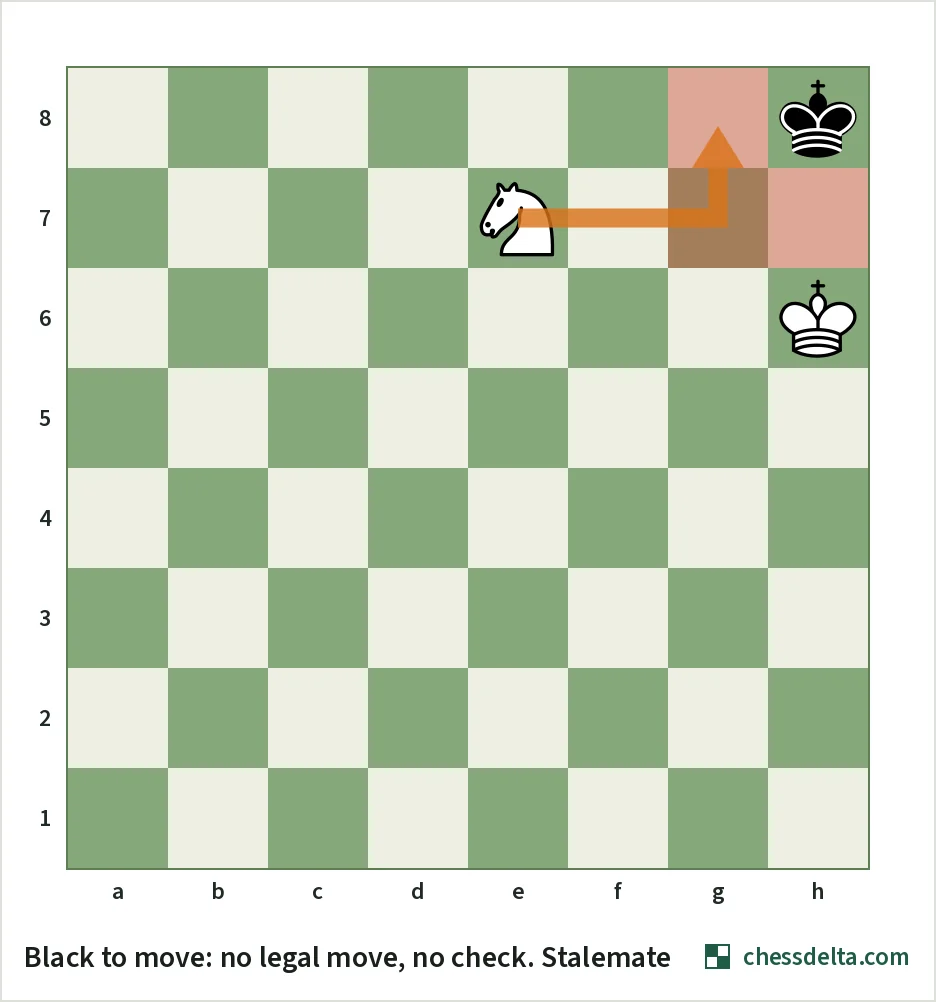
Here’s the kind of position you end up in. Look at what each piece is doing:
- Black’s king is on h8.
- White’s king is on h6, covering h7 and g7.
- White’s knight is on e7, covering g8.
- Nothing attacks h8, so Black’s king is safe where it stands.
- Black has no legal moves but isn’t in check. That’s stalemate.
White got close and still couldn’t mate. One knight just isn’t enough to cover h8 as well.
So what about 2 knights, or 3? You can’t force checkmate with 2 knights, but with 3 knights you can.
Final Thoughts
When you have a king and knights against a lone king, or a similar endgame, here’s a simple plan to follow.
It’s just 3 steps:
- Bring your pieces to the center first. Don’t worry much about where the enemy king goes.
- Use your chess pieces to push the enemy king toward the edge of the board.
- Then go for checkmate in a corner.
Want the rules of checkmate in one place? Read our 7 Checkmate Rules Every Chess Player Should Know
Related Questions:
Can You Win Chess With Just A King?
No, you can’t win chess with just a king. You can lose or draw, but not win, because one king can’t checkmate another.
Why not? To give check, your king would have to move next to the enemy king. That puts your own king in check, which is an illegal move.
For the full explanation, read our guide: Can A King Kill A King In Chess? (Explained)
What Happens If King Vs King In Chess?
King vs king in chess is an immediate draw. Neither king can checkmate the other, so the game ends for insufficient mating material.
Can A Knight Double Jump In Chess?
No, a knight can’t double jump in chess. It makes 1 jump per turn. Unlike checkers, you move only 1 piece per turn in chess. The exception is castling, where the king and rook move together in a single move.