Quick answer: Chess pieces come in 6 shapes, and the top of each one tells you which is which. The king is the tallest piece, with a cross on top. The queen wears a pointed crown. The bishop has a pointed top with a slit, and the knight is a horse’s head. The rook is a castle tower, and the pawn is the smallest, with a round head.
Part of our guide to how chess pieces move.
What do chess pieces look like?
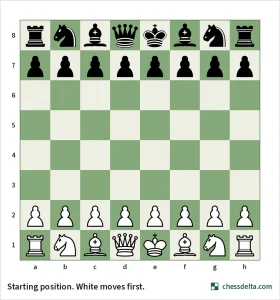
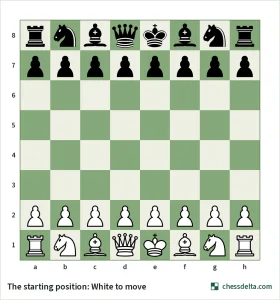
Chess pieces in a standard set look like the Staunton design, which FIDE recommends for its events. Each side has 16 pieces: 1 king, 1 queen, 2 rooks, 2 bishops, 2 knights and 8 pawns.
So how do you tell them apart at a glance? Look at 2 things: the top of each piece and its height. The chart below lines them up tallest to shortest.
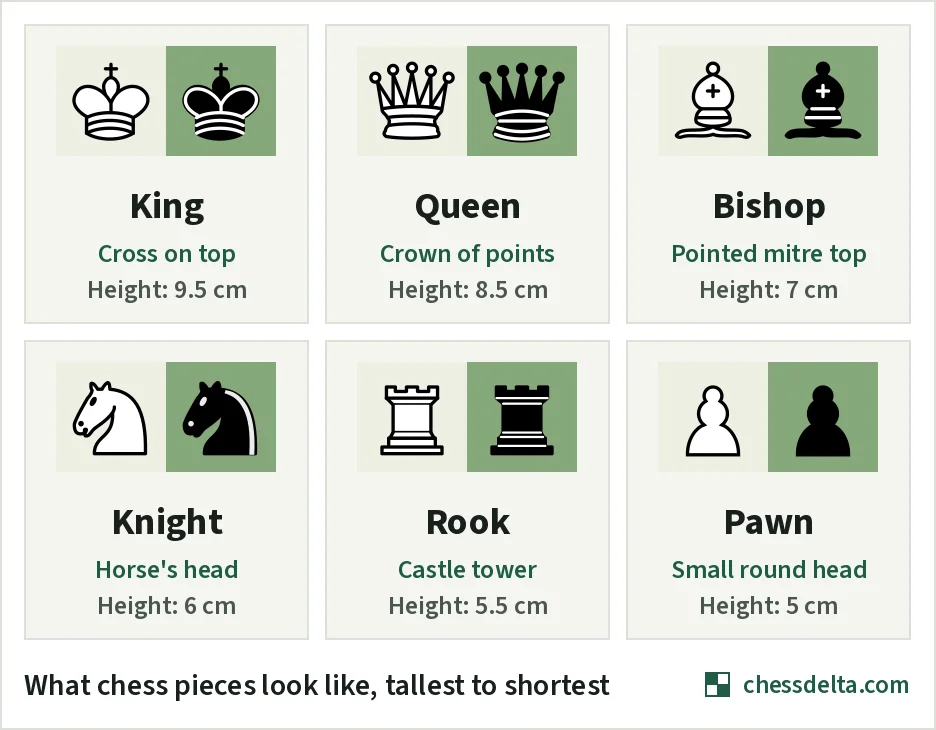
Want the names, letters and counts in one table too? See our guide to chess pieces names.
What does the king look like in chess?
The king is the tallest chess piece, with a small cross on top of its crown. Each side has 1 king, starting on e1 for White and e8 for Black.
It’s also the most important piece: if your king is checkmated, you lose. But tallest doesn’t mean strongest. The king moves just 1 square in any direction.
To learn more, read our full guide to how the king moves.
What does the queen look like in chess?
The queen is the second-tallest chess piece, with a crown of points instead of a cross. That top is your quickest way to tell her from the king. Each side starts with 1 queen, on d1 or d8.
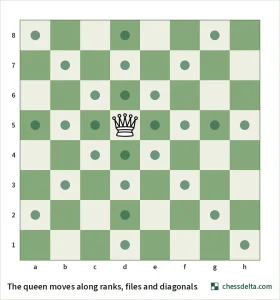
And she’s the strongest piece on the board, worth 9 points in the usual chess piece value scale. She moves any number of empty squares along a rank, file or diagonal. To learn more, read our full guide to how the queen moves.
And yes, you can get a second queen by promoting a pawn. Find out how in can you have more than one queen.
What does the rook look like in chess?
The rook looks like a castle tower, with a notched top like battlements. Each side has 2 rooks, and they start in the corners: a1 and h1 for White, a8 and h8 for Black.
Don’t let the short tower fool you. The rook is the second most valuable piece, worth 5 points. It moves any number of empty squares along a rank or file, and it joins the king in castling.
To learn more, read our guides to how the rook moves and when you can castle.
What does the bishop look like in chess?
The bishop has a rounded, pointed top with a slit cut into it. Why the slit? It separates the bishop from the pawn, which also has a round head.
Each side has 2 bishops, and they start next to the king and queen on c1 and f1, or c8 and f8.
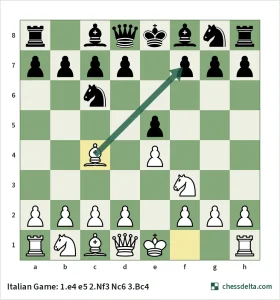
The bishop moves any number of empty squares diagonally, forward or back. To learn more, read how bishops move and why chess bishops have a cut.
What does the knight look like in chess?
The knight looks like a horse’s head. It’s the only piece shaped like an animal, so it’s the easiest one to spot. Each side has 2 knights, and they start between the rooks and bishops on b1 and g1, or b8 and g8.
Its move is just as unusual as its shape. The knight moves in an L: 2 squares one way, then 1 square at a right angle. It’s the only piece that can jump over other pieces in a normal move.
To learn more, read our full guide to how knights move.
What does the pawn look like in chess?
The pawn is the shortest chess piece, with a small round head and no slit. Each side has 8 pawns, and they start on the 2nd rank for White and the 7th rank for Black.
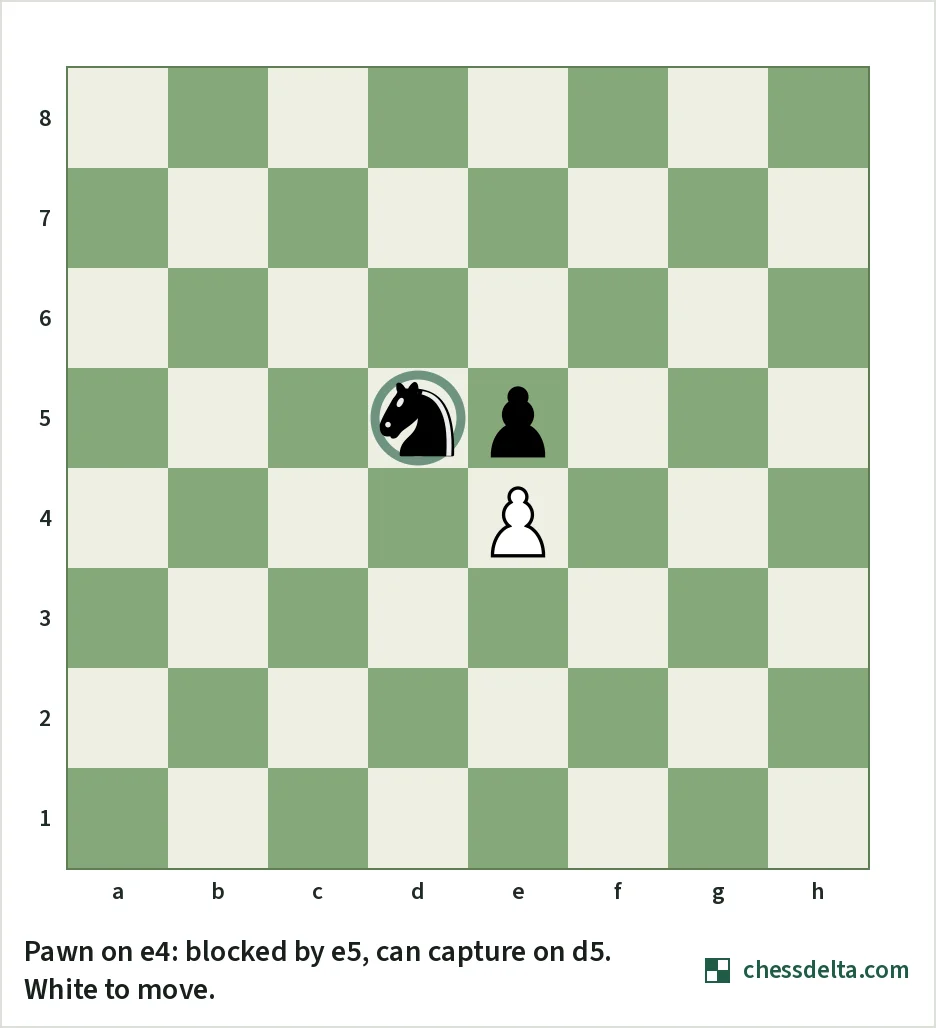
A pawn moves 1 square straight forward, or 2 squares on its first move. But here’s the catch: it captures 1 square diagonally forward instead.
A pawn can’t capture straight ahead, and it’s the only piece that can never move backward. The diagram shows what that means on the board.
Pawns also have 2 special moves. En passant is a capture of a pawn that just moved 2 squares. Promotion turns a pawn into a queen, rook, bishop or knight when a pawn reaches the other side. To learn more, read our full guide to how pawns move in chess.
How do you identify chess pieces?
You identify chess pieces in an unusual set by counting them and comparing heights. A decorative set can change every shape, but it can’t change the numbers per side.
So take one color’s 16 pieces and sort them like this:
- Check the set’s leaflet or box for a key to the pieces.
- Find the 8 matching pieces. Those are the pawns.
- Group the 3 pairs that match. Those are the rooks, knights and bishops.
- The 2 pieces left are the king and queen. The taller one is the king.
Still stuck on a pair? Height settles most of them. FIDE’s equipment standard gives these recommended heights for tournament pieces:
| Piece | Recommended height | How to spot it |
|---|---|---|
| King | 9.5 cm | Tallest, cross on top |
| Queen | 8.5 cm | Crown of points |
| Bishop | 7 cm | Pointed top with a slit |
| Knight | 6 cm | Horse’s head |
| Rook | 5.5 cm | Castle tower |
| Pawn | 5 cm | Shortest, round head |
FIDE allows sizes to vary by up to 10%, but the order must stay the same. So in any tournament-style set, you can trust it: the king is tallest and the pawn is shortest.
FAQ
Which chess piece looks like a horse?
The knight looks like a horse. Each side has 2 knights, starting on b1 and g1 for White and b8 and g8 for Black.
Which chess piece looks like a castle?
The rook looks like a castle tower. Some people call it a castle, but its name is the rook. Castling is a move, not a piece, so the right name saves you a mix-up.
How do you tell the king from the queen?
You tell the king from the queen by the top. The king has a cross and is the taller of the 2, while the queen has a crown of points. FIDE’s equipment standard says the 2 tops must clearly differ.
What is the tallest chess piece?
The king is the tallest chess piece. FIDE recommends 9.5 cm for the king and 5 cm for the pawn, the shortest piece.
Why does the bishop have a slit?
The slit tells the bishop apart from the pawn, which also has a round head. FIDE’s equipment standard says the bishop’s top may carry a notch, or a special color, to tell it apart from the pawn.
Updated .