Quick answer: To get better at chess, solve tactics puzzles for 20 to 30 minutes a day. Play 3 or more rapid games a week at 15+10 or slower. Review every loss before you check it with an engine. Add endgames and opening plans as your rating climbs past 1000 and 1500.
This page is for players who know the rules and want a plan. Still learning how the pieces move or what to do in your first games? Start with our guide to chess for beginners. Below, the Chess Delta team sets out a weekly routine for 3 rating bands, with free tools for each.
What actually makes you better at chess?
You get better at chess by doing 4 things every week: solving tactics, playing slow games, reviewing those games and studying endgames. Opening theory matters less than most players think until about 1500.
- Tactics. Most games below 1500 are decided by a piece left loose or a 2-move combination that one side missed.
- Slow games. You need time on the clock to practice thinking: checking threats, comparing candidate moves, calculating 2 or 3 moves ahead.
- Review. Finding your own mistakes, before the engine tells you, is how a lesson sticks.
- Endgames. A few key positions turn winning games into wins and save drawn ones.
Playing alone helps, but slowly. Games give you problems. Training gives you the patterns to solve them. You need both.
How should you split your chess training by rating?
Your chess training plan should change as your rating goes up. Use your rapid rating on the site where you play most. Ratings on different sites are not on the same scale, so treat the bands as rough guides.
| Rating band | Main focus | Hours a week | Weekly split |
|---|---|---|---|
| Under 1000 | Stop hanging pieces, learn basic mates | About 3 | 40% puzzles, 40% games and review, 20% checkmate drills |
| 1000 to 1500 | Forks, pins and 2-move tactics, simple endgames | About 5 | 40% puzzles, 40% games and review, 20% endgames |
| 1500 to 2000 | Calculation, plans, rook endgames, a real repertoire | About 7 | 30% calculation, 35% games and review, 20% endgames, 15% openings and plans |
How do you get better at chess under 1000?
Under 1000, you get better at chess by losing fewer pieces for nothing. Most games at this level end because someone left a piece undefended or missed a 1-move checkmate.
Build one habit before every move. Ask 2 questions: what does my opponent’s last move attack, and is any of my pieces undefended? Our page on chess piece values helps you judge which trades are fair.
Weekly routine under 1000 (about 3 hours)
- Monday, Wednesday, Friday: 20 minutes of Lichess puzzles on the themes “Hanging piece”, “Mate in 1” and “Mate in 2”.
- Tuesday, Thursday: 1 game at 15+10, then 10 minutes finding the first move that lost material.
- Saturday: 1 lesson from Lichess Practice, starting with “Piece Checkmates I” and “Checkmate Patterns I”.
- Sunday: 2 games at 15+10, and review both losses.
Practice position: the back-rank mate
The back-rank mate is the first pattern to learn under 1000. Black’s king is boxed in by its own pawns on f7, g7 and h7. White to move has a mate in 1.
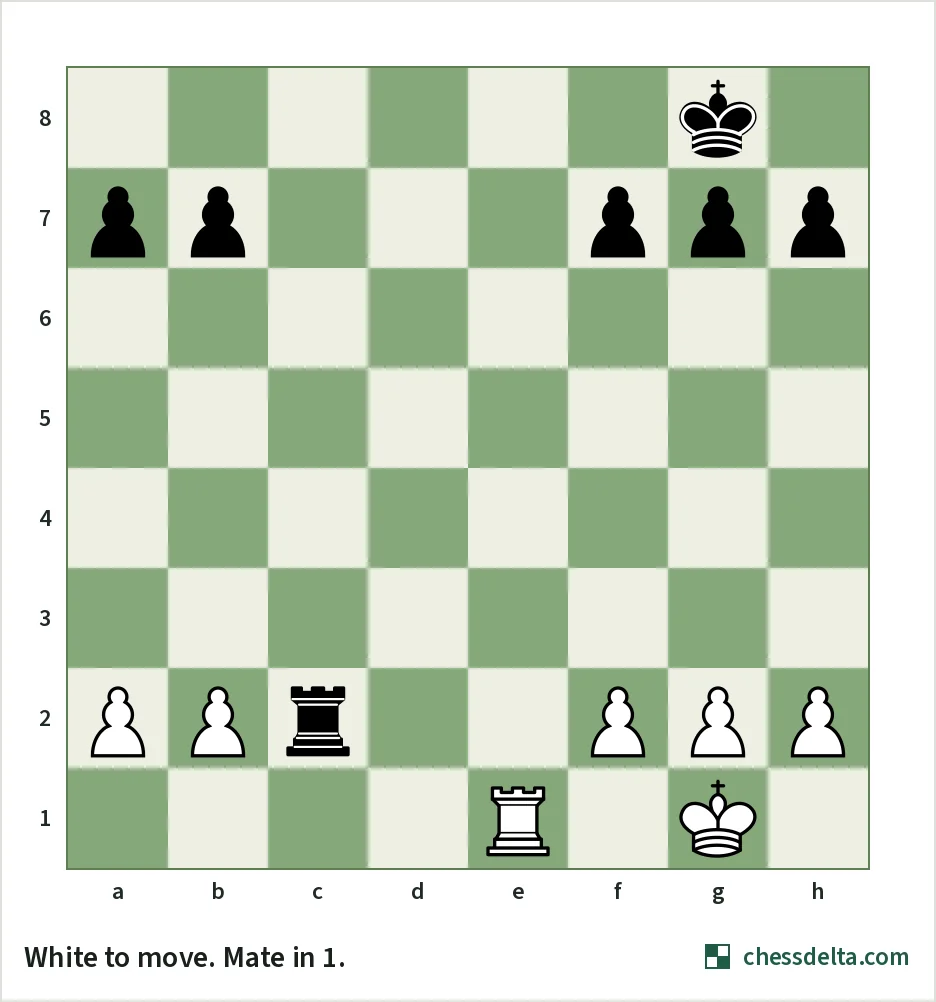
Solution: 1.Re8#. The rook checks along the 8th rank. The king can’t go to f8 or h8, and its own pawns block f7, g7 and h7. Black’s rook is busy on c2 and can’t come back. The fix for Black is “luft”: a pawn move such as …h6 that gives the king a square.
How do you get better at chess from 1000 to 1500?
From 1000 to 1500, you get better at chess by spotting 2-move tactics: forks, pins, skewers and discovered attacks. You also need a short list of endgames you can win or hold without thinking.
Your habit at this level is a 3-step scan before each move: checks, captures, threats. Look at every check and capture for both sides, even the ones that look silly. The quiet move you never considered is usually the one that beats you.
Weekly routine from 1000 to 1500 (about 5 hours)
- Every day: 25 minutes of themed puzzles. Rotate Fork, Pin, Skewer and Discovered attack, 1 theme per day.
- 3 times a week: 1 game at 15+10 or slower. Review it the same day, before you open an engine.
- Once a week: 1 Lichess Practice lesson from “Fundamental tactics”, then “Key Squares” and “Opposition” from Pawn Endgames.
- Once a week: 30 minutes on your openings. Learn 1 opening as White and 1 reply each to 1.e4 and 1.d4, about 8 moves deep.
For openings, learn the ideas before the moves. Our page on chess opening principles covers the 10 rules that steer every opening at this level.
Practice position: Légal’s mate
This position comes from the Légal Trap: 1.e4 e5 2.Nf3 d6 3.Bc4 Bg4 4.Nc3 g6 5.Nxe5 Bxd1. Black has just taken White’s queen. White to move has a mate in 2.
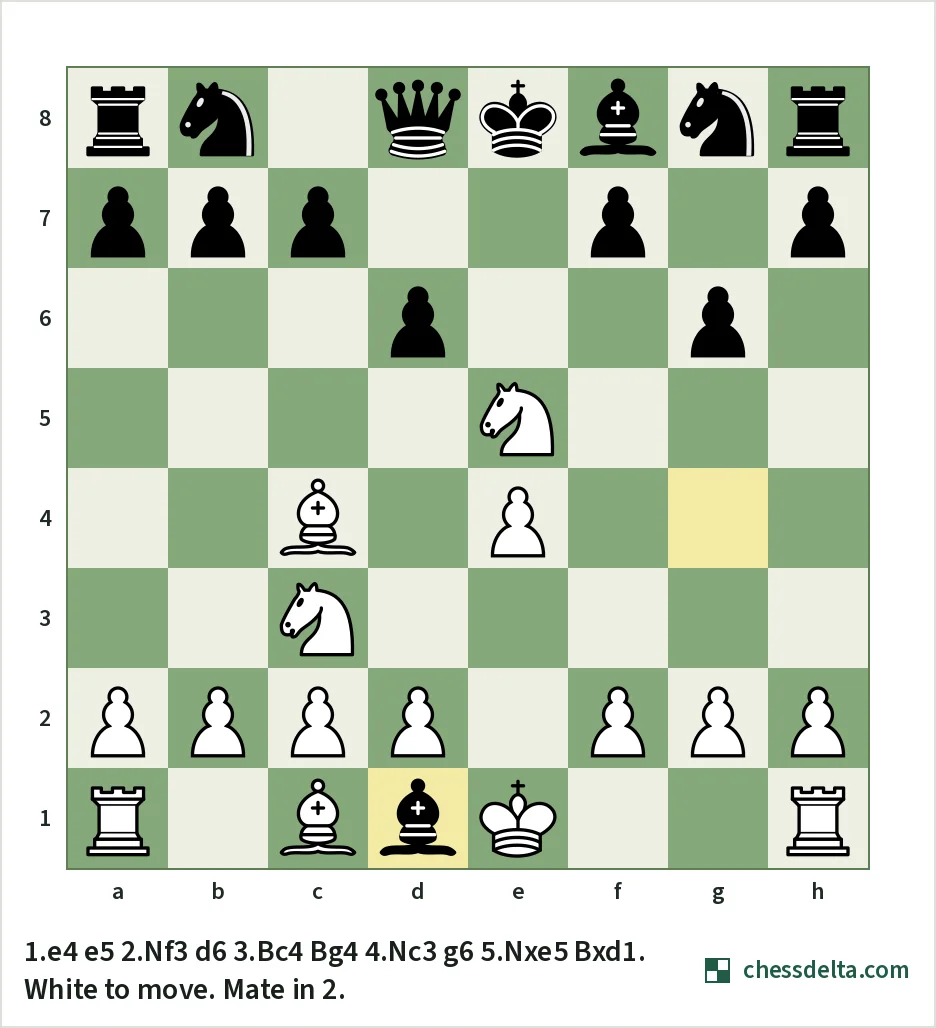
Solution: 6.Bxf7+ Ke7 7.Nd5#. After 6.Bxf7+, the king has only e7, since the e5 knight guards f7. Then 7.Nd5 covers f6 and the e5 knight covers d7. The bishop covers e6 and e8, and Black’s own pawn and bishop block d6 and f8.
The lesson is the scan. Black saw a free queen and stopped looking. Checking White’s checks, 6.Bxf7+, would have shown the mate. Black does better with 5…dxe5, though 6.Qxg4 still leaves White a pawn up.
How do you get better at chess from 1500 to 2000?
From 1500 to 2000, you get better at chess by calculating further and planning better. Your opponents stop leaving pieces loose. Games are now lost to a miscalculated line or a middlegame with no plan.
Weekly routine from 1500 to 2000 (about 7 hours)
- 5 days a week: 30 minutes of harder puzzles. Solve the whole line in your head before you touch a piece. If you move and you’re wrong, the puzzle counts as failed.
- 2 or 3 times a week: 1 long game, online at 30+0 or slower, or a rated game at a club.
- After each long game: write notes on the critical moments, then compare them with the engine.
- Twice a week: 30 minutes of rook endgames. Work through Lichess Practice “Basic Rook Endgames”, then “Intermediate Rook Endings” and “Practical Rook Endings”.
- Once a week: play through 1 annotated master game in an opening you play. Stop before each move and guess.
Plans come from pawn structure. Our guide to middle game theory explains how to pick a plan once the opening is over. Keep your repertoire in a Lichess study so you can drill it and add lines from your own games.
At this level, rated over-the-board games pay off. A club night or weekend tournament gives you slow games against opponents who won’t resign early. Our guide on how to get a FIDE rating shows how to start.
Which time control helps you improve the most?
Rapid and classical games help you improve the most because you have time to think. Bullet and most blitz games train speed and instinct, not calculation.
The FIDE Laws of Chess define the two faster categories. Under Appendix A.1, a rapid game gives each player more than 10 and less than 60 minutes. Under Appendix B.1, a blitz game gives each player 10 minutes or less. In both, the time counts the base time plus 60 times any increment.
FIDE has no bullet category. Lichess sorts games by estimated length: base time in seconds plus 40 times the increment. Up to 179 seconds is bullet, up to 479 is blitz and up to 1,499 is rapid. Anything from 1,500 seconds is classical.
| Time control | FIDE category | Lichess category | Good for improving? |
|---|---|---|---|
| 1+0 | Blitz | Bullet | No. You play on instinct and the clock decides many games. |
| 3+2 | Blitz | Blitz | For testing openings, not for learning to calculate. |
| 10+0 | Blitz | Rapid | Some. Short for careful thinking. |
| 15+10 | Rapid | Rapid | Yes. Our default for players under 1500. |
| 30+0 | Rapid | Classical | Yes. Good for players above 1500. |
Fast games are fine for fun. Just don’t count them as training. If you play 10 bullet games for every slow game, swap the ratio.
How do you review your own chess games?
To review a chess game, go through it on your own first, then check with an engine. The engine shows what went wrong. Your own review shows why you missed it.
- Play through the game without an engine. Mark the 2 or 3 moves where you felt unsure.
- At each marked move, write down what you were thinking and which move you rejected.
- Now turn the engine on. Find the first move where the evaluation swung by a pawn or more.
- Name the cause in a few words: “missed a fork”, “no plan”, “ran low on time”, “didn’t know the endgame”.
- Keep a list. After 10 games, the most common cause tells you what to train next.
Review your losses first. Then review wins where your opponent gave you the game, since you may have missed the same chance earlier.
What are the best free resources to get better at chess?
The best free resources to get better at chess are Lichess’s puzzles and Practice lessons. Chess.com’s free daily allowance is a smaller add-on. Books are the best paid option.
Lichess (free, no ads)
- Puzzle themes (lichess.org/training/themes): pick a single theme such as Fork, Pin or Back rank mate. The “Healthy mix” set alone held over 6 million puzzles when we checked in November 2026.
- Puzzle Storm: solve as many puzzles as you can in 3 minutes. A wrong move costs 10 seconds. Use it as a warm-up, not as your main training.
- Practice (lichess.org/practice): short interactive lessons in Checkmates, Fundamental tactics, Advanced tactics, Pawn Endgames and Rook Endgames.
- Studies: build your own chapters for openings and endgames, or follow studies other players share.
Chess.com (free Basic account)
- Puzzles: 3 rated puzzles a day, plus 1 Puzzle Rush and 1 Puzzle Battle.
- Lessons: unlimited “Learn to Play” lessons, plus 1 lesson a day from the other sections.
- Game Review: 1 full Game Review a day. Use it on your most important game.
Chess.com limits change, so check its help pages for the current numbers. If you want one structured book, see our list of the best chess books for beginners. Many of those books still suit players up to about 1500.
Why can’t you get better at chess?
If you can’t get better at chess, the cause is usually one of 4 habits. Each has a fix.
- Only fast games. Play at least 3 games a week at 15+10 or slower.
- No review. Spend 10 minutes on every loss before you queue another game.
- Random puzzles at speed. Use themed puzzles and solve the full line before moving.
- Too much opening theory. Below 1500, spend no more than 1 hour in 6 on openings.
Tilt costs rating too. After 2 losses in a row, stop playing for the day and review the games instead.
FAQ
Can you get better at chess by just playing?
Yes, but slowly. Playing without review means you repeat the same mistakes. Add 20 minutes of puzzles a day and a short review of each loss, and you improve faster from the same number of games.
How many chess puzzles should I do a day?
Aim for time, not a number: 20 to 30 minutes a day. Ten puzzles solved carefully, with the full line worked out, teach more than 50 guessed at speed.
Is bullet chess bad for improving?
Bullet chess won’t hurt you, but it does little to improve your calculation. With under 3 minutes for the game, you play on instinct. Count bullet as fun and do your training at rapid or slower.
Should I memorize chess openings to improve?
Not below about 1500. Learn the opening principles and 1 opening for each color to around 8 moves. Tactics and endgames win you more points for the same hours.
Is rapid chess the same as blitz?
No. Under the FIDE Laws of Chess, blitz is 10 minutes or less per player (Appendix B.1). Rapid is more than 10 and less than 60 minutes per player (Appendix A.1).
Read next
- Still learning the basics: chess for beginners
- Plans after the opening: middle game theory
- Play the first moves well: chess opening principles
- Ready for rated games: how to get a FIDE rating
Every move and evaluation on this page was checked with Stockfish. Updated .