Quick answer: Yes, a king can take a queen in chess. The queen must stand on a square next to the king, and no other enemy piece may guard that square. If the queen is protected, taking it would walk your king into check, and that’s illegal. The same rule applies to every piece the king captures.
Part of our guide to how chess pieces move. The short version: yes, but only an unguarded queen. The diagrams below show you how to tell which is which.
Can a king take a queen in chess?
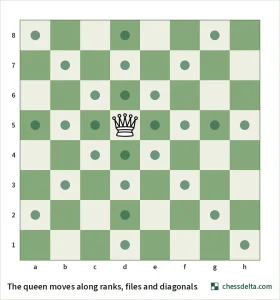
A king can take a queen in chess when 2 things are true. The queen is on a square next to the king, and no enemy piece guards that square. The king captures the same way it moves: 1 square in any direction (FIDE Laws of Chess, Article 3.8.1).
So why can’t the king grab any queen in reach? Article 3.9.2 says no move may expose your own king to check or leave it in check.
If the queen is guarded, your king would land on an attacked square. That makes the capture illegal, even though it would win the most valuable piece on the board.
When can a king take a queen?
A king can take a queen when the queen is unprotected. Here Black’s queen on e2 checks White’s king on e1. Nothing guards e2, so White plays 1.Kxe2 and wins the queen.
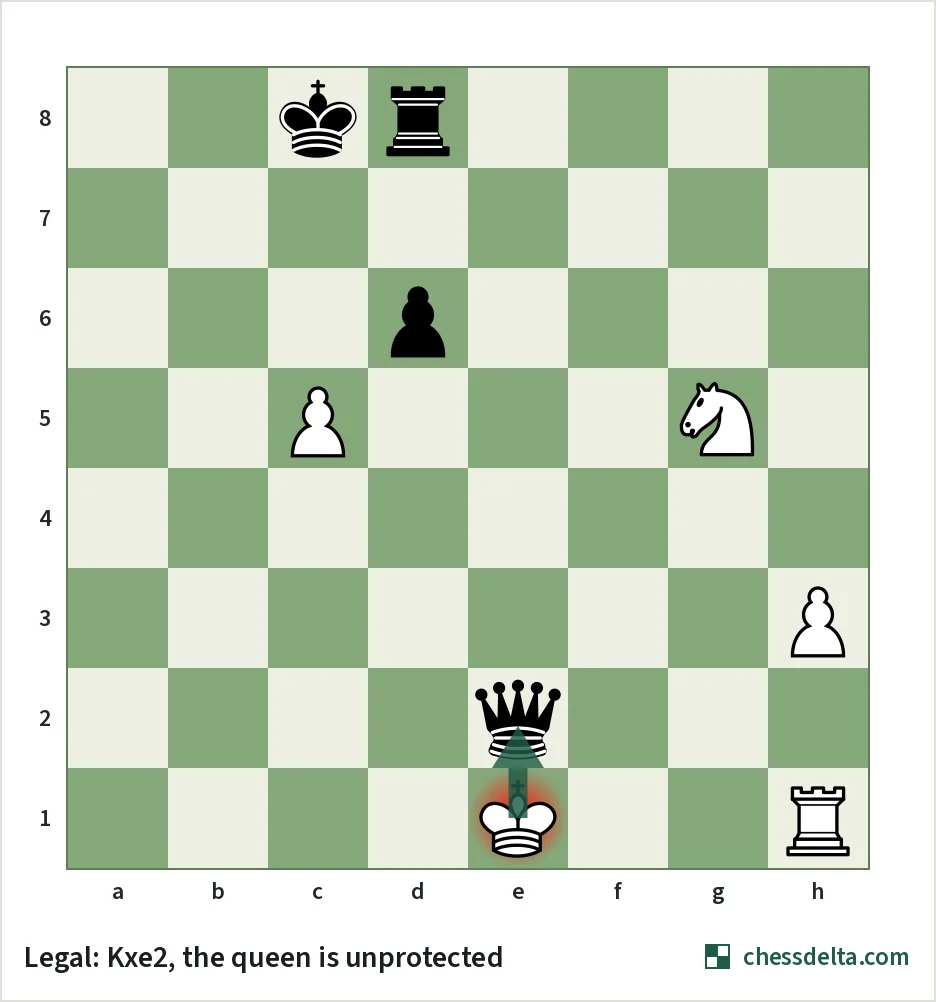
In fact, 1.Kxe2 is White’s only legal move. The queen covers d1, d2, f1 and f2, so the king can’t step to any of them. Capturing the checking piece is the only way out.
When can’t a king take a queen?
A king can’t take a queen when another enemy piece protects it. Now add a black bishop on b5 to the same position, and everything changes. The bishop guards e2 along the diagonal, so 1.Kxe2 would put White’s king in check.
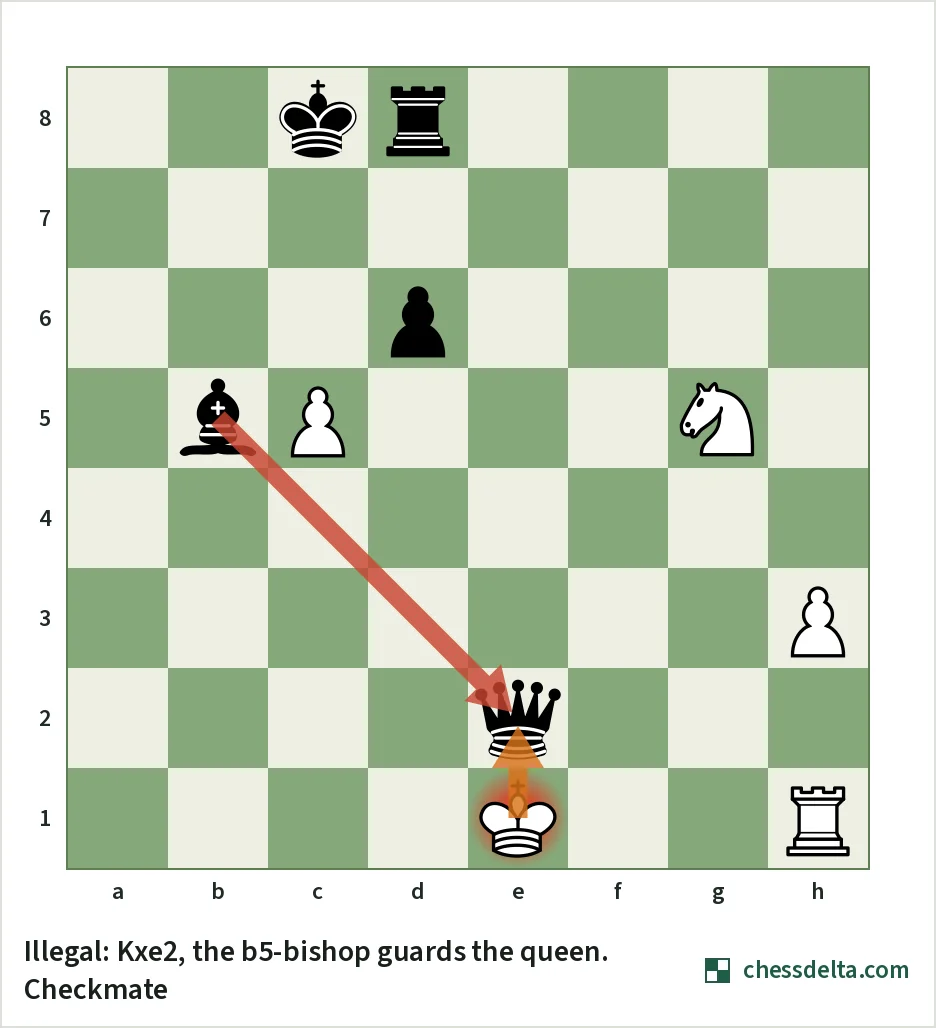
White has no legal move at all, so this is checkmate. One bishop, far across the board, turned a free queen into a lost game.
So before you grab a queen with your king, check every diagonal, file and rank that leads to its square.
Can the king take a queen that gives check next to it?
The king can take a queen that gives check from the next square, if that square is unguarded. But what if the queen checks from 2 or more squares away? Then it’s out of reach, and the king has to step away or block the check with another piece.
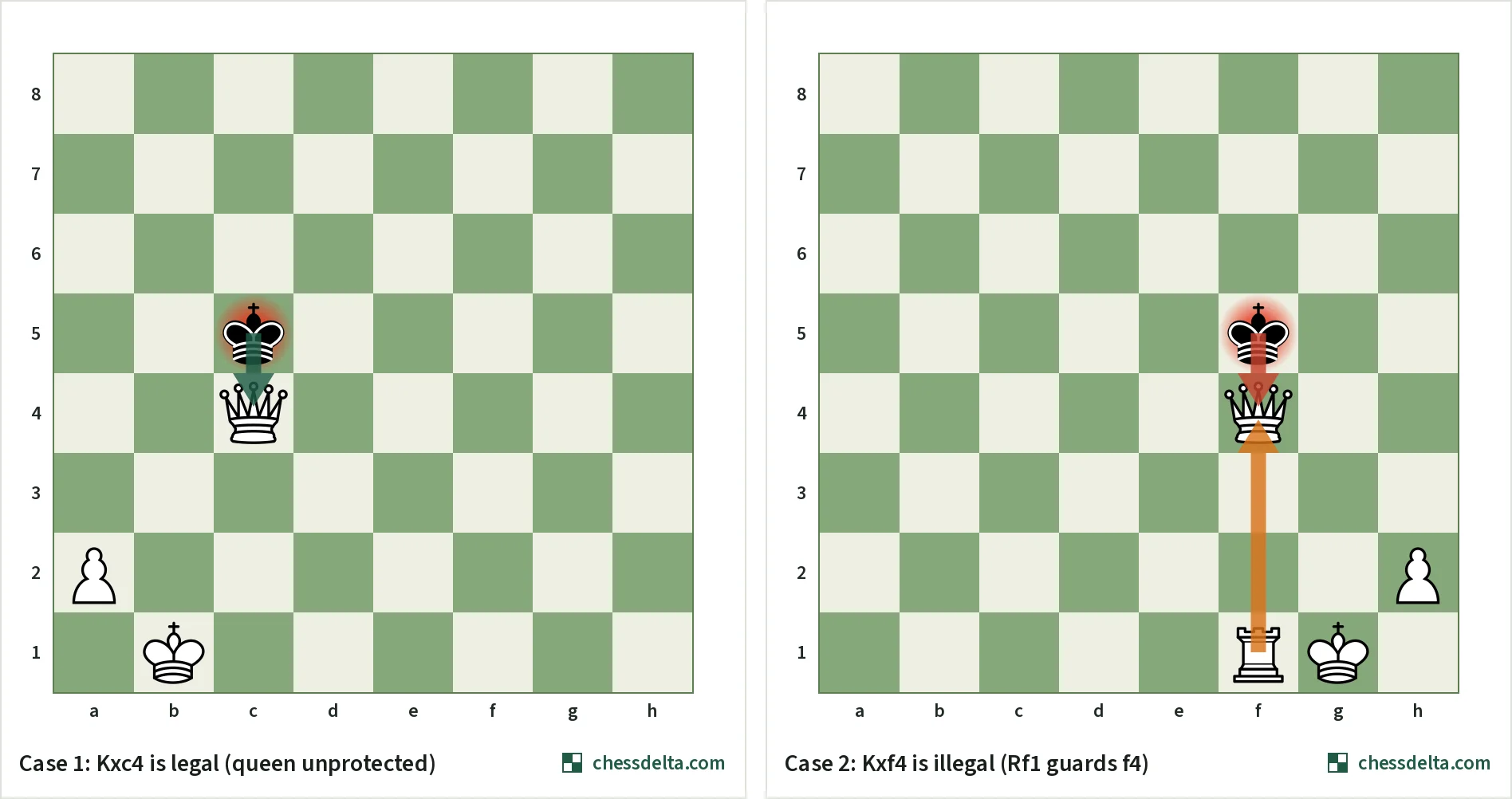
On the left board, White’s queen on c4 checks Black’s king on c5. Nothing protects c4, so Black can play 1…Kxc4. Black could also play 1…Kb6 or 1…Kd6, but 1…Kxc4 is the strongest move: it wins the queen for free.
On the right board, White’s queen on f4 checks Black’s king on f5. This time White’s rook on f1 guards f4 up the f-file, so 1…Kxf4 is illegal. Black’s only legal moves are 1…Ke6 and 1…Kg6.
Does a pinned piece still protect the queen?
A pinned piece still protects the queen. Under FIDE Article 3.9.1, a piece gives check even if moving it would expose its own king. So your king still can’t step onto that square.
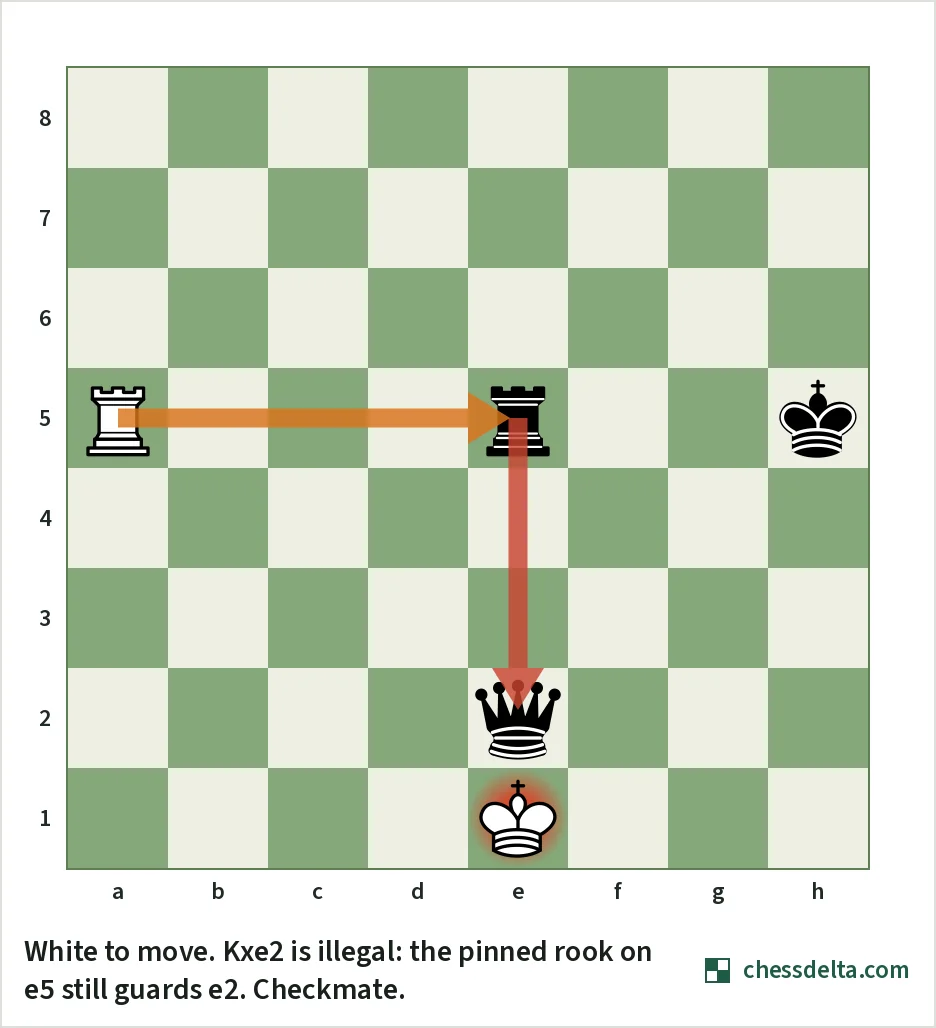
Here White’s rook on a5 pins Black’s rook on e5 to the king on h5. The black rook can’t leave the 5th rank. But it still guards e2 down the e-file, so 1.Kxe2 is illegal and White is checkmated.
Can the king capture other pieces?
The king can capture any enemy piece except the other king: a queen, rook, bishop, knight or pawn. It captures 1 square in any direction, including diagonally. And the rule never changes: the square must not be guarded by another enemy piece.
The king can also capture while it’s in check. Taking the checking piece is 1 of 3 ways out of check, along with moving the king and blocking.
To learn all 3, read our full guide to do you have to move your king in check.
Can a king take the other king?
A king can never take the other king. Article 1.4.1 says “capturing” the opponent’s king is not allowed. In fact, the 2 kings can’t even stand on next-door squares, because each would be moving into check.
For the full rule, read our guide to can a king kill a king in chess.
How do you checkmate with a protected queen?
A protected queen next to the enemy king is a common checkmate pattern. Why does it work? The king can’t take the queen, and the queen covers the escape squares.
Here’s what it looks like in a king and queen ending. Black’s king on a1 is checkmated.
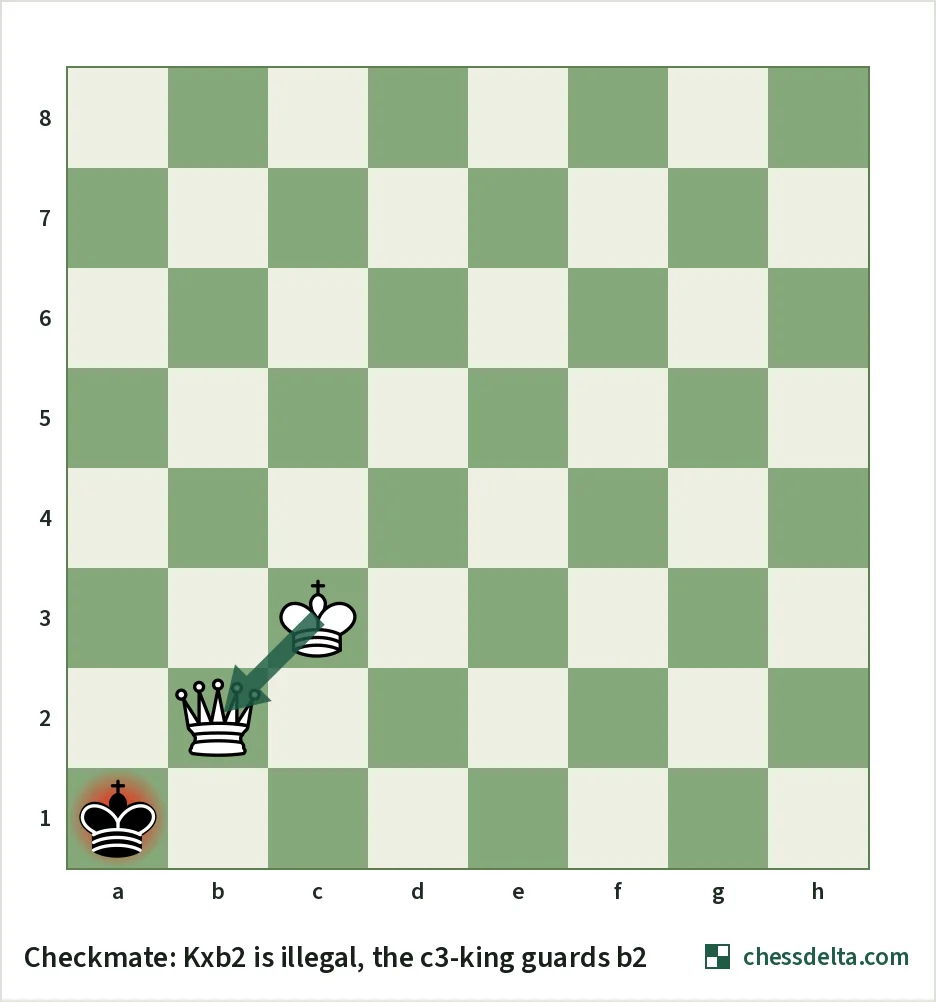
White’s queen on b2 checks the king on a1 and covers a2 and b1. And White’s king on c3 protects the queen, so Black can’t take it.
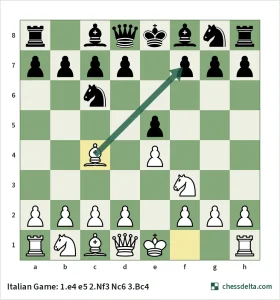
The Scholar’s Mate uses the same idea: 1.e4 e5 2.Bc4 Nc6 3.Qh5 Nf6 4.Qxf7#. The bishop on c4 guards f7, so Black’s king can’t take the queen.
Now compare 1.e4 e5 2.Qh5 Nc6 3.Qxf7+. Nothing guards f7 there, so 3…Kxf7 wins White’s queen for a pawn.
What happens if you take a protected queen with your king?
Taking a protected queen with your king is an illegal move. So what happens if you play it anyway? In a friendly game, you take it back and play a legal move.
In a FIDE standard game, the stakes are higher. The first illegal move gives your opponent 2 extra minutes. A second illegal move loses the game (Article 7.5.5).
In rapid and blitz, the same penalty applies if the arbiter or your opponent spots it. Once your opponent has made the next move, the illegal move stands (Articles A.5.2 and B.3). Online sites simply refuse the move.
To learn more, read our guide to illegal moves in chess.
FAQ
Can a queen take a king in chess?
No. A queen can attack the king, which is check, but no piece can capture a king (Article 1.4.1). If the king can’t escape the check, it’s checkmate and the game ends.
Can a king take a queen when in check?
Yes, if the queen is the piece giving check, it’s next to the king and it’s unprotected. Capturing the checking piece is a legal way out of check.
Can a king take a queen diagonally?
Yes. The king captures 1 square in any direction, diagonals included. The queen still has to be unprotected.
Can a queen take a queen in chess?
Yes. A queen can capture the enemy queen like any other piece, as long as the move doesn’t leave its own king in check.
Can a king take a pawn?
Yes. A king can take a pawn on any square next to it, if no enemy piece guards that square. Watch out for a pawn guarded by another pawn diagonally behind it.
Updated .