Quick answer: Learn the rules first, then three habits: check what every move attacks, castle in the first ten moves, and don’t bring your queen out early. Play games of 15 minutes or longer, do 15 minutes of puzzles a day, and learn one opening for White (the Italian Game) and one reply each to 1.e4 and 1.d4.
This guide is for anyone who knows how the pieces move, or is about to learn, and wants to stop losing the same way every game. It gives you an order to learn things in, the habits that fix most beginner losses, and the openings worth your time first.
What to learn first, in order
Learn these in this order. Each step makes the next one easier.
- The rules. How each piece moves, check and checkmate, castling, en passant, promotion and stalemate. Our chess rules guide and how the chess pieces move cover all of it.
- Chess notation. Moves like 1.e4 e5 2.Nf3 are how every book, video and website writes chess. Ten minutes with algebraic notation and you can follow all of them.
- Piece values. Pawn 1, knight 3, bishop 3, rook 5, queen 9. You need these to know whether a trade is good. See chess piece values.
- The basic checkmates. King and queen against king, and king and rook against king. If you can’t finish a won game, you’ll draw or lose it on time.
- Opening principles. Control the center, develop knights and bishops, castle. Our opening principles guide explains why.
- Simple tactics. Forks, pins, skewers and double attacks. Most beginner games are decided by one of these.
- One opening for each color. Only now. Openings make sense once you know what the moves are trying to do.
Habits that fix most beginner losses
Below about 1000 rating, most games are lost to a piece left undefended or a quick attack on the king. These four habits stop most of that.
1. Do a blunder check before every move
Before you touch a piece, ask two questions:
- What does my opponent’s last move attack?
- After my move, which of my pieces will be undefended?
Then look at every check, capture and threat your opponent will have after your move. It takes ten seconds and saves whole games.
Here’s a common way beginners lose material. After 1.e4 e5 2.Nf3 Nc6 3.Bc4 Nd4, the pawn on e5 looks free. White takes it with 4.Nxe5? and Black answers 4…Qg5!
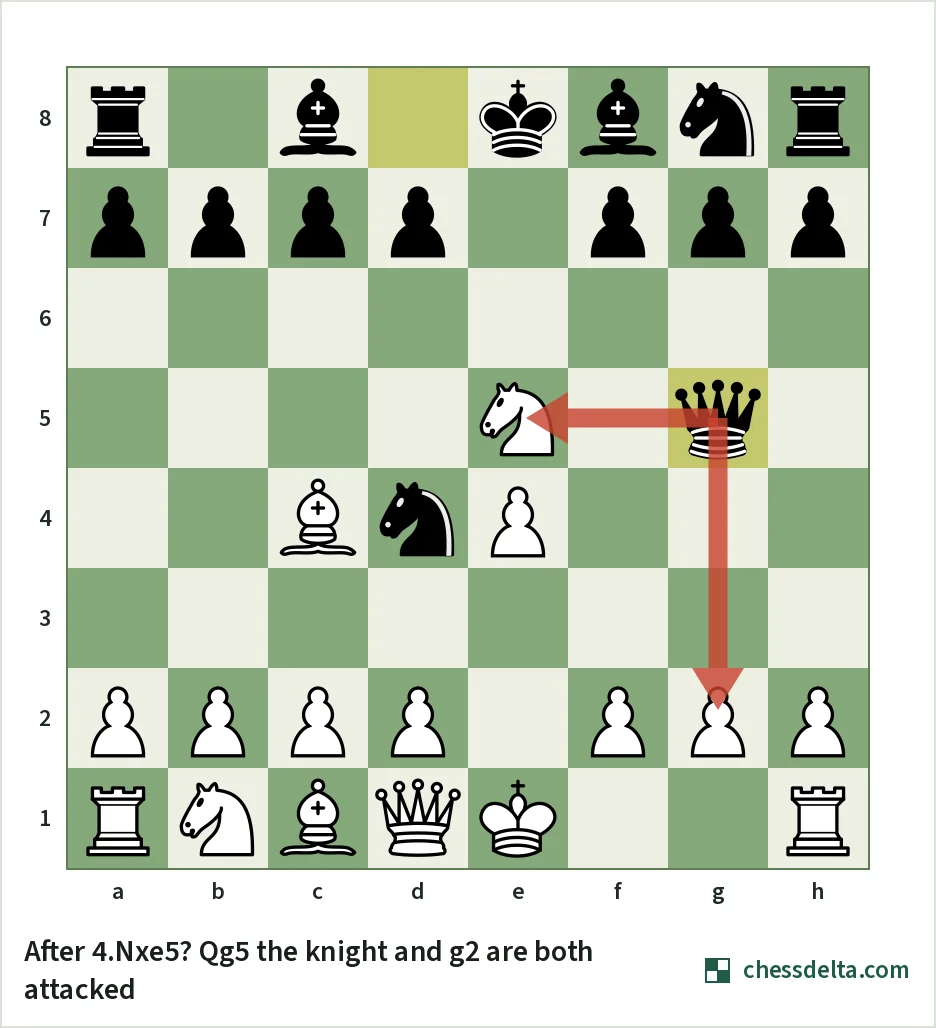
The queen now hits the knight on e5 and the pawn on g2 at the same time. White’s best is to castle and give the knight back. Greedy 5.Nxf7? loses straight away: 5…Qxg2 6.Rf1 Qxe4+ 7.Be2 Nf3 is checkmate. One blunder check (what can Black’s queen reach after I take?) avoids all of it. The simple 4.Nxd4 leaves White comfortably better.
2. Know how to stop Scholar’s Mate
Scholar’s Mate is the four-move checkmate that catches more new players than anything else. White’s queen and bishop both aim at f7, the square only Black’s king defends.
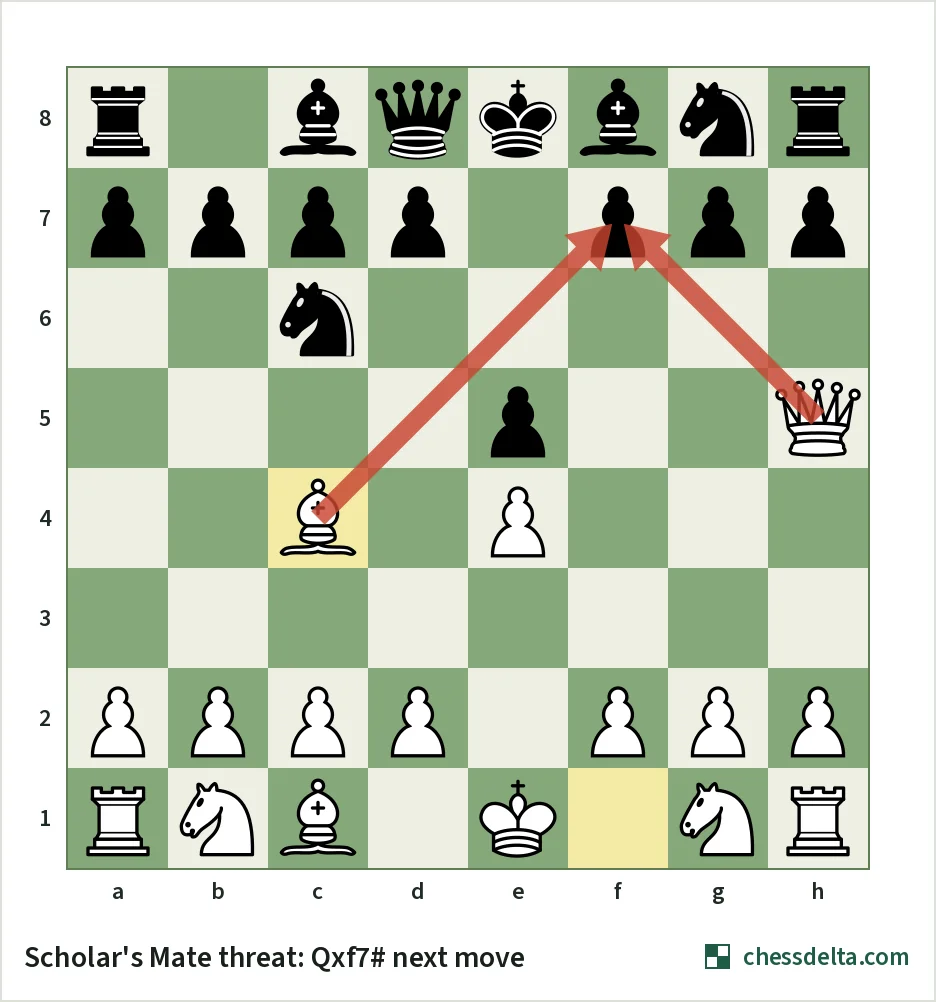
If Black plays the natural-looking 3…Nf6??, then 4.Qxf7 is checkmate. The fix is 3…g6, which blocks the queen’s path to f7 and attacks the queen.
White usually tries again with 4.Qf3, aiming at f7 a second time. Answer with 4…Nf6, which blocks the queen and develops a piece. Black is now at least equal, and White’s queen has moved three times while Black has been developing.
The same idea works against every early queen attack on f7 (or f2 if you’re White): block the line or defend the square, and develop with tempo.
3. Castle early
An uncastled king in the center gets attacked once the center opens. Aim to castle within your first ten moves. In most openings that means getting your knight and bishop off the back rank on the side you want to castle, then castling.
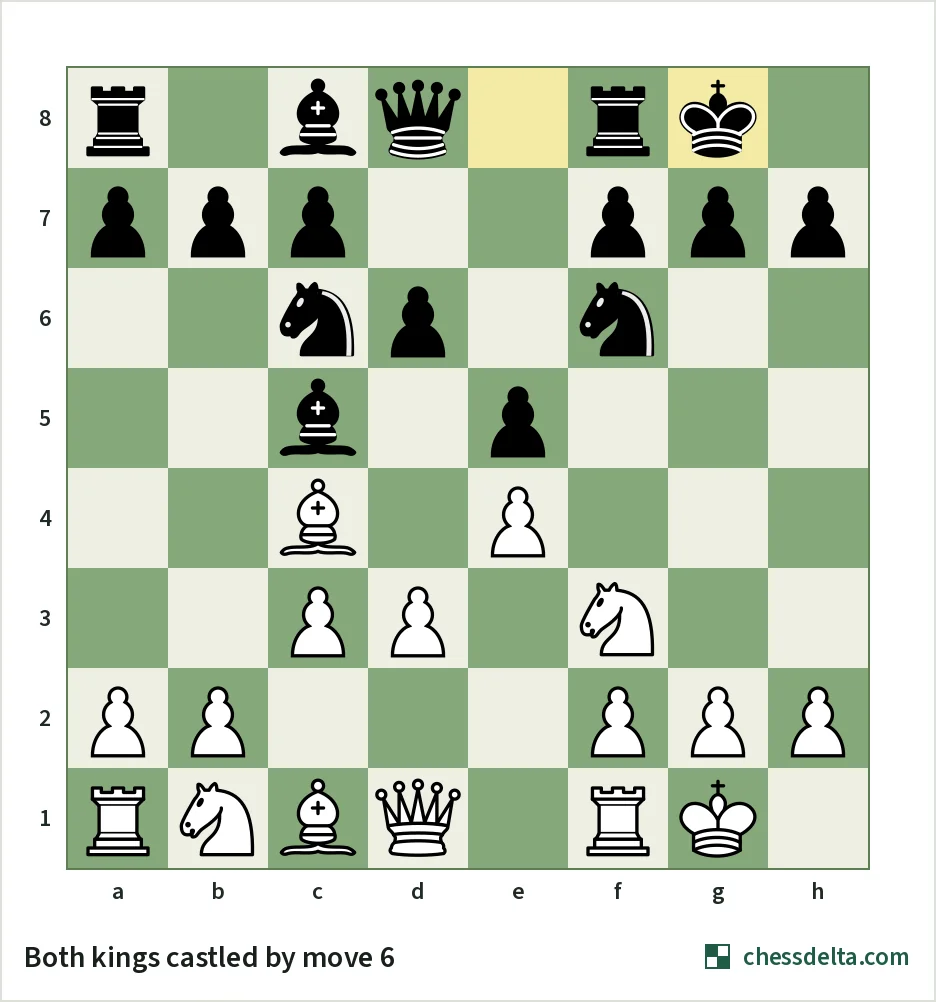
In this quiet Italian Game both sides have developed their kingside pieces, pushed center pawns and castled by move 6. That’s the shape to aim for. Kingside castling is usually quicker for beginners because only two pieces stand in the way. For the full rules, see when can you castle.
4. Don’t bring your queen out early
Your queen is your most valuable piece, so every time a knight or bishop attacks it, you lose a move running away. The Scholar’s Mate line above shows this: after 4…Nf6, White has made three queen moves and Black has developed two pieces. Develop knights and bishops first. Bring the queen out once you’ve castled.
Two more habits that save points
- Trade when you’re ahead. If you’re a piece up, swap pieces. Every trade makes your extra piece count for more.
- Use your clock. Beginners lose far more games by moving too fast than by running out of time. Play games where you have time to do your blunder check.
How to practice
You’ll improve faster with a little structure. Here’s a weekly plan that works for adults and older kids with 30 to 60 minutes a day.
- Play longer games. Use 15 minutes plus a 10-second increment (15|10) or longer. Bullet and 3-minute blitz train fast habits, including bad ones.
- Review every loss. Find the first move where things went wrong. Use the free computer analysis on Lichess or Chess.com only after you’ve looked yourself.
- Do puzzles daily. About 15 minutes of tactics puzzles a day. Easy ones are fine; speed of recognition is the point.
- Learn one endgame a week. Start with king and queen against king, then king and rook against king, then king and pawn against king.
- Watch or play over one annotated master game a week. Short, sharp games from the 1800s are ideal because the mistakes are easy to see.
For a longer plan by rating level, read how to get better at chess.
The best openings to learn first
Pick one opening as White and one reply to each of White’s two most common first moves. That’s three openings, and it covers most of your games. Learn the ideas, not long move lists.
As White: the Italian Game
1.e4 e5 2.Nf3 Nc6 3.Bc4. Every move develops a piece or takes the center, and the bishop on c4 aims at f7 straight away. It teaches the opening principles by playing them.
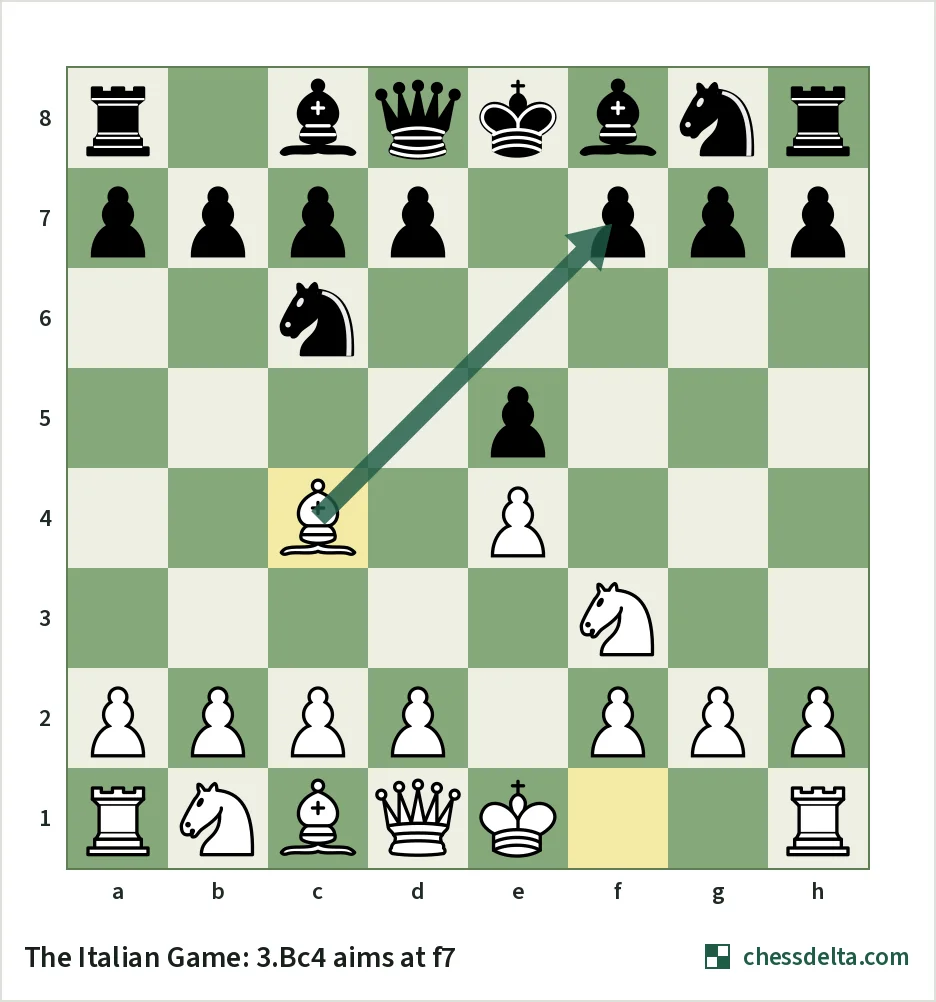
A simple plan: follow with c3, d3, castle, and later d4 when you’re ready to open the center. Our Italian Game guide covers Black’s replies and the traps to know on both sides.
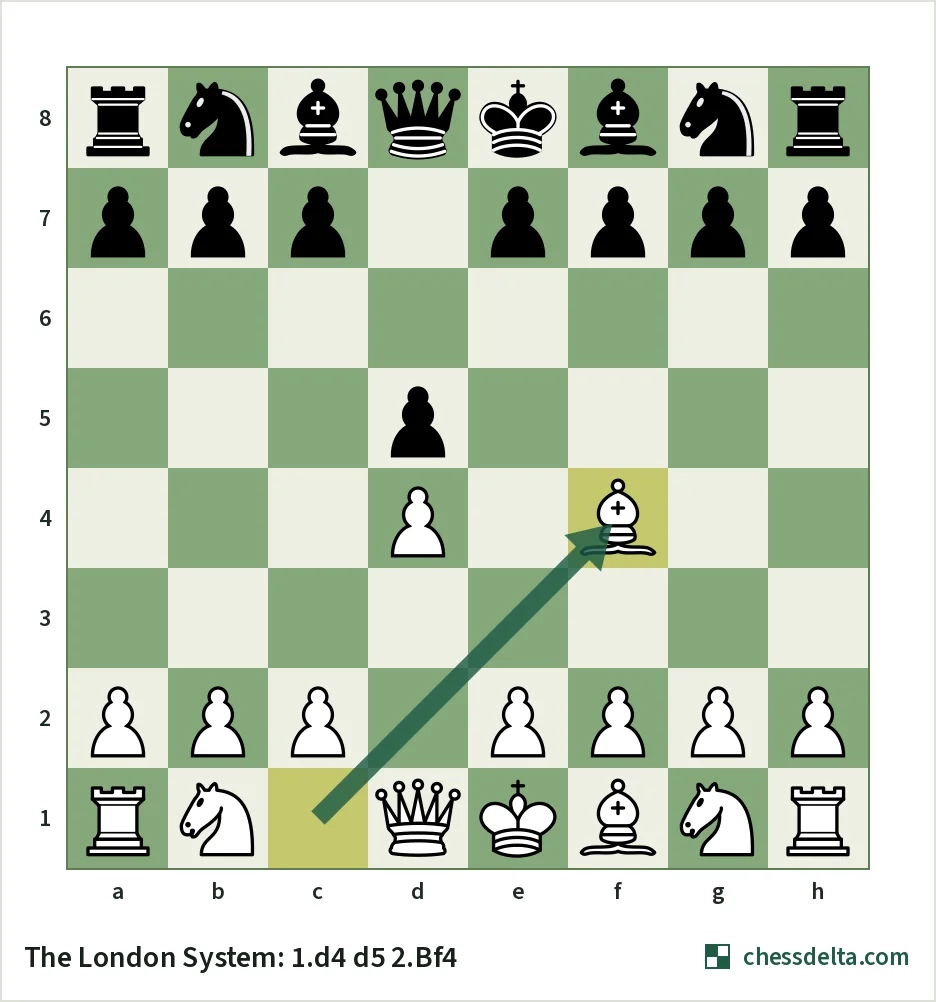
Alternative for White: the London System
1.d4 d5 2.Bf4, followed by e3, Nf3, c3 and Bd3 against almost anything. It suits players who’d rather play a familiar setup every game than learn a lot of lines. The downside is that it teaches less about open, tactical positions, which is where most beginner games are decided. We recommend starting with the Italian and adding the London later if you want a 1.d4 option.
As Black against 1.e4: 1…e5
Answer 1.e4 with 1…e5 and 2…Nc6. You get the same open, natural positions as the Italian Game, and when White plays 3.Bc4 you already know the ideas from the White side. Against the Italian, 3…Bc5 is the simplest reply.
If you prefer a more solid, less tactical game, the Caro-Kann (1.e4 c6 followed by 2…d5) is a good second choice once you’re comfortable.
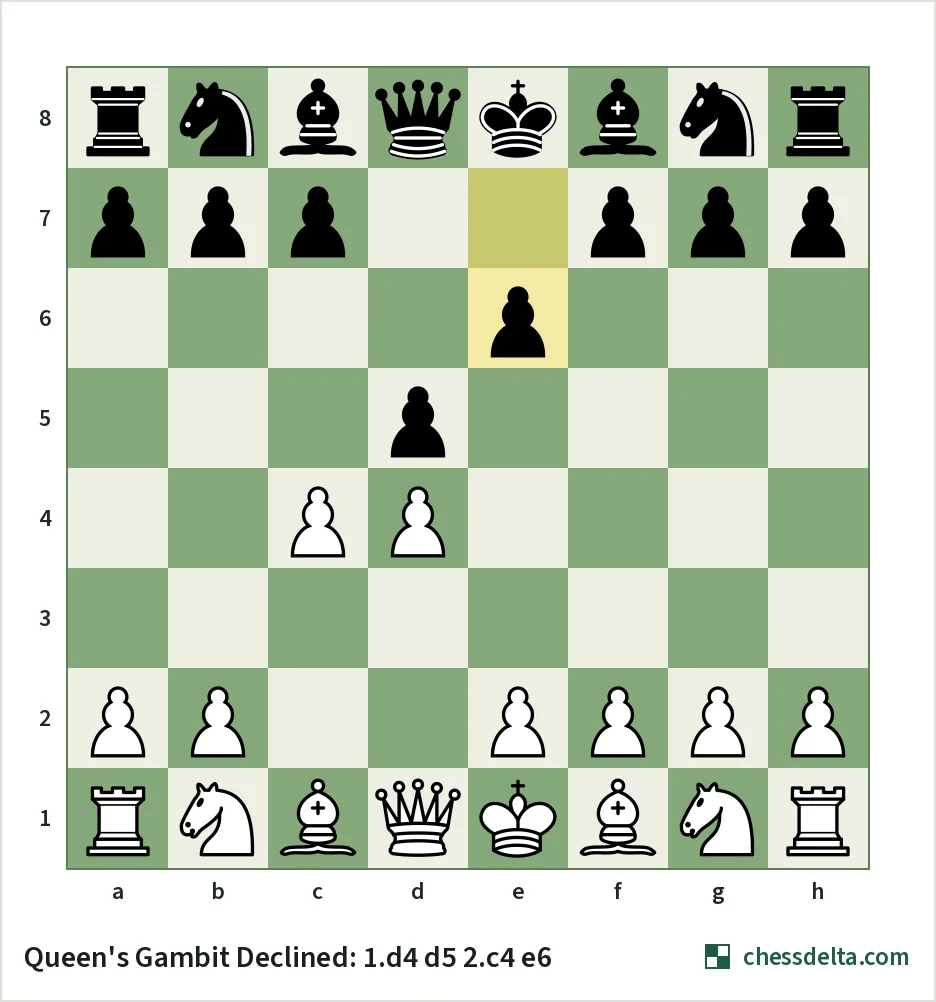
As Black against 1.d4: the Queen’s Gambit Declined
1.d4 d5 2.c4 e6. Black holds the d5 pawn, opens a diagonal for the dark-squared bishop and plans …Nf6, …Be7 and castling. It is solid, follows the opening principles and has been trusted at every level for over a century.
For the full list, see our guides to the best chess openings for White and the best chess openings for Black.
How chess ratings work
A chess rating is a number that predicts how you’ll score against other rated players. Win and it goes up, lose and it goes down. Beating a higher-rated player gains you more points than beating a lower-rated one. Most systems are based on the Elo system or its newer cousin, Glicko.
What beginners need to know:
- Ratings from different places don’t match. Lichess, Chess.com, US Chess and FIDE each run their own pool, so a “1200” means something different on each.
- New ratings move fast. Your first 20 or so games swing your number a lot while the system works out your level. Don’t read much into it yet.
- Starting points differ. Lichess starts every new player at 1500. Chess.com asks your level when you sign up and sets your first rating from that.
- Over-the-board ratings are separate. To get a US Chess rating, join US Chess and play a rated tournament. The lowest published FIDE rating is 1400.
The best use of your rating is to compare yourself with yourself over months, not with friends on a different site.
Where to play
- Lichess (lichess.org): free, no ads, open source. Free computer analysis of every game, puzzles and lessons.
- Chess.com: the largest site. Free to play; lessons, puzzles and game reviews are limited on the free plan, with more on paid memberships.
- ChessKid (chesskid.com): run by Chess.com, built for children, with safer chat settings.
- A local chess club. Playing across a real board against people who can explain what went wrong is the fastest way to improve. Find a chess club near you.
Most clubs welcome beginners and many run casual nights alongside rated tournaments. If you’re nervous, go to a casual night first.
Next steps
- Learn the rules properly: chess rules, en passant, pawn promotion and stalemate.
- Learn your first opening: the Italian Game.
- Learn the traps people will try on you: the Fried Liver Attack.
- Build a study routine: how to get better at chess.
FAQ
What should I learn first in chess?
The rules, including castling, en passant and promotion. Then piece values, the two basic checkmates (king and queen, king and rook) and the opening principles. Leave opening theory until last.
What is the best first move in chess for beginners?
1.e4. It opens lines for your queen and bishop, takes central space and leads to open games where you learn tactics fastest. 1.d4 is just as good objectively, but its positions tend to be slower.
How do I stop losing to Scholar’s Mate?
After 1.e4 e5 2.Qh5 Nc6 3.Bc4, play 3…g6 to block the queen and attack it. If White follows with 4.Qf3, play 4…Nf6. Never play 3…Nf6?? in that position, because 4.Qxf7 is checkmate.
How long does it take to get good at chess?
Most adults who play and study a few times a week can stop hanging pieces and reach the middle of the online rating pool within six to twelve months. Getting genuinely strong takes years. Steady practice matters more than talent.
Can I learn chess by myself?
Yes. Free sites like Lichess have lessons, puzzles and computer analysis, and plenty of strong players learned alone. A club or coach speeds things up because someone can spot the habits you can’t see in your own games.
Is chess hard to learn?
The rules take an afternoon. Playing well takes longer, but the first big jump comes quickly once you stop leaving pieces undefended. See is chess hard to learn for more.