Quick answer: To avoid stalemate in chess, check that your opponent still has a legal move before every move in a won ending. With a queen, push the king to the edge and leave it at least 1 free square. Bring your own king up, then take the last square only with check. King and queen always beat a lone king.
You’ve done the hard work. You’re a queen up, the enemy king is cornered, and then 1 careless move hands your opponent a draw.
Below are the positions where winning players throw the game away, and the moves that win instead. Stalemate is one of the draw rules in our full chess rules guide.
What is stalemate, and why does it cost you the win?
Stalemate is a position where the player to move has no legal move and is not in check. The game ends at once in a draw (FIDE Laws, Article 5.2.1). Your extra material counts for nothing.
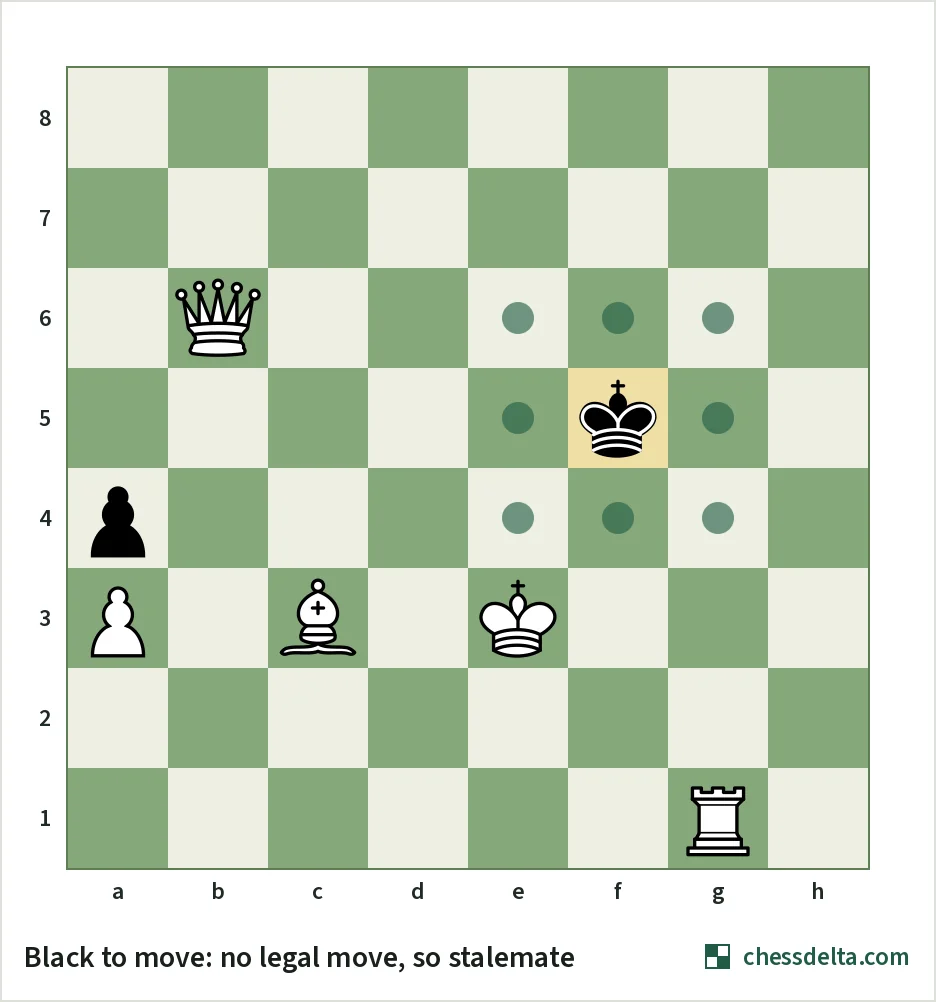
Look at this position with Black to move. All 8 squares around the black king on f5 are covered, but the king itself isn’t attacked.
Black’s pawn on a4 is blocked by the pawn on a3. So Black has 0 legal moves, and the game is drawn, even though White is a queen, a rook and a bishop up.
To learn more, read our full guide to what is stalemate in chess, with the full rule and the other draws.
Why do I keep getting stalemate?
You keep getting stalemate because you take away the enemy king’s last square without giving check. It almost always happens in a won ending, when you stop counting your opponent’s moves. Watch for these 5 habits, which cause nearly every accidental stalemate:
- A quiet queen move near the king. The queen covers every free square, but it isn’t check.
- Grabbing the last loose pawn. That pawn was your opponent’s only legal move.
- Forgetting that blocked pawns can’t move. If the king is boxed in and the pawns are stuck, any quiet move is stalemate.
- Promoting to a queen on autopilot. Sometimes the new queen covers the last square.
- Taking a piece your opponent offers. The losing side throws its last piece at you to reach stalemate on purpose.
The good news? 1 question fixes all 5. Before every move, ask: “After this, does my opponent have a legal move?” If the answer is no and your move isn’t check, play something else.
Now let’s see each habit on the board.
How do you avoid stalemate with a king and queen?
King and queen against a lone king is always a win with White to move. From any legal position, White mates in 10 moves or fewer. So stalemate is the only way to draw it.
So how do you make sure you never fall into it? The safe technique has 3 rules:
- Box the king toward the edge with quiet queen moves. Don’t chase it with checks.
- Once it’s on the edge, leave it a square and stop moving the queen. Walk your own king over instead.
- Count its moves before every queen move. Take the last free square only with a check that is mate.
The corner trap: the queen a knight’s move away
The most common queen stalemate puts the queen a knight’s move from a king in the corner. Why is that square so dangerous? From there, the queen covers all 3 squares next to the corner.
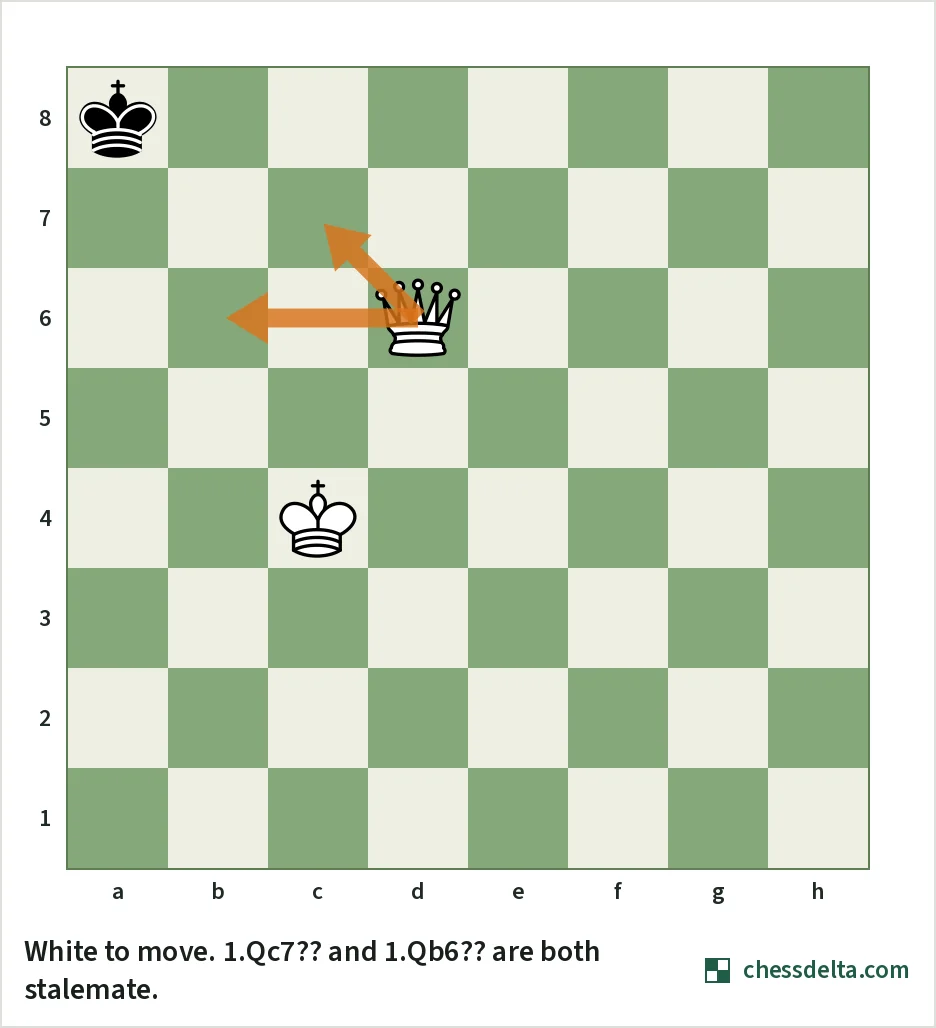
Here White has a king on c4 and a queen on d6. The black king on a8 has 2 free squares, a7 and b7. Both 1.Qc7?? and 1.Qb6?? take them away without check, and the game is drawn.
So what should White play? The box is already built, so bring the king. After 1.Kb5 Kb7 2.Qd8 Ka7 3.Kc6 Ka6 4.Qa8#, Black’s last 2 moves are forced.
If Black answers 1…Ka7 instead, 2.Kc6 still mates in 2 more moves. And don’t reach for 1.Qb8+?? either, a different blunder: 1…Kxb8 takes the queen.
The edge trap: kings facing each other
The edge trap comes right after you do the hard part well. Your king faces the enemy king on the edge, and a quiet queen move finishes the box instead of giving mate.
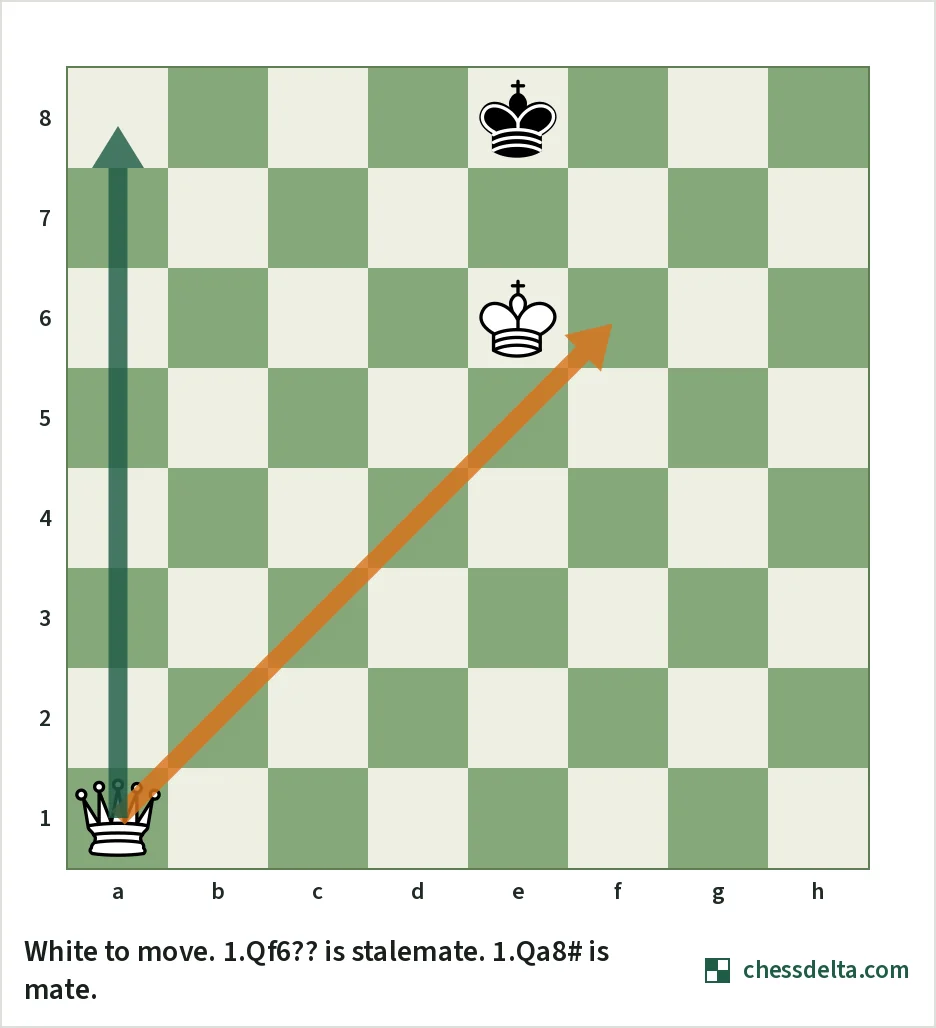
The white king on e6 covers d7, e7 and f7, so the black king on e8 has 2 free squares, d8 and f8. 1.Qf6?? covers both without check, which is stalemate.
Now spot the difference. 1.Qa8# and 1.Qh8# cover the same squares with check, which is mate.
Give the king a square, then bring your king
When the enemy king is on the edge and your queen is close, step back and give the king room to breathe. It feels backwards, but it lets your king walk over and cover the escape squares.
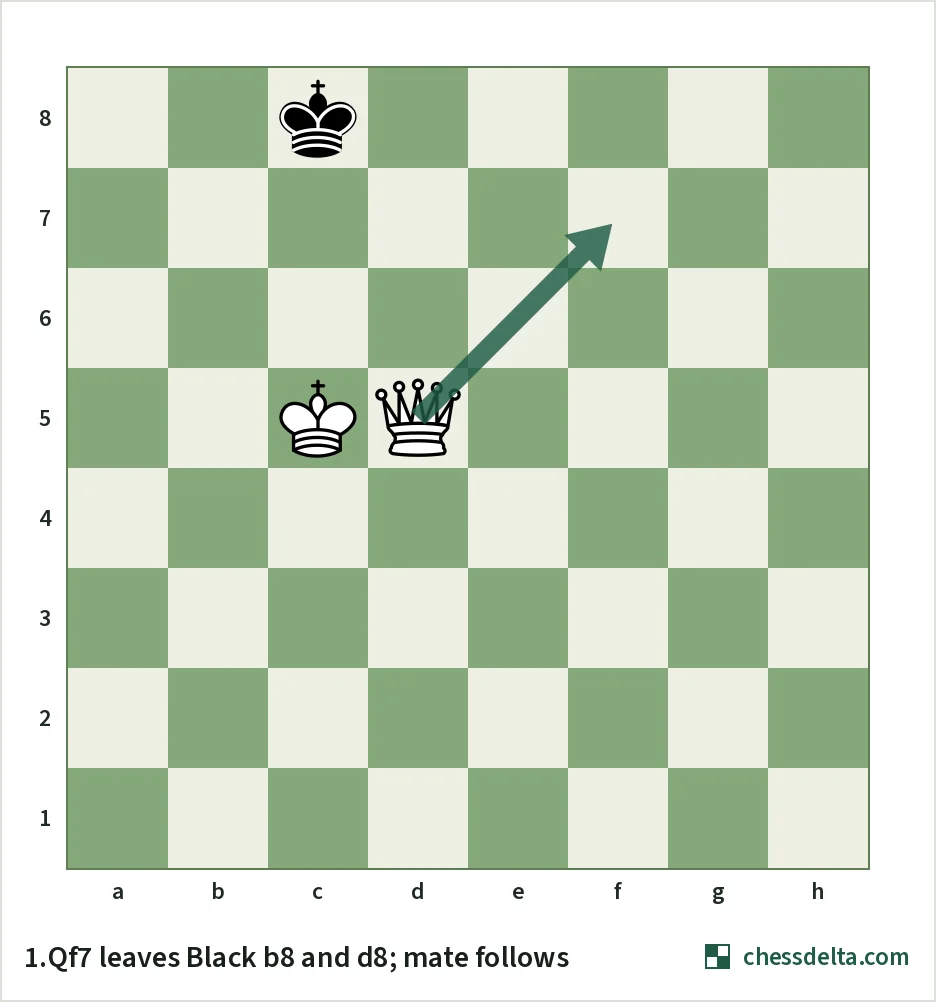
White has a king on c5 and a queen on d5, and the black king is on c8. After 1.Qf7, Black has 2 moves, 1…Kb8 and 1…Kd8. Whichever side Black picks, your king follows, and the queen mates:
- 1…Kb8 2.Kb6. Then 2…Ka8 3.Qb7# or 2…Kc8 3.Qc7#.
- 1…Kd8 2.Kd6 Kc8 3.Qc7#. Black’s 2nd move is forced.
Want it faster? 1.Kb6 is even quicker: 1…Kb8 is forced, then 2.Qd8#. But avoid 1.Qd7+, 1.Qd8+ and 1.Qb7+, which put the unprotected queen next to the black king, and Black takes it.
Do too many checks make the game a draw?
No, too many checks don’t make the game a draw. There’s no rule that a number of checks in a row draws the game. Checks only lead to a draw if they repeat the same position or run out the move count.
So which FIDE draw rules can apply? Threefold repetition, claimed by the player to move (Article 9.2), and the 50-move rule (Article 9.3). Fivefold repetition and the 75-move rule draw automatically (Article 9.6).
To learn more about how a repetition claim works, read our guide on can you repeat moves in chess.
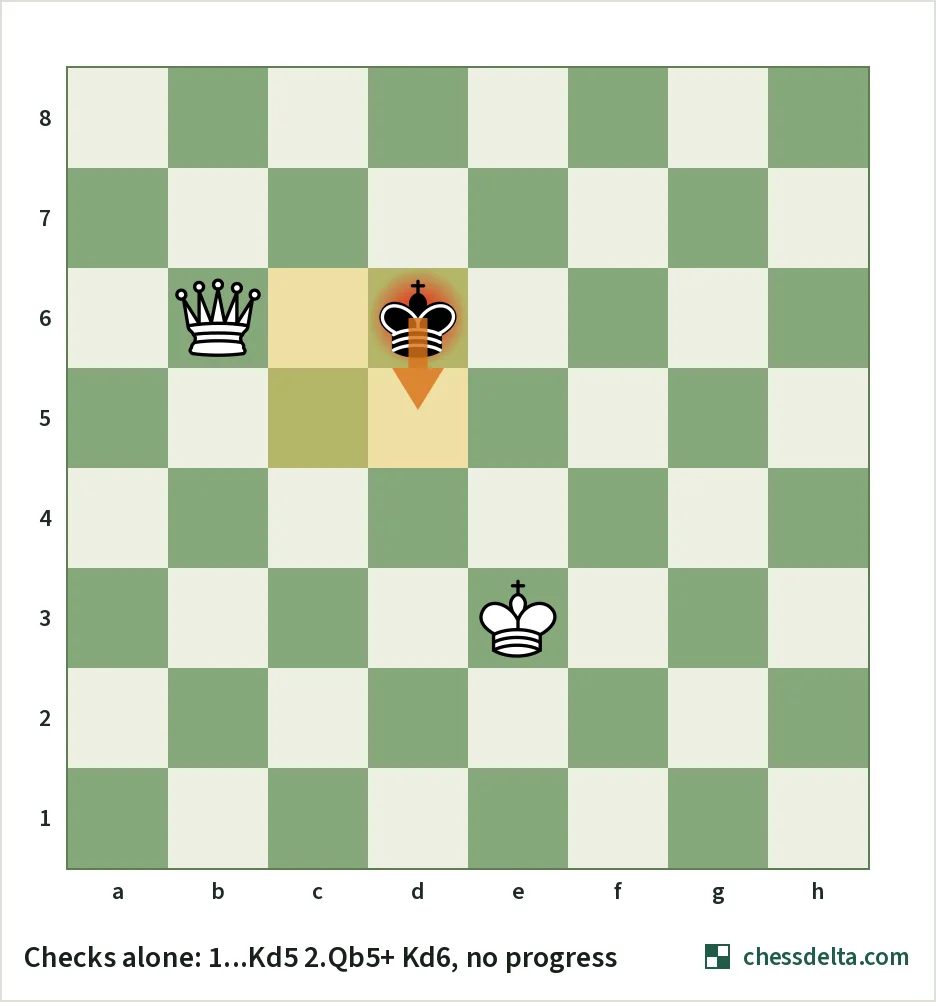
Random checks do waste your time, though. Here the black king on d6 steps to d5, White checks with 2.Qb5+, and the king walks back to d6. Nothing has changed.
The good news is that the position is still a win. White mates in 6 moves or fewer, whatever Black plays first. Use quiet queen moves to shrink the box, and save the checks for the mate.
Why can taking the last pawn cause stalemate?
Taking the last pawn can cause stalemate because that pawn was your opponent’s only way to move. Once it’s gone, a boxed-in king has nothing left to play.
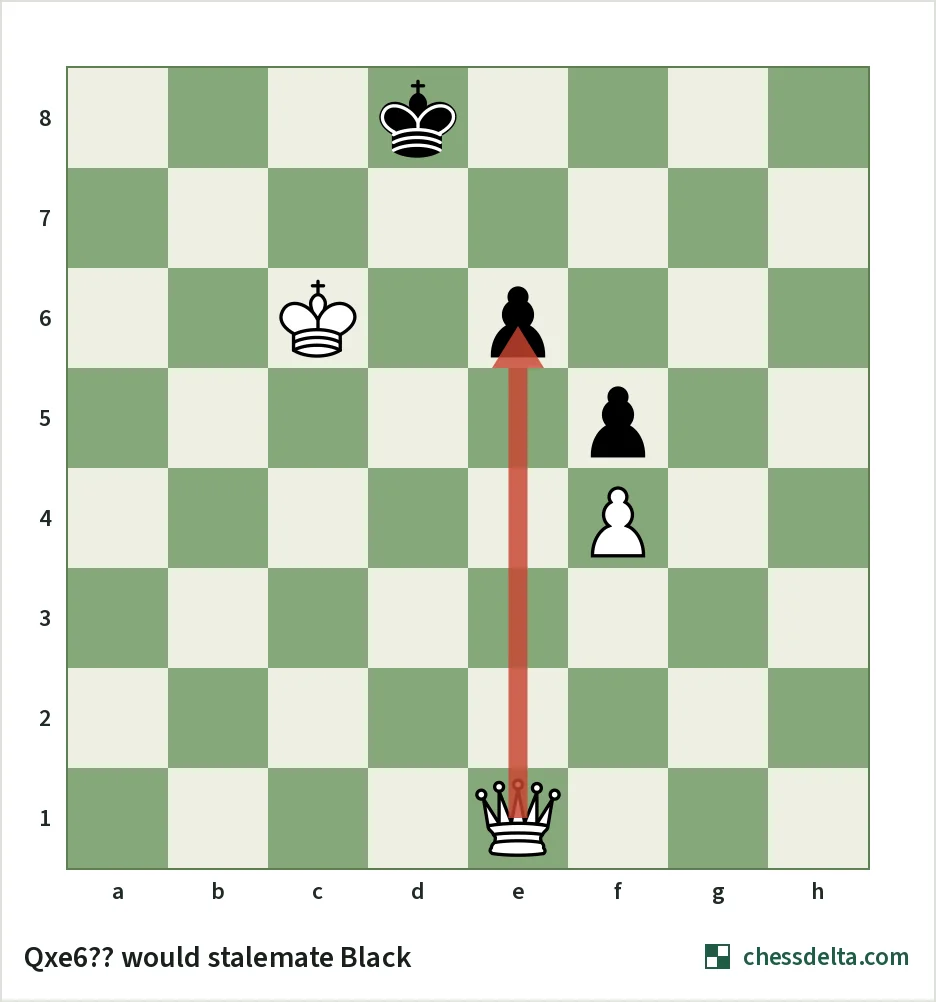
White has a king on c6, a queen on e1 and a pawn on f4. Black has a king on d8 and pawns on e6 and f5. The f5 pawn is blocked, but the e6 pawn can still move to e5.
1.Qxe6?? looks natural, but it’s stalemate. Count the black king’s possible squares: c7, c8, d7, e7 and e8.
The white king covers c7 and d7, and the queen on e6 covers c8, d7, e7 and e8. With the e-pawn gone, Black has no legal move.
So leave the pawn alone and keep playing for mate. A quiet move like 1.Qb4 takes e7 away while Black still has pawn moves, so there’s no stalemate.
What if the king is boxed in and its pawns are blocked?
If the enemy king has no squares and its pawns are blocked, every move you make must be check. A quiet move with any other piece is stalemate.
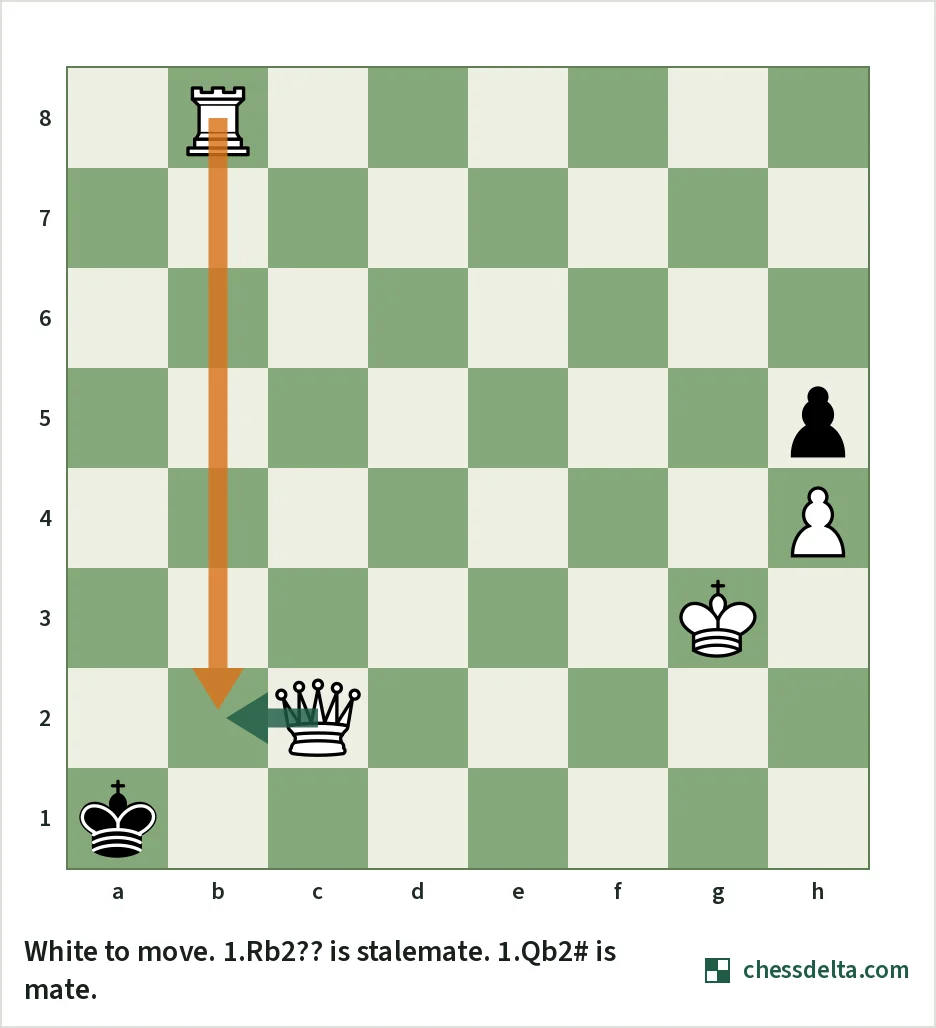
Here the black king on a1 can’t move, because the queen on c2 covers a2, b1 and b2. Black’s pawn on h5 is blocked by the pawn on h4, and Black isn’t in check yet.
White has 5 mates in 1: 1.Qb2#, 1.Qb1#, 1.Qa4#, 1.Ra8# and 1.Rb1#. But 12 of White’s 14 rook moves are stalemate, including the natural 1.Rb2??, and so are all 6 king moves.
The lesson? You don’t need more pieces near the king. You need check.
When should you promote to a rook instead of a queen?
Promote to a rook when a new queen would take away the enemy king’s last square without check. A pawn can promote to a queen, rook, bishop or knight (FIDE Laws, Article 3.7.3.3).
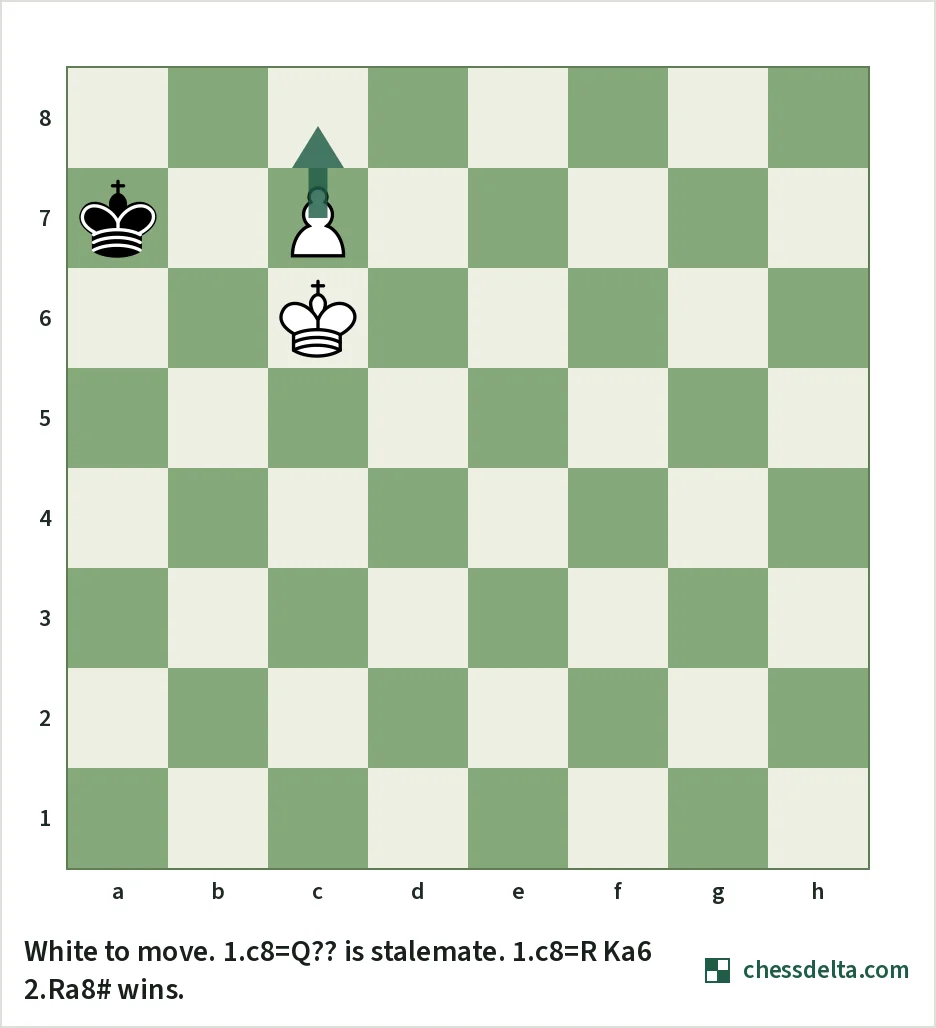
Why does the queen fail here? The white king on c6 covers b6 and b7, and after 1.c8=Q?? the queen covers a6, a8 and b8 as well. The black king on a7 has no square and isn’t in check, so it’s stalemate.
A rook doesn’t cover a6, and that’s the point. After 1.c8=R, Black’s only move is 1…Ka6, and 2.Ra8# is mate.
To learn more, read our full guide on what happens when a pawn reaches the other side, with every promotion choice.
How do you spot a stalemate trap set by the losing side?
You spot a stalemate trap when a losing opponent offers you a free piece. So ask why it’s free. If their king has no moves, that piece may be their last legal move, and taking it gives them the draw.
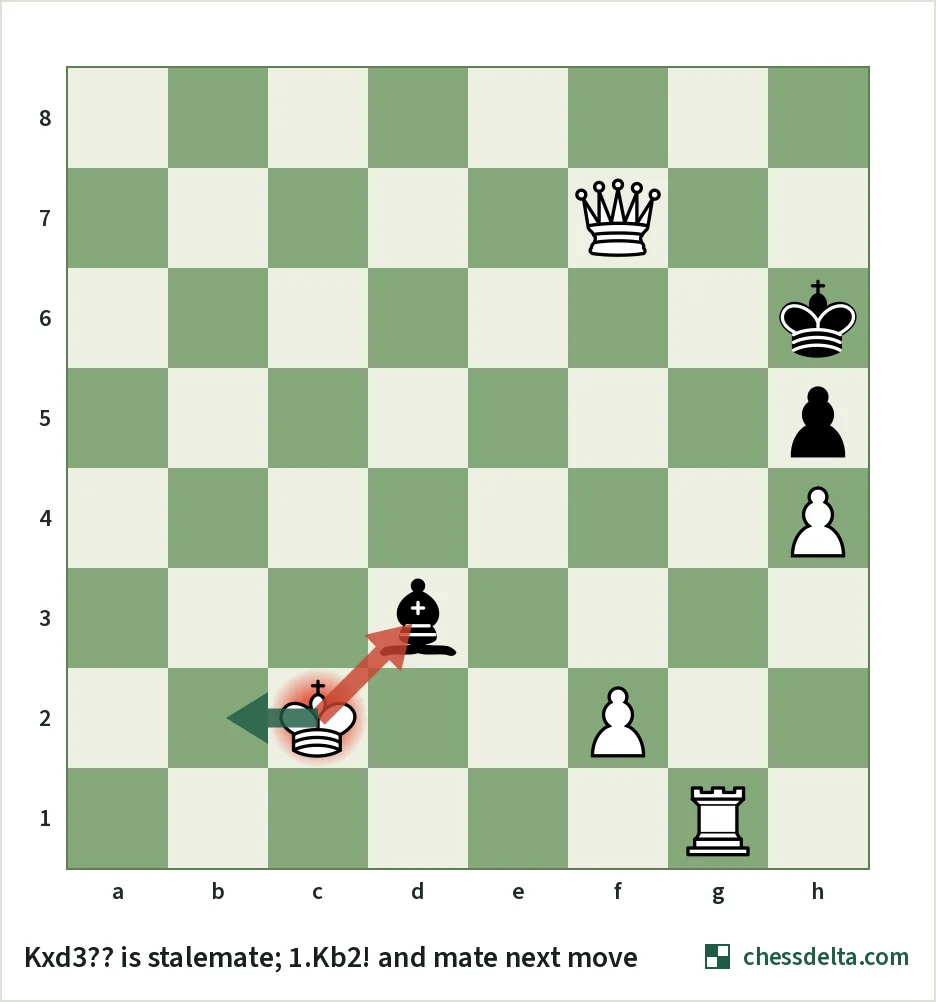
Black’s bishop on d3 checks the white king on c2. The black king on h6 has no free square, and the pawn on h5 is blocked. The bishop is Black’s only piece that can move.
1.Kxd3?? is stalemate. Step out of check instead with 1.Kb2, 1.Kc1, 1.Kc3 or 1.Kd2, and White mates next move against any reply, usually with 2.Qg7#.
If Black plays 1…Bg6, take it with 2.Qxg6#. Just avoid 1.Kb3 and 1.Kd1, which let the bishop check again.
Losing players pull the same trick with a rook that keeps checking your king. To learn more, read our full guide to what is stalemate in chess, which shows the rook version.
FAQ
Can a king and queen always checkmate a lone king?
Yes, a king and queen can always checkmate a lone king, as long as the queen can’t be taken at once. With correct play, mate takes 10 moves or fewer.
Is stalemate a win for the player who has more pieces?
No, stalemate is a draw, whatever the material. Each player scores half a point. See stalemate vs checkmate for the one difference that decides the result.
Can you stalemate with a king and rook?
Yes, you can stalemate with a king and rook, the same way: a quiet rook or king move that takes the last free square. King and rook against a lone king is also always a win if the rook can’t be taken at once, with mate in 16 moves or fewer.
What happens when only the king is left?
The game goes on. A lone king can still be checkmated, and it can still be stalemated. Read what happens when only the king is left for the rules and the draws that can follow.
Is it stalemate if the king can’t move but a pawn can?
No, it isn’t stalemate if a pawn can still move. Stalemate needs every piece and pawn on that side to be stuck. If a pawn can move, your opponent must play a legal move, and the game goes on.
Read next
- Chess rules: every rule in one place, including all the draws.
- What is stalemate in chess: the FIDE rule, more examples and the stalemate trick.
- Stalemate vs checkmate: the same box, with and without check.
- What happens when only the king is left: the lone king endings.
- Chess for beginners: what to learn next once you know the rules.
Updated .