Quick answer: The London System is a setup for White: 1.d4, 2.Bf4, then e3, Nf3, c3, Bd3, Nbd2 and h3. You can play it against almost any Black defense. The main line is equal, with a tiny edge for White, so the London won’t win the opening for you. What it gives you is a sound position and the same plans in most games.
At a glance
- Moves: 1.d4 d5 2.Bf4, or 1.d4 d5 2.Nf3 Nf6 3.Bf4.
- Type: Queen’s pawn system. ECO codes D00 and D02 against 1…d5, A46 and A48 against 1…Nf6.
- White’s idea: bishop to f4 before e3, a pawn triangle on c3, d4 and e3, then e4 or a knight on e5.
- Black’s main replies: …c5 with …Qb6, a bishop trade with …Bd6, or the King’s Indian setup with …g6.
- Good for: beginners and club players who want one setup with little theory.
What is the London System?
The London System, also called the London opening, is a setup and not a single line. White puts the dark-squared bishop on f4 and builds the same pawn triangle against almost any defense. It sits with the queen’s pawn openings in our chess openings directory.
The name comes from the London tournament of 1922, where the opening appeared 7 times. And it’s not just a club opening: Magnus Carlsen, Gata Kamsky and Levon Aronian have all played it often.
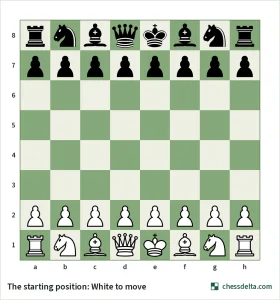
The London System setup: 1.d4 d5 2.Bf4
The main line runs 1.d4 d5 2.Bf4 Nf6 3.e3 e6 4.Nf3 c5 5.c3 Nc6 6.Nbd2 Bd6 7.Bg3 O-O 8.Bd3. Step through it on the board below, then check why each move is there.
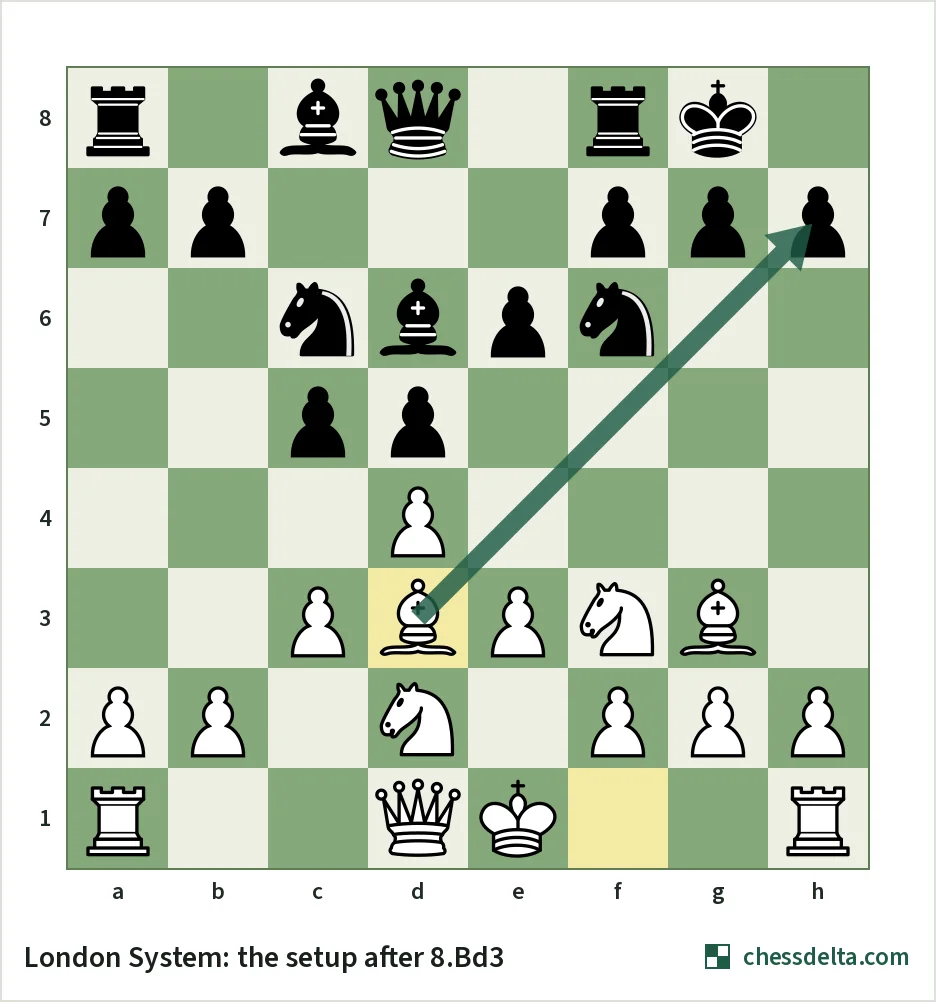
- 2.Bf4. The bishop comes out before e3 shuts it in.
- 3.e3 and 5.c3. The pawns on c3, d4 and e3 form a triangle, and each one is guarded by a pawn.
- 4.Nf3 and 6.Nbd2. One knight watches e5. The other supports e4 and leaves c3 for the pawn.
- 7.Bg3. Don’t take on d6. If Black takes on g3, recapture with the h-pawn and your rook gets a half-open h-file.
- 8.Bd3. The bishop points at h7. Castle next.
- h3. Play it when Black can chase the bishop with …Nh5, so the bishop can drop back to h2. A typical case is 6…Be7 7.h3.
So where does that leave you? After 8.Bd3 the game is equal, with a tiny edge for White. That small edge is the reason to prefer 7.Bg3 over the trade 7.Bxd6, which is dead level.
Should you play 2.Bf4 or 2.Nf3?
Play 2.Bf4. Both moves reach the same London System setup most of the time, but 2.Bf4 keeps the g1 knight at home. Why does that matter? Because of what happens when Black attacks b2.
Opening databases split it by move order. 1.d4 d5 2.Nf3 Nf6 3.Bf4 is the Queen’s Pawn Game: London System. 1.d4 d5 2.Bf4 is the Accelerated London System.
The 2.Nf3 problem. After 1.d4 d5 2.Nf3 Nf6 3.Bf4 c5 4.e3 Nc6 5.c3 Qb6 6.Qb3 c4 7.Qc2, Black plays 7…Bf5 and hits your queen.
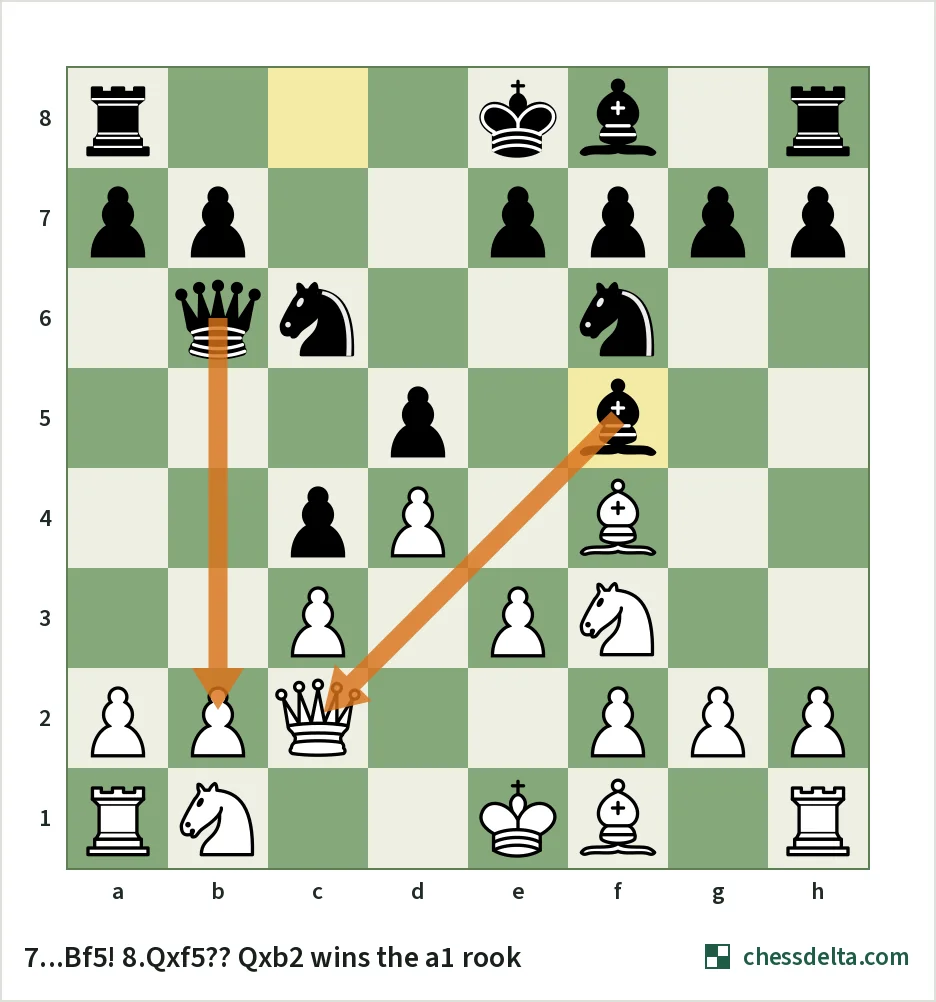
Why not just take the bishop? Because 8.Qxf5?? Qxb2 wins the rook on a1, and Black is winning. So White has to retreat with 8.Qc1, and the game is equal but tilts slightly toward Black.
The 2.Bf4 fix. Develop the queen’s knight first: 1.d4 d5 2.Bf4 Nf6 3.e3 c5 4.c3 Nc6 5.Nd2 Qb6 6.Qb3 c4 7.Qc2. Here White is slightly better.
And the bishop trick now fails: 7…Bf5? 8.Qxf5 Qxb2 9.Qb1. The b1 square is free, so the queen covers the rook. White keeps an extra bishop for 2 pawns.
If you still prefer 2.Nf3, meet 4…Nc6 with 5.Nbd2 and save c3 for later.
The ideas for both sides
White’s plan
- Finish the setup and castle kingside.
- Break in the center with e4, or put a knight on e5.
- Keep the f4 bishop. It retreats to g3 or h2 instead of being traded for a knight.
- Aim the d3 bishop and the queen at h7 once Black has castled.
Black’s plan
- Attack d4 and b2 early with …c5 and …Qb6.
- Offer to trade White’s best bishop with …Bd6.
- Chase the bishop with …Nh5 when it has no retreat.
- Or fianchetto with …g6 and push …e5.
How to play the London System against each defense
Against …d5 and …e6
Against …d5 and …e6 you get the main line above. After 8.Bd3 you choose between the e4 break and Ne5. Which one? Let Black’s 8th move decide.
If Black plays 8…b6, push 9.e4 at once, and White is slightly better. Against 8…Qe7, the top choice is 9.Ne5.
Against …c5 and …Qb6
With …c5 and …Qb6, Black attacks b2, which the f4 bishop no longer guards. So how do you defend it? That depends on where your c-pawn is.
- Pawn still on c2: play Nc3. After 1.d4 d5 2.Bf4 c5 3.e3 Qb6 4.Nc3, White is slightly better. Taking on b2 runs into Nb5, and White is clearly better.
- Pawn already on c3: play Qb3. After 1.d4 d5 2.Bf4 c5 3.e3 Nc6 4.c3 Qb6 5.Qb3 c4 6.Qc2, the game is equal.
Against the King’s Indian setup
In the King’s Indian setup, Black plays …Nf6, …g6, …Bg7 and …d6, then aims for …e5. You only need to change 2 details: the bishop goes to e2, and h3 comes early.
1.d4 Nf6 2.Bf4 g6 3.Nf3 Bg7 4.e3 d6 5.h3 O-O 6.Be2
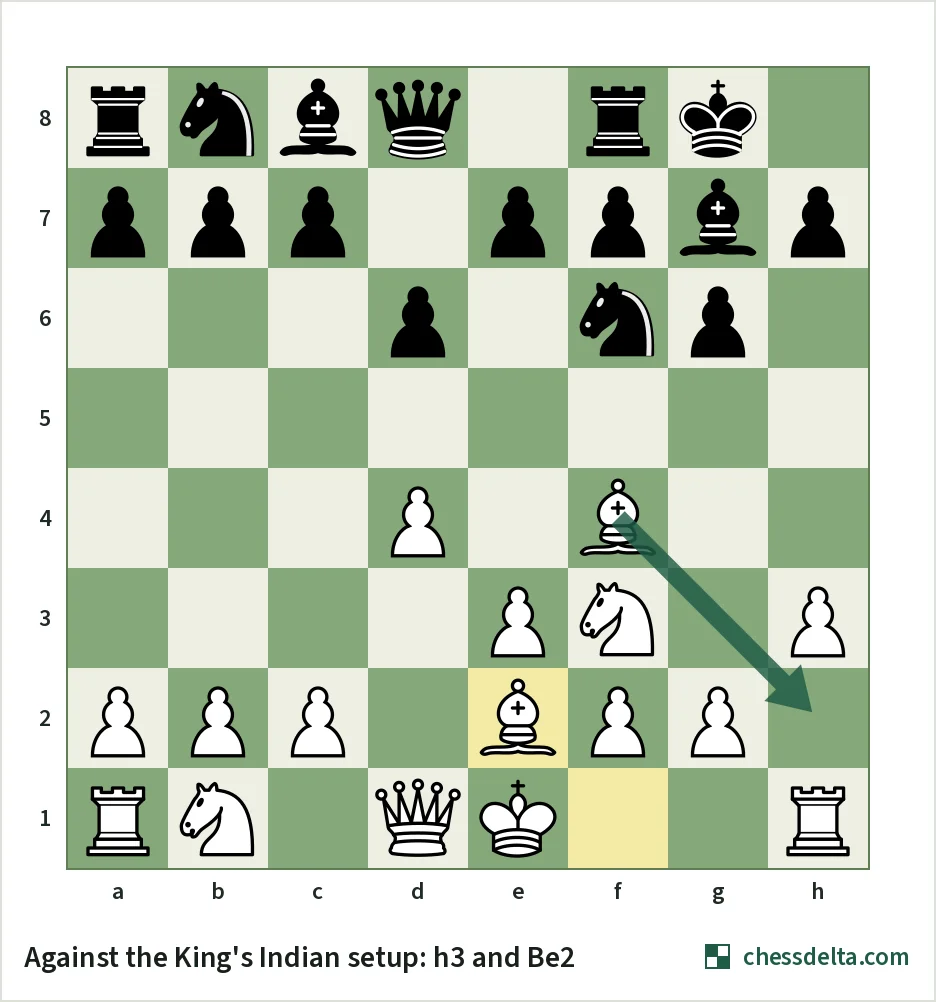
Why those 2 changes? On e2 the bishop can’t be forked by …e5 and …e4. And the h3 pawn gives the f4 bishop a home on h2.
After 6.Be2 the game is equal.
After 6…Nbd7 7.O-O Qe8 8.c4 e5 9.Bh2, White is slightly better. Notice the c-pawn goes to c4 here, not c3, to take space.
To learn more, read our full guide to the King’s Indian Defense, with Black’s side of this setup.
Against …Bf5
What if Black copies you with 1.d4 d5 2.Bf4 Bf5? Play 3.c4. The b7 pawn has lost its defender, so Qb3 will come with a threat. After 3.c4 the game is equal.
The Jobava London
Want something sharper? The Jobava London swaps the c3 pawn for a knight: 1.d4 d5 2.Nc3 Nf6 3.Bf4. Opening databases list it as the Rapport-Jobava System, after grandmasters Richárd Rapport and Baadur Jobava. White plays for Nb5 and a quick attack, so it needs its own study.
Typical plans in the middlegame
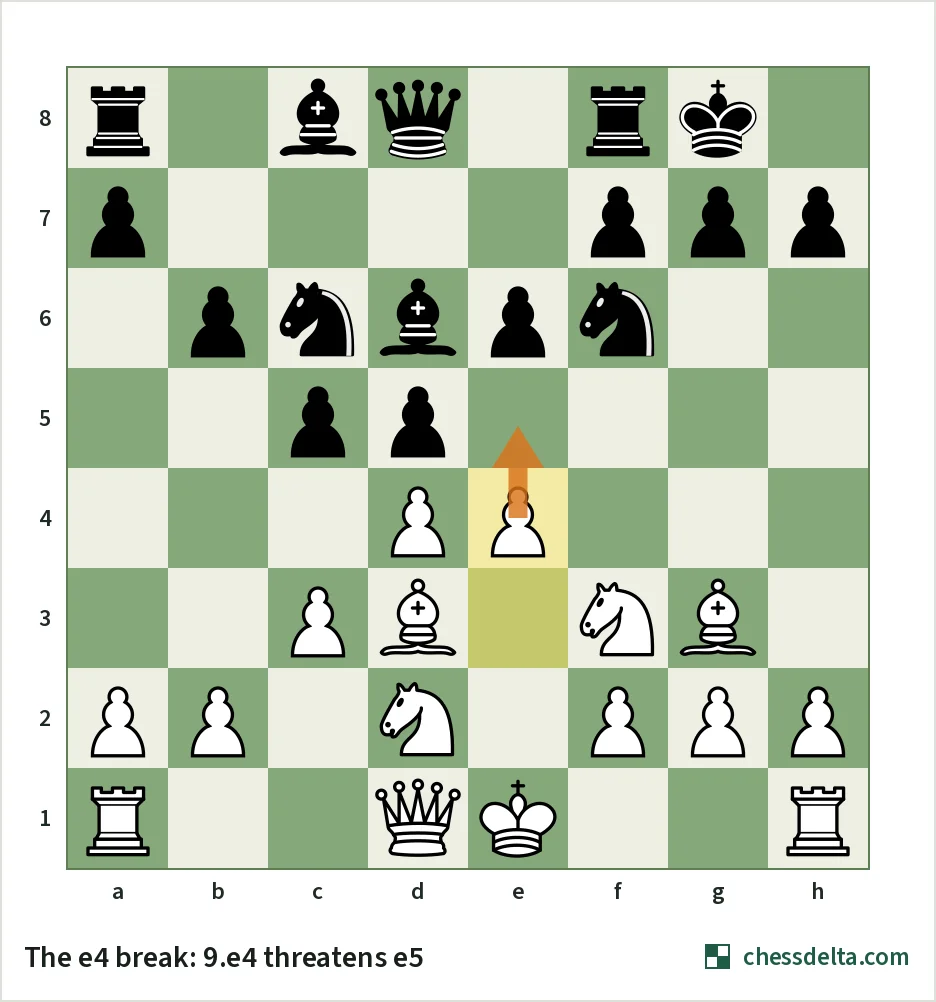
- The e4 break. With the d2 knight and the d3 bishop behind it, e4 opens the center. After 8…b6 9.e4 the pawn threatens e5, a fork of the d6 bishop and the f6 knight.
- A knight on e5. From e5 the knight attacks c6 and f7 and stops …e5.
- Don’t rush f4. The Ne5 and f4 attack looks natural, but after 8…b6 9.Ne5 Bb7 10.f4, Black is slightly better. Castle first with 10.O-O, which keeps the game equal.
- The h-file. If Black trades bishops on g3, recapture hxg3. The h1 rook then looks down a half-open file at h7.
- Queenside space. Against the King’s Indian setup, c4 and Nc3 gain room on the queenside.
Common traps in the London System
The poisoned b2 pawn
1.d4 Nf6 2.Nf3 d5 3.Bf4 c5 4.e3 Qb6 5.Nc3 Qxb2?? 6.Nb5
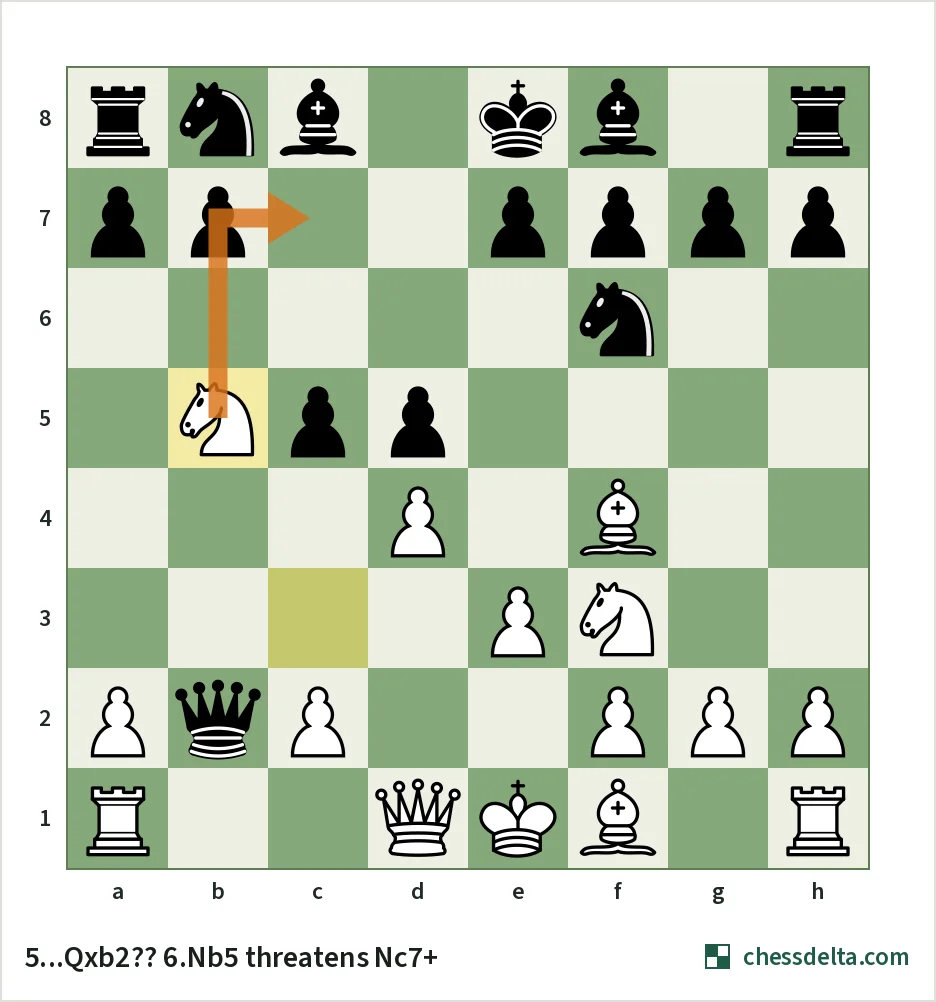
Why is the pawn poisoned? If Black takes, 6.Nb5 threatens Nc7+ and cuts off the queen. Opening databases even call 5.Nc3 the London System: Poisoned Pawn Variation.
After 6…Na6 7.a3 e6 8.Rb1 Qa2 9.Qc1, White plays Ra1 next and wins the queen for a rook. White is winning.
So as Black, decline with 5…a6, which is equal.
The …e4 fork
Against the King’s Indian setup, Bd3 can walk into a pawn fork: 1.d4 Nf6 2.Bf4 g6 3.Nf3 Bg7 4.e3 d6 5.Bd3 O-O 6.O-O Nbd7 7.c3 Re8 8.Nbd2 e5 9.Bg3?? e4.
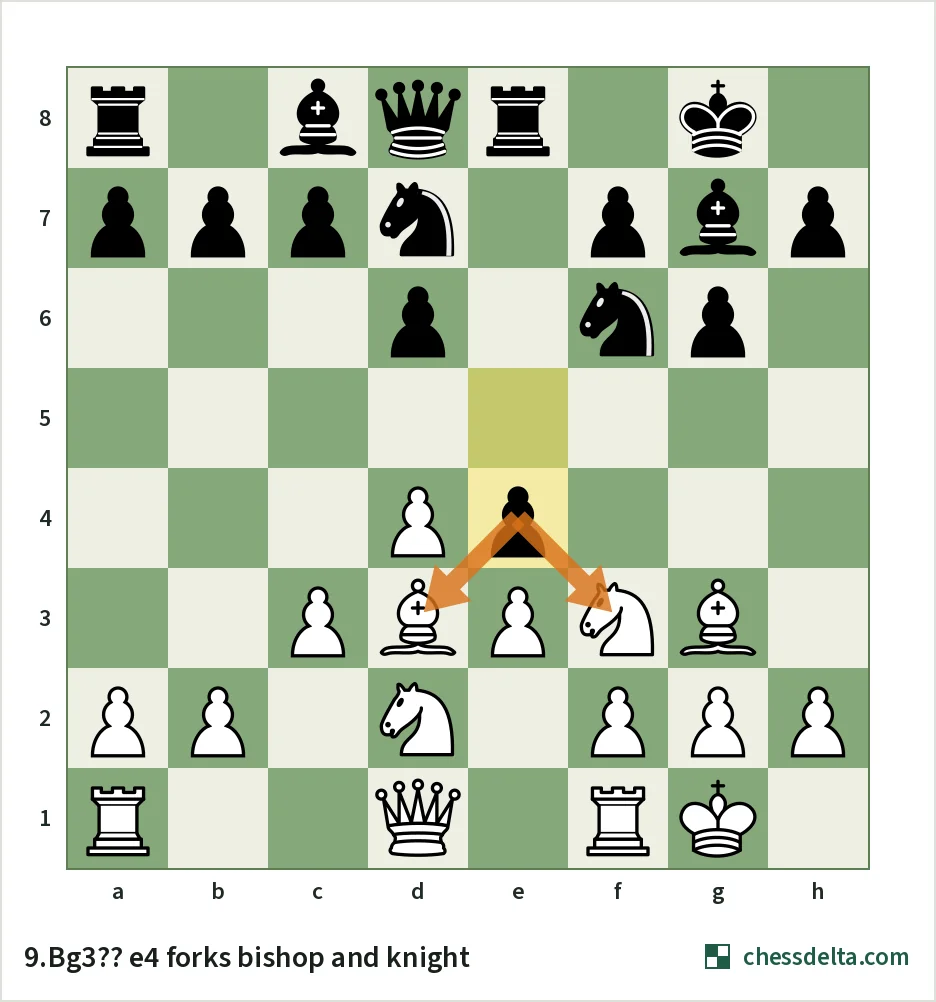
The pawn forks the bishop on d3 and the knight on f3, and the rook on e8 backs it up. Black wins a piece and is winning.
White had to play 9.Bg5, which keeps the game equal. And with the bishop on e2, there’s no fork at all. That’s why the setup above puts it there.
The Bxh7+ sacrifice
From the main line after 8.Bd3: 8…Qe7 9.Ne5 Nd7 10.Nxd7 Bxd7 11.Bxd6 Qxd6 12.dxc5 Qxc5?? 13.Bxh7+ Kxh7 14.Qh5+ Kg8 15.Ne4.
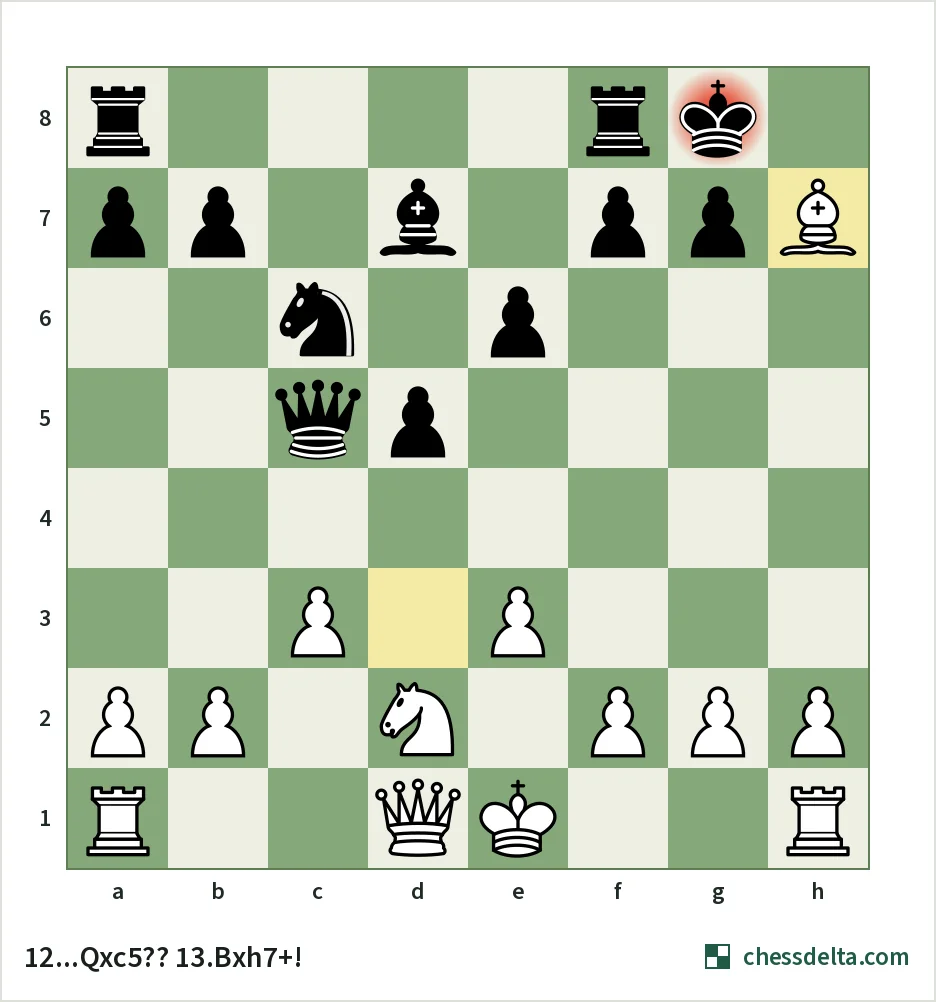
Now the knight on e4 hits the queen and is ready to jump to g5, with Qh7 mate to follow. Can Black bail out? Giving the queen back with 15…g6 16.Nxc5 gxh5 17.Nxd7 still leaves White winning.
The fix comes earlier. Black should play 12…Qe7 instead, which leaves White only slightly better.
How can Black meet the London System?
Black can meet the London System with any of the main defenses below, and each one reaches an equal game. So pick the one that suits your style.
- Hit b2. Play …c5 and …Qb6 before White is set up. Don’t take on b2 when Nb5 is the reply.
- Trade the bishop. …Bd6 challenges White’s best piece.
- Go for …e5. The King’s Indian setup with …g6, …Bg7 and …d6 prepares …e5, which gains time on the f4 bishop.
- Be careful with …Bf5. It leaves b7 loose against c4 and Qb3.
Learn the London System in 5 moves
Short on time? If you only remember 5 things, make it these:
- Play the setup in this order: d4, Bf4, e3, Nf3, c3, Nbd2, Bd3.
- Against …Bd6, step back with Bg3. Don’t trade.
- Against …Qb6, play Nc3 with your pawn on c2 and Qb3 with your pawn on c3.
- Against …g6, play h3 and Be2, not Bd3.
- Then pick a plan: the e4 break, or a knight on e5.
[Event "London System: main line"]
[Result "*"]
1. d4 d5 2. Bf4 Nf6 3. e3 e6 4. Nf3 c5 5. c3 Nc6 6. Nbd2 Bd6 7. Bg3 O-O 8. Bd3 *
[Event "London System against the King's Indian setup"]
[Result "*"]
1. d4 Nf6 2. Bf4 g6 3. Nf3 Bg7 4. e3 d6 5. h3 O-O 6. Be2 Nbd7 7. O-O Qe8 8. c4 e5 9. Bh2 *
FAQ
Is the London System good for beginners?
Yes, the London System is good for beginners. You learn one setup that develops every minor piece and gets you castled, as the chess opening principles ask. New to the game? Start with our chess for beginners guide.
Is the London System a good opening?
Yes, the London System is a good opening. The main line is equal, with a tiny edge for White, which is normal for a sound opening. Magnus Carlsen, Gata Kamsky and Levon Aronian have all used it.
Why do some players call the London System boring?
Some players call the London System boring because White plays the same moves whatever Black does. The fight also often starts later than in other openings. But the traps on this page show it has tactics too.
What is the best defense against the London System?
The best defenses against the London System give Black an equal game, but none of them refutes it. …c5 with …Qb6 and the King’s Indian setup both get there.
What is the difference between the London System and the Queen’s Gambit?
The London System and the Queen’s Gambit both start 1.d4 d5, then split on move 2. The Queen’s Gambit plays 2.c4 and fights for the center at once. The London System plays 2.Bf4 and builds its setup first.
Read next
Updated November 18, 2026.