Quick answer: The Caro-Kann Defense is 1.e4 c6, followed by 2.d4 d5. Black backs up the d5 pawn with the c-pawn and keeps the light-squared bishop free to come out to f5. The main line is the Classical Variation, 3.Nc3 dxe4 4.Nxe4 Bf5, where Stockfish gives White a small edge of about +0.3.
At a glance
- Moves: 1.e4 c6 2.d4 d5
- Type: Semi-open game. ECO codes B10 to B19.
- Black’s idea: support …d5 with the c-pawn, bring the c8 bishop out before playing …e6, then hit d4 with …c5.
- White’s main choices: the Advance Variation (3.e5), the Exchange Variation (3.exd5), the main line (3.Nc3), the Two Knights Attack (2.Nc3 and 3.Nf3) and the Maróczy Variation (3.f3).
What is the Caro-Kann Defense?
The Caro-Kann Defense is Black’s reply 1…c6 to 1.e4, with 2…d5 on the next move. It is a common defense against 1.e4 and is still played at the top level, by Ding Liren and Alireza Firouzja among others.
This guide is for the player with Black, with a section for White near the end. It is part of our guide to chess openings.
The move order
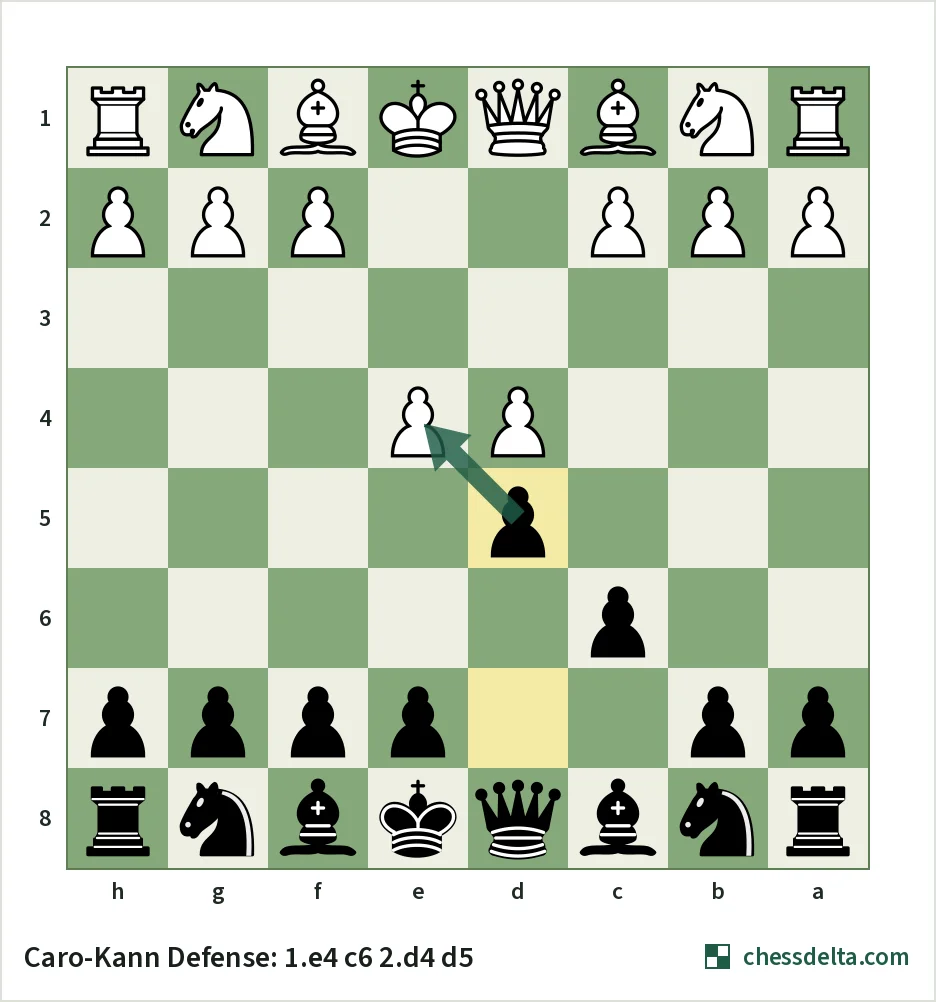
- 1.e4 c6. The c-pawn gets ready to support …d5. It doesn’t block the c8 bishop, which is the difference from the French Defense (1…e6).
- 2.d4 d5. Black attacks e4. If White takes on d5, Black takes back with the c-pawn and keeps a pawn in the center.
- 3.Nc3. White defends e4. 3.Nd2 reaches the same position after 3…dxe4 4.Nxe4.
The main line continues 3…dxe4 4.Nxe4 Bf5 5.Ng3 Bg6 6.h4 h6 7.Nf3 Nd7 8.h5 Bh7 9.Bd3 Bxd3 10.Qxd3 e6. Step through it on the board below.
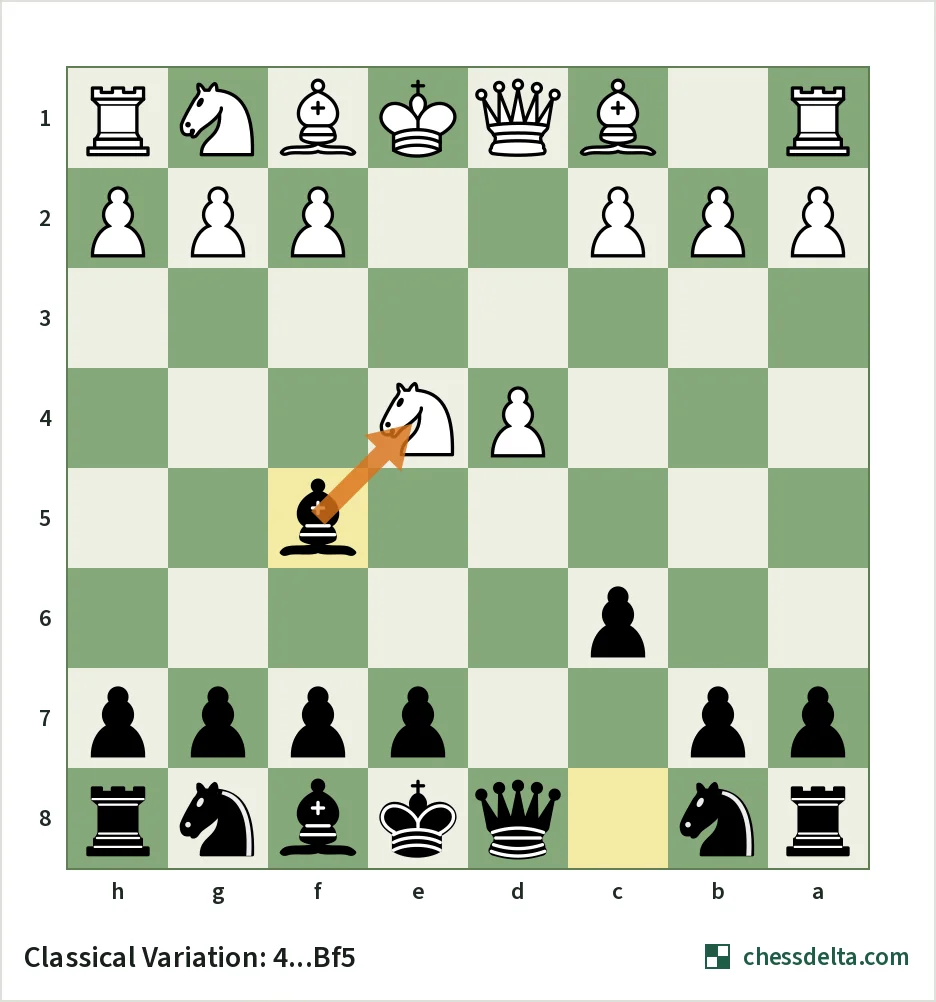
6.h4 plans h5 to chase the bishop, so Black plays 6…h6 and the bishop has a home on h7. 7…Nd7 keeps White’s knight out of e5.
The ideas for both sides
Black’s plan
- Bring the c8 bishop out to f5 or g4 before playing …e6. In the French Defense that bishop stays shut in behind the e6 pawn.
- Finish with …e6, …Nd7 and …Ngf6, then castle.
- Break with …c5. The c-pawn has already moved once, so this costs a move, but it is Black’s main way to attack d4.
White’s plan
- Use the extra space. The d4 pawn, and the e5 pawn in the Advance Variation, give White’s pieces more room.
- Gain time on the f5 bishop with Ng3, h4 and h5, or with g4 in the Advance Variation.
- In the Classical main line, castle queenside and push on the kingside.
- Open the game with c4 before Black finishes developing.
The main branches of the Caro-Kann Defense
Classical Variation: 3.Nc3 dxe4 4.Nxe4 Bf5
The Classical Variation is the main line shown above. Black develops the bishop with an attack on the e4 knight, and after 5.Ng3 Bg6 the bishop stays on the long b1 to h7 diagonal. At move 10 Stockfish gives White a small edge of about +0.3.
Black has 2 other fourth moves:
- Karpov Variation, 4…Nd7. Black prepares …Ngf6 so that a trade on f6 doesn’t double the pawns. Stockfish rates it about +0.4.
- Tartakower Variation, 4…Nf6 5.Nxf6+ exf6. Black accepts doubled f-pawns for open lines and a safe king. Stockfish rates it about +0.4.
Advance Variation: 3.e5
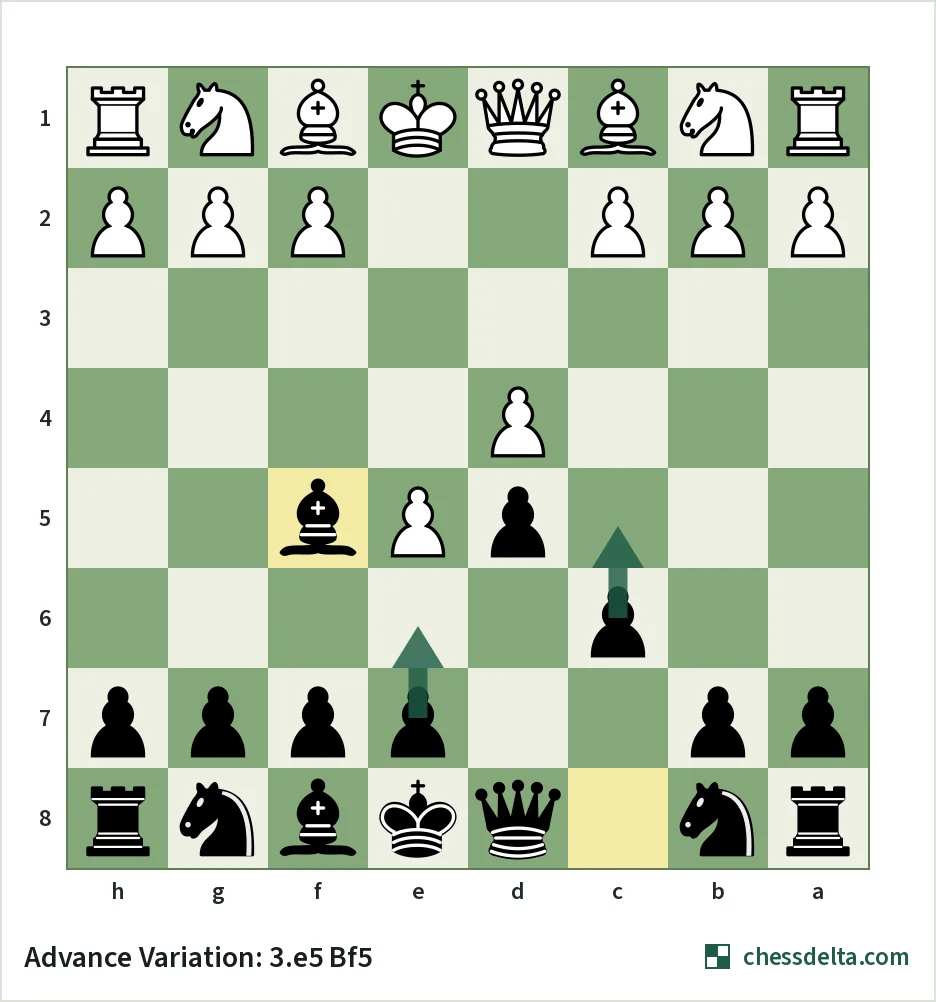
The Advance Variation closes the center and takes space. Black answers 3…Bf5, getting the bishop out before …e6. Then …e6 and …c5 attack the d4 pawn. Stockfish rates the Advance about the same as 3.Nc3 and 3.Nd2: a small edge for White (about +0.3).
White’s usual setup is the Short Variation, 4.Nf3 e6 5.Be2, and Black replies 5…c5. Black’s other third move is 3…c5, the Botvinnik-Carls Defense, which Stockfish rates about +0.4.
Exchange Variation: 3.exd5 cxd5
The Exchange Variation trades e-pawn for d-pawn. Black gets the half-open c-file, White the half-open e-file. The quiet line is 4.Bd3 Nc6 5.c3 Nf6 6.Bf4 Bg4 7.Qb3 Qd7, which Stockfish rates about +0.3.
Panov Attack: 3.exd5 cxd5 4.c4
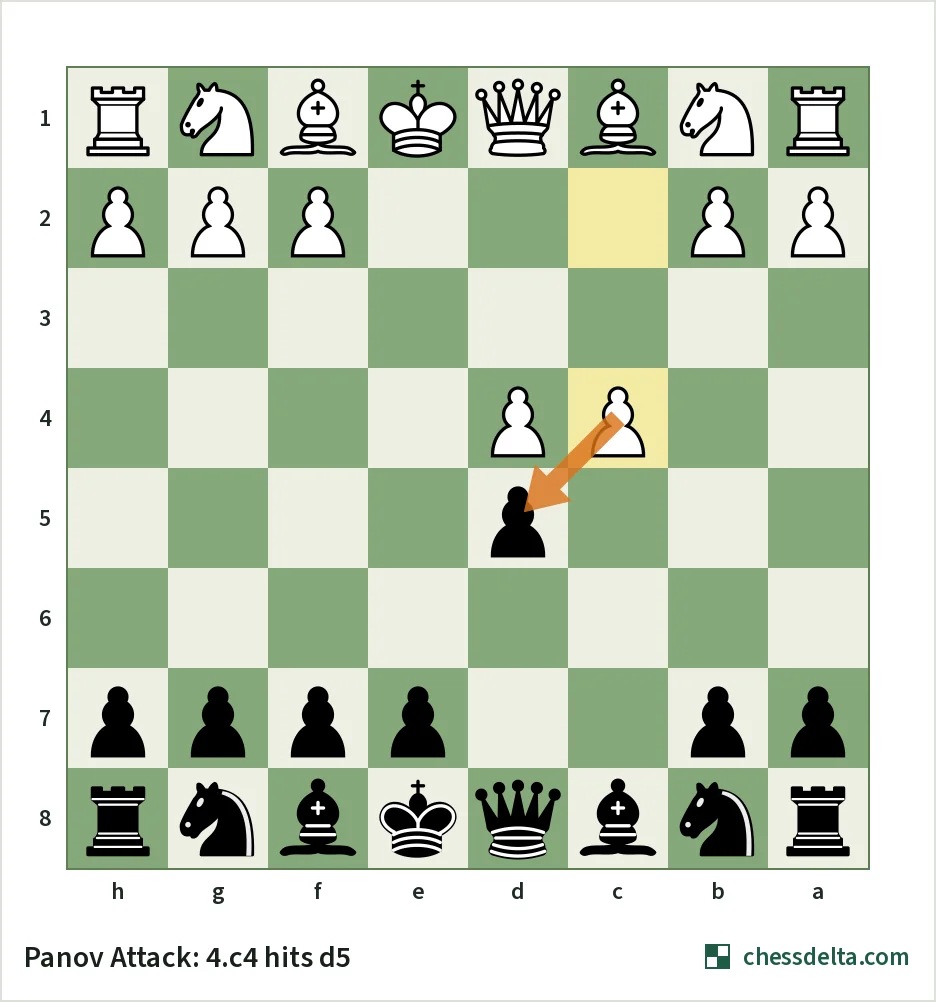
The Panov Attack, also called the Panov-Botvinnik Attack, hits d5 with the c-pawn. White often ends up with an isolated d-pawn and gets fast development in return. Black develops with 4…Nf6 5.Nc3 e6 6.Nf3 Bb4, and Stockfish rates it about +0.3.
White can try the same idea a move early with 2.c4, the Accelerated Panov Attack. After 2…d5 3.exd5 cxd5 4.cxd5 Nf6 Black wins the pawn back and the game is equal.
Two Knights Attack: 2.Nc3 d5 3.Nf3
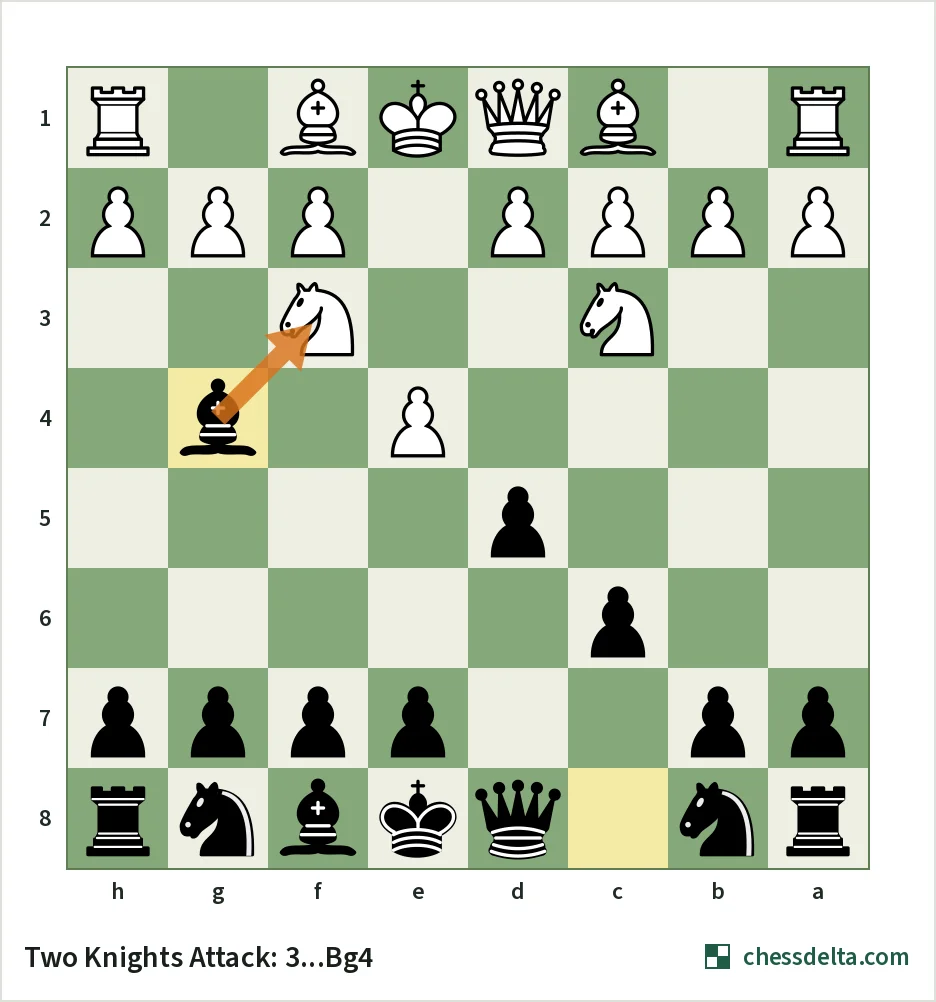
The Two Knights Attack, also called the Two Knights Variation, brings out both knights and keeps the d-pawn at home. Bobby Fischer played it in his youth. Black’s reply is 3…Bg4, pinning the f3 knight.
After 4.h3 Bxf3 5.Qxf3 e6 Black has given up the bishop pair for a firm center, and Stockfish rates it about +0.3. Take the knight: the retreat 4…Bh5 gives White more (about +0.8). The Classical setup with …Bf5 fails here, as the trap below shows.
Maróczy Variation: 3.f3
The Maróczy Variation is better known as the Fantasy Variation. White guards e4 with the f-pawn, so that after …dxe4 a pawn takes back and the center stays whole.
The low-risk reply is 3…e6 4.Nc3 Bb4, which Stockfish rates about +0.1. The sharp reply is 3…dxe4 4.fxe4 e5. Then 5.dxe5? runs into 5…Qh4+. Blocking with 6.g3 loses the h1 rook to 6…Qxe4+, and after 6.Kd2 Black is clearly better (about -1.0). White’s move is 5.Nf3, which Stockfish rates about +0.2.
Typical plans in the middlegame
- The …c5 break. In the Advance Variation …c5 attacks d4, the base of White’s pawn chain. In the Classical Variation Black plays it after castling, to open the c-file and d-file.
- Trading the light-squared bishops. In the Classical main line White plays Bd3 and Black takes it. Black’s pawns on c6 and e6 then cover the light squares, and they don’t block the dark-squared bishop Black has left.
- The minority attack. In the Exchange Variation Black pushes …b5 and …b4 at the c3 pawn. A trade there leaves White with a weak pawn on the queenside.
Common traps in the Caro-Kann Defense
The smothered mate: 5.Qe2 Ngf6??
In the Karpov Variation, 1.e4 c6 2.d4 d5 3.Nc3 dxe4 4.Nxe4 Nd7, White can try 5.Qe2. The queen stands behind the e4 knight. The moment that knight moves, the e7 pawn is pinned.
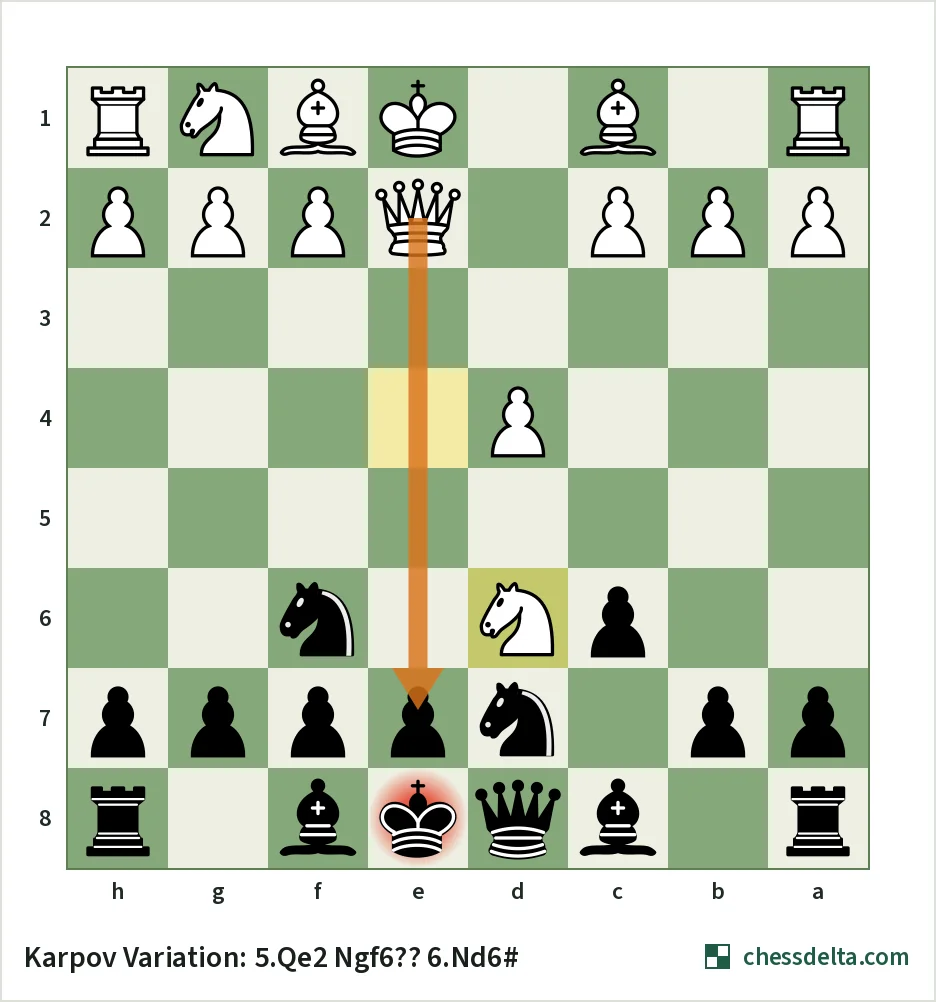
The natural 5…Ngf6?? allows 6.Nd6#. The e7 pawn can’t take the knight because it is pinned, and Black’s own pieces fill every square next to the king. Play 5…Ndf6, which Stockfish rates about +0.2.
The Two Knights trap: 7.Ne5 Bh7?
In the Two Knights Attack the Classical recipe gets Black into trouble: 1.e4 c6 2.Nc3 d5 3.Nf3 dxe4 4.Nxe4 Bf5?! 5.Ng3 Bg6? 6.h4 h6 7.Ne5. White’s knight was already on f3, so it reaches e5 before Black can play …Nd7. Stockfish rates Black’s top defense, 7…Qd6, at about +1.0 for White.
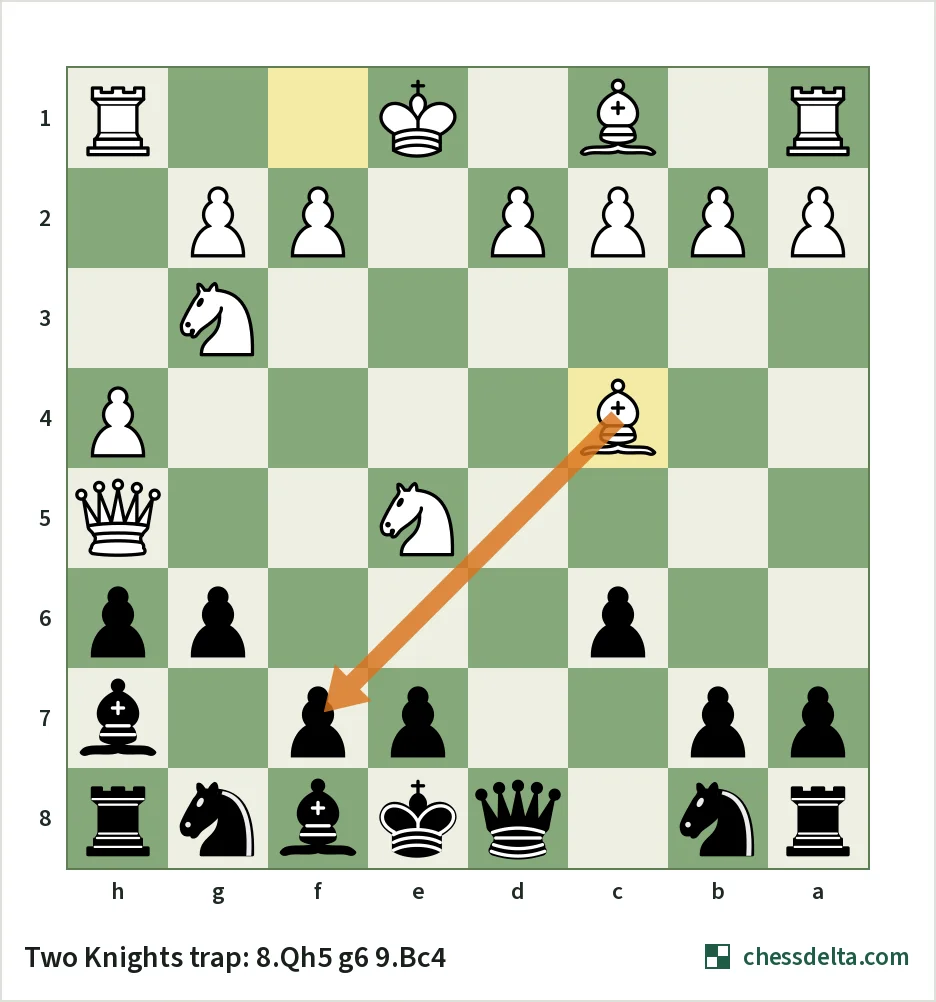
After 7…Bh7? 8.Qh5 White threatens Qxf7#. Black has to play 8…g6, and 9.Bc4 leaves the queen where it is: 9…gxh5?? 10.Bxf7# is checkmate. After 9…e6 10.Qe2 Stockfish gives White about +2.
Then 10…Nf6?? loses to 11.Nxf7 Kxf7 12.Qxe6+ Kg7 13.Qf7#. Alexander Alekhine won quickly with 11.Nxf7 in a 1938 game against this line. If you have already played 4…Bf5, answer 5.Ng3 with 5…Bg4, which keeps White to about +0.4.
The Advance bishop trap: 4.h4 e6??
In the Advance Variation after 3.e5 Bf5, the Tal Variation 4.h4 sets a trap. The normal-looking 4…e6?? shuts the bishop’s way back to d7, and 5.g4 wins it: 5…Be4 6.f3 Bg6 7.h5.
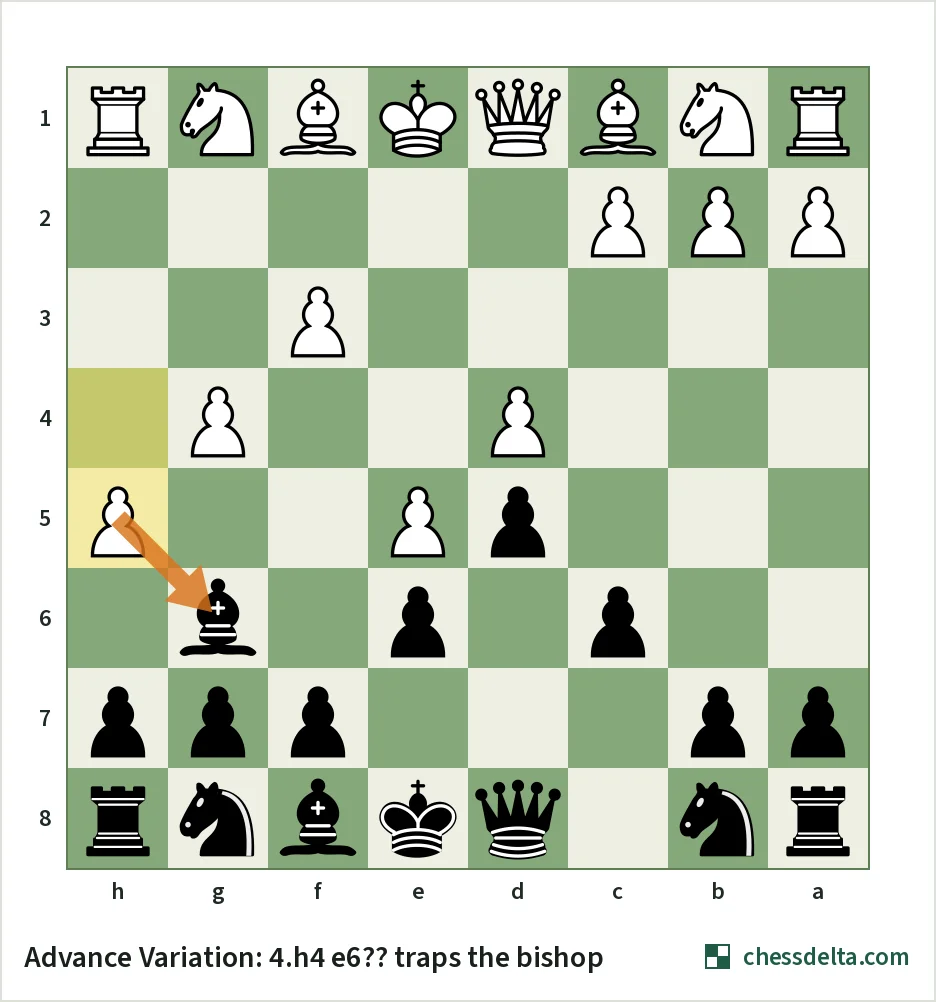
The bishop has no safe square and White is winning (about +5). Play 4…h5 first. It is Stockfish’s first choice, it holds back g4, and the position is about +0.3.
How to play against the Caro-Kann Defense
As White, choose by how much theory you want to learn.
- Advance Variation, 3.e5. One of Stockfish’s top 3 moves (about +0.3). You gain space, and Black has to know when to play …c5.
- Main line, 3.Nc3. White gets about +0.3 and a clear plan: Ng3, h4, h5, Bd3, then castle queenside.
- Exchange Variation, 4.Bd3. One setup against everything: Bd3, c3, Bf4 and Nf3. Stockfish gives White about +0.1.
- Panov Attack, 4.c4. Open lines and active pieces, at the cost of an isolated d-pawn.
- Two Knights Attack, 2.Nc3 and 3.Nf3. Little theory, and the trap above catches players who only know the Classical Variation.
- Skip 2.Bc4. That is the Hillbilly Attack. Black hits the bishop with 2…d5 and is already a shade ahead (about -0.3).
Learn the Caro-Kann Defense in 5 moves
If you only remember 5 things as Black:
- Play 1…c6 and 2…d5. Against 3.Nc3 or 3.Nd2, take on e4 and play 4…Bf5.
- In the Classical Variation, answer 6.h4 with 6…h6 and 7.Nf3 with 7…Nd7.
- Against 3.e5, play 3…Bf5, then …e6 and …c5. If White plays 4.h4, reply 4…h5.
- Against 3.exd5, take back with the c-pawn. Then …Nc6, …Nf6 and …Bg4 against 4.Bd3, or …Nf6 and …e6 against 4.c4.
- Against 2.Nc3 and 3.Nf3, play 3…Bg4. Against 3.f3, play 3…e6.
[Event "Caro-Kann Defense: Classical Variation starter line"]
[Result "*"]
1. e4 c6 2. d4 d5 3. Nc3 dxe4 4. Nxe4 Bf5 5. Ng3 Bg6 6. h4 h6 7. Nf3 Nd7 8. h5 Bh7 9. Bd3 Bxd3 10. Qxd3 e6 11. Bd2 Ngf6 12. O-O-O Be7 *
[Event "Caro-Kann Defense: Advance Variation starter line"]
[Result "*"]
1. e4 c6 2. d4 d5 3. e5 Bf5 4. Nf3 e6 5. Be2 c5 6. Be3 cxd4 7. Nxd4 Ne7 8. O-O Nbc6 *
Stockfish gives White no more than a small edge at the end of both lines.
FAQ
Is the Caro-Kann Defense good for beginners?
Yes. One plan works in most lines: …c6, …d5, bishop out, …e6, then …c5. Learn the 3 traps above, then read the chess opening principles. If you are new to the game, start with chess for beginners.
Why is it called the Caro-Kann?
The Caro-Kann is named after Horatio Caro of England and Marcus Kann of Austria, who both analyzed it in 1886. A year earlier Kann had won a 24-move game with it against Jacques Mieses in Hamburg.
What is the best response to the Caro-Kann?
Stockfish rates 3.e5, 3.Nc3 and 3.Nd2 about the same, each about +0.3 for White. Pick 3.e5 for space or 3.Nc3 for a clear attacking plan. For less theory, play the Exchange Variation with 4.Bd3 (about +0.1).
Is the Caro-Kann better than the French Defense?
Stockfish rates them about the same: about +0.3 for White after both 1.e4 c6 2.d4 d5 and 1.e4 e6 2.d4 d5. The practical difference is the c8 bishop. In the Caro-Kann it comes out to f5 or g4. In the French it stays behind the e6 pawn, but Black gets …c5 in one move.
What is the difference between the Caro-Kann and the Sicilian Defense?
Both start with a c-pawn move against 1.e4. In the Sicilian Defense the pawn goes to c5 and fights for d4 itself. In the Caro-Kann it goes to c6 and supports …d5, so Black keeps a pawn in the center.
Is the Caro-Kann the same as the Scandinavian Defense?
No. Both put a pawn on d5 against 1.e4. In the Scandinavian Defense Black plays 1…d5 at once and often takes back on d5 with the queen. In the Caro-Kann 1…c6 comes first, so a pawn can take back.
Every move and position on this page was checked with python-chess and Stockfish. Updated November 18, 2026.