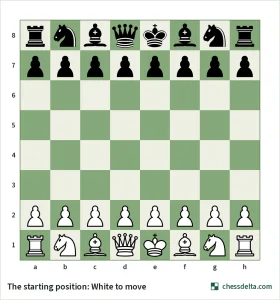
Quick answer: A standard chess set has 32 pieces, 16 for each player. Each side gets 1 king, 1 queen, 2 rooks, 2 bishops, 2 knights and 8 pawns. Counted 34 in the box? Some sets add 1 spare queen per color. You need only the 32 to play.
Part of our guide to how chess pieces move.
What are the 16 chess pieces called?
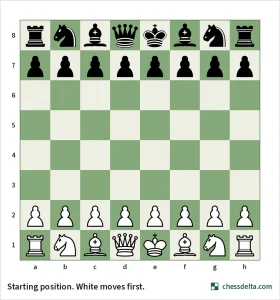
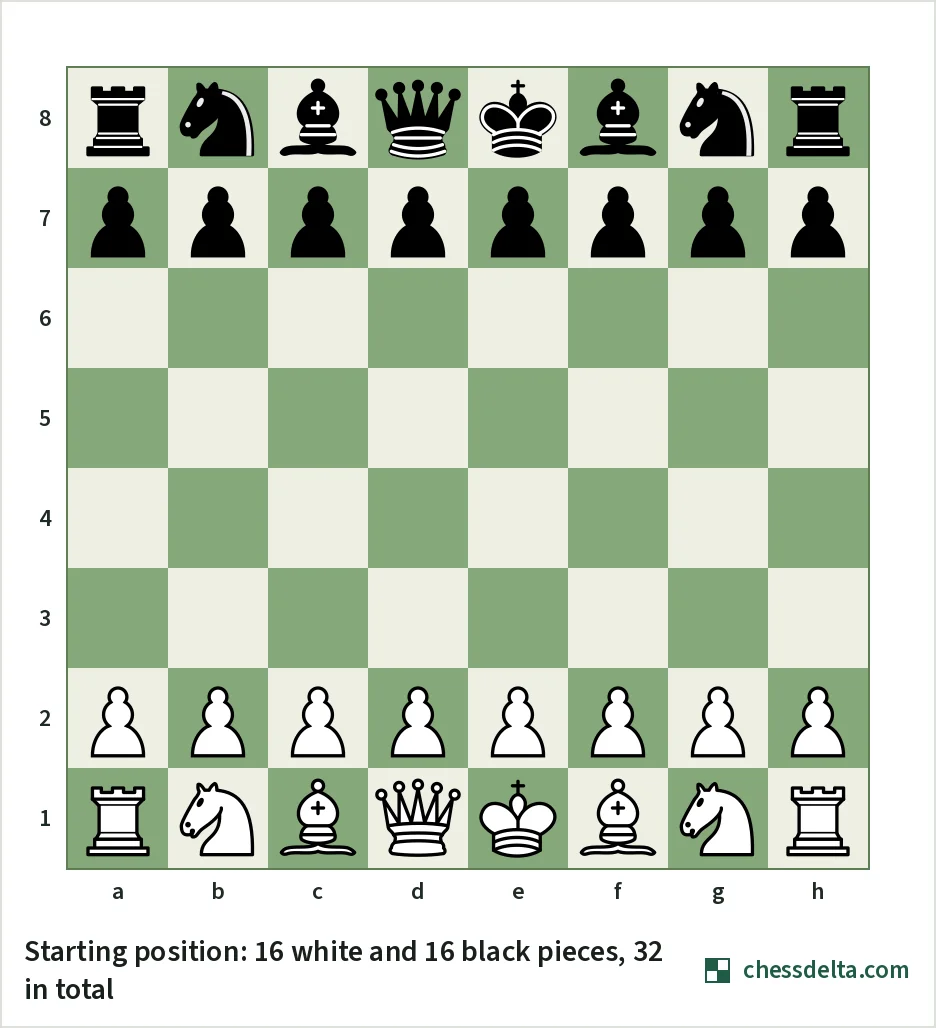
The 16 chess pieces on each side are 8 pawns, 2 rooks, 2 knights, 2 bishops, 1 queen and 1 king. So you only have 6 kinds of piece to learn.
White gets the light-colored set and Black gets the dark one (FIDE Laws of Chess, Article 2.2).
| Piece | White | Black | Total |
|---|---|---|---|
| King | 1 | 1 | 2 |
| Queen | 1 | 1 | 2 |
| Rook | 2 | 2 | 4 |
| Bishop | 2 | 2 | 4 |
| Knight | 2 | 2 | 4 |
| Pawn | 8 | 8 | 16 |
| All pieces | 16 | 16 | 32 |
The board has 64 squares, so half of them start empty. Not sure which piece goes where? Our chess board setup guide shows every square.
And if you want to know where the names come from, see chess pieces names.
Do chess sets come with extra pieces?
Some chess sets come with extra pieces, usually 1 spare queen for each color. That makes 34 pieces in the box. Don’t put the spares on the board, though: they’re for pawn promotion.
Why do chess sets come with extra queens?
Chess sets come with extra queens so you can promote a pawn while your first queen is still on the board. Here’s why that comes up. A pawn that reaches the far rank must become a queen, rook, bishop or knight (Article 3.7.3.3).
And your choice isn’t limited to pieces that were captured (Article 3.7.3.4). So you can have 2 queens at once, and the spare queen in the box covers that.
No spare queen? In a casual game, players often turn a rook upside down. Don’t try that in a rated game, where an upside-down rook counts as a rook.
Instead, pause the clock and ask the arbiter for a queen (Article 6.11.2).
To learn more, read what happens when a pawn reaches the other side and can you have more than one queen.
Why did my chess set come with extra kings?
Extra kings in a chess set are spares, in case one gets lost or broken. You’ll never need one in a game. Promotion to a king isn’t allowed, so no side ever has 2 kings (Article 3.7.3.3).
How many chess pieces do you need?
You need every piece in the table above to start a standard game. Even 1 missing pawn matters. It changes the starting position, so the game is no longer standard chess.
Once the game starts, the count drops as pieces are captured. Only the kings always stay. The game ends at checkmate, with the king still on the board (see checkmate rules).
What is each chess piece worth?
Each chess piece has a standard point value: pawn 1, knight 3, bishop 3, rook 5 and queen 9. The king gets no value, because you can’t trade it.
These numbers help you decide whether a trade is good for you. To learn more, read our chess pieces value guide, which shows how to use them.
FAQ
Are there 32 pieces in chess?
Yes. Chess starts with 32 pieces on the board, 16 for White and 16 for Black.
How many types of chess pieces are there?
There are 6 types of chess pieces: king, queen, rook, bishop, knight and pawn. Each side starts with all 6.
How many pawns are in chess?
Chess has 16 pawns, 8 for each player. White’s pawns start on the 2nd rank and Black’s on the 7th rank.
How many chess pieces should a chess set have?
A complete chess set should have 32 pieces. Sets with 34 pieces add a spare queen per color for promotion.
Read next
- How chess pieces move: every piece’s moves, with diagrams
- Chess pieces names: all 6 pieces and their letters
- Chess board setup: where each piece starts
- Chess pieces value: what each piece is worth in a trade
- Chess for beginners: what to learn first
Every count and rule on this page was checked against the FIDE Laws of Chess. Updated .