Quick answer: The French Defense is 1.e4 e6, followed by 2.d4 d5. As Black, you build a solid pawn chain, then attack White’s center with …c5 and …f6. White’s main choices are 3.e5, 3.Nc3, 3.Nd2 and 3.exd5. After 2…d5, White keeps only a small edge.
At a glance
- Moves: 1.e4 e6 2.d4 d5
- Type: Semi-open game. ECO codes C00 to C19.
- Black’s idea: let White take space, then hit the d4 pawn with …c5 and the e5 pawn with …f6.
- White’s main choices: the Advance Variation (3.e5), the Winawer and Classical Variations (3.Nc3), the Tarrasch Variation (3.Nd2) and the Exchange Variation (3.exd5).
What is the French Defense?
The French Defense is Black’s reply 1…e6 to 1.e4, with 2…d5 on the next move. Why “French”? It’s named after an 1834 correspondence match between London and Paris, where the Paris team played it. For decades it has been the 3rd most popular answer to 1.e4, after 1…c5 and 1…e5.
So why do so many club players trust it? The pawn structure tells you the plan, and that plan barely changes from line to line. This guide plays it from Black’s side, with a section for White near the end, as part of our guide to chess openings.
The move order
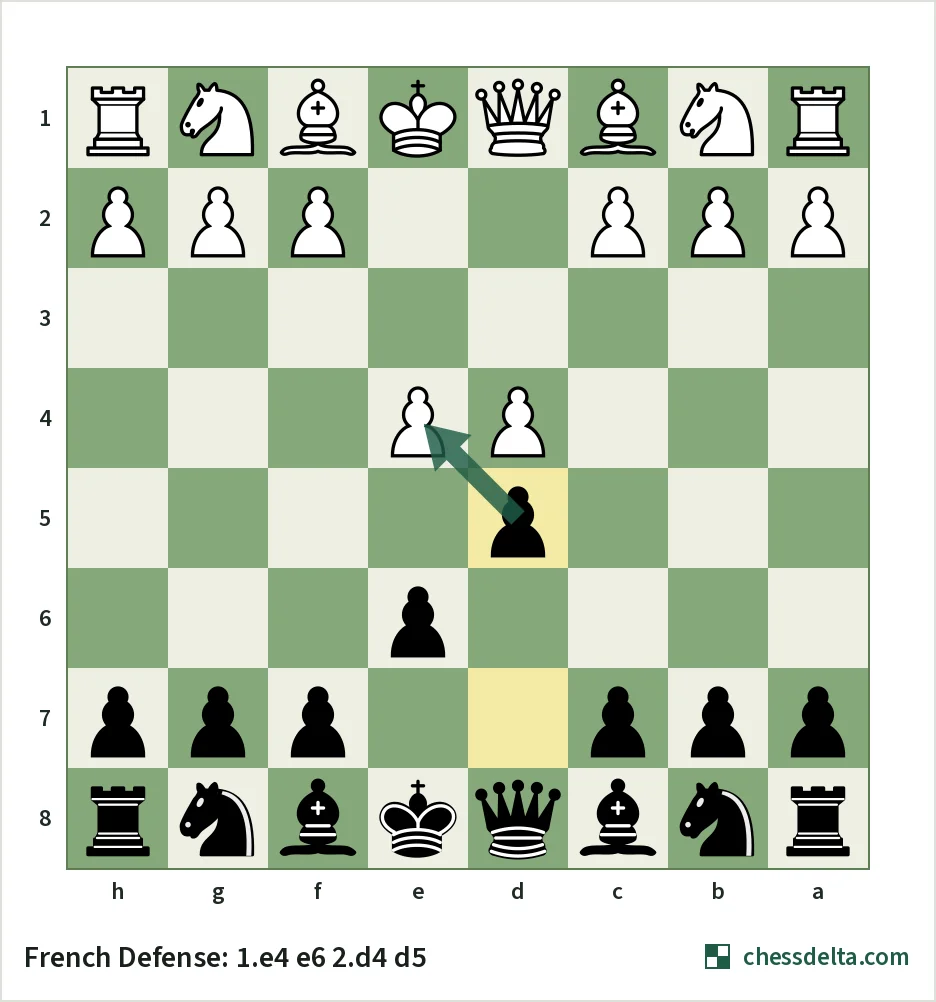
- 1.e4 e6. The e-pawn gets ready to support …d5. But it also shuts in your c8 bishop. That’s the price of a firm center, and you’ll meet it again below.
- 2.d4 d5. Now e4 is under attack. White has to defend it, push past it with 3.e5, or trade it with 3.exd5. That choice decides which French you get.
The ideas for both sides
Black’s plan
- Strike at the base of White’s pawn chain with …c5. It’s your main break in almost every line.
- Once your pieces are ready, hit the head of the chain with …f6.
- Pile up on d4 with …Nc6, …Qb6 and a knight on f5.
- Find work for the c8 bishop. It’s the long-term problem of the French Defense, and the next section shows 3 ways to solve it.
White’s plan
- Use the extra space. With a pawn on e5, Black’s knight has no safe home on f6.
- Attack on the kingside, where the e5 pawn cramps Black’s pieces. Expect this as Black, and keep enough defenders near your king.
- Keep d4 strong with c3 and Nf3, so …c5 doesn’t break the chain.
The bad light-squared bishop
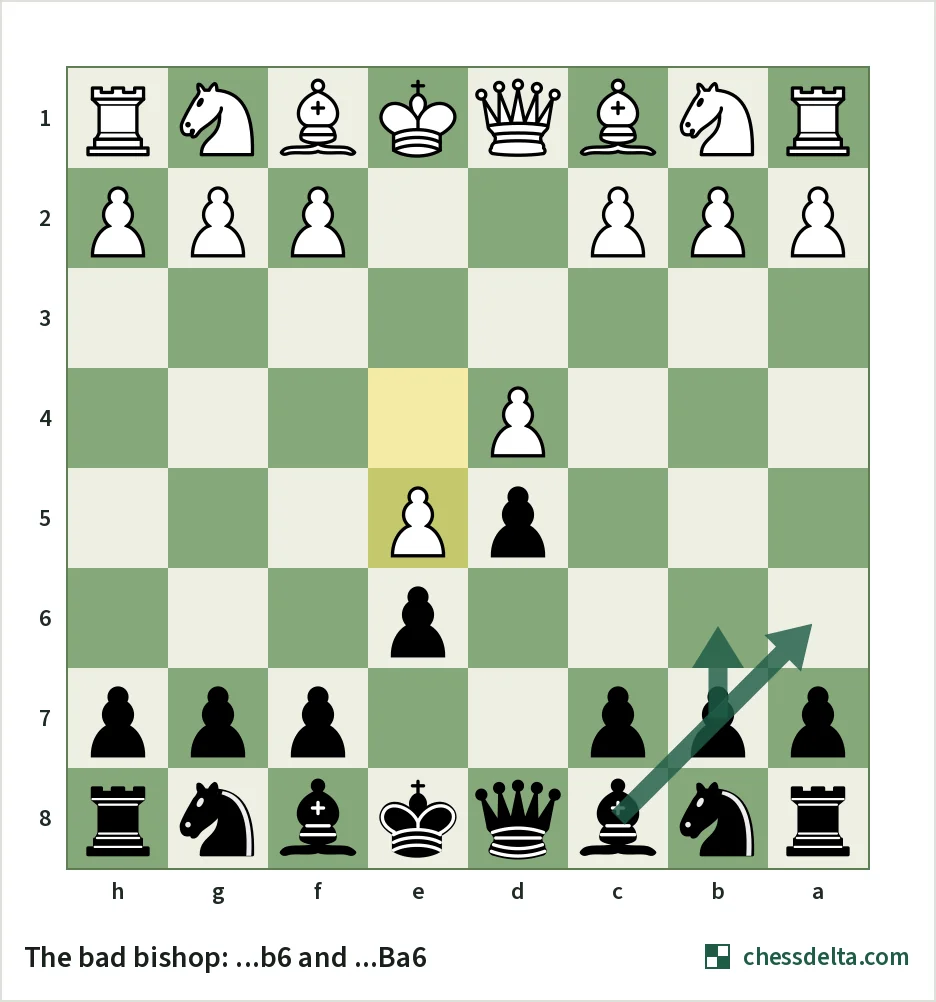
Why do French Defense players worry about the c8 bishop? It sits behind your pawns on e6 and d5, and both stand on light squares. Many players call it the “French bishop”.
Leave it there, and you play the middlegame a piece short. So you have 3 fixes. Trade it with …b6 and …Ba6, bring it out with …Bd7 and …Bb5, or play …f6 and …e5 to open its diagonal again.
In the Advance Variation, 3…Bd7 starts the swap at once, and White keeps only a small edge.
The main branches of the French Defense
Advance Variation: 3.e5
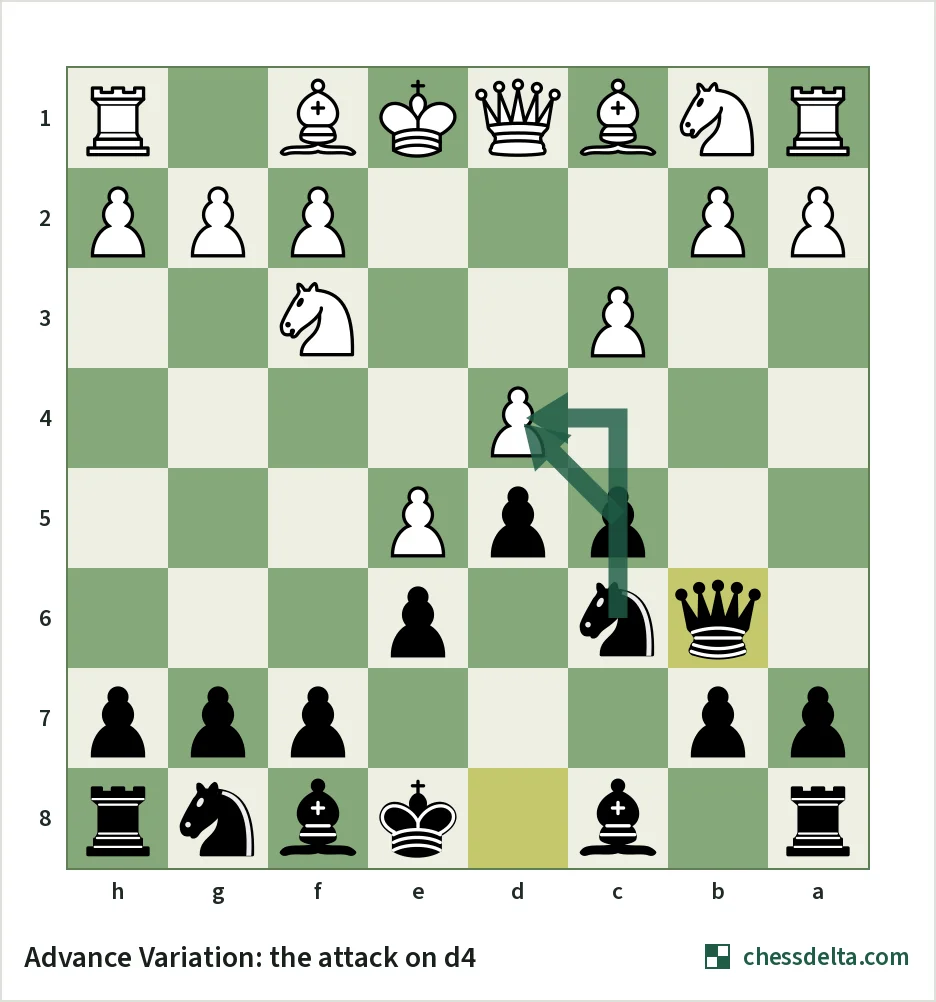
The French Defense Advance Variation closes the center and grabs space. Your answer is to hit d4 right away: 3…c5 4.c3 Nc6 5.Nf3 Qb6. Pawn and knight attack d4, and the queen joins in once the c-pawns are traded.
White keeps a small edge, but you know exactly what to attack: d4. The main line is 6.a3, which plans b4. You can answer 6…c4 and lock the queenside, and White’s edge stays small.
Step through the whole line on the board below, from move 1. Use the arrows to see which pieces hit d4.
What if White simply gives up d4? That’s the Milner-Barry Gambit: 6.Bd3 cxd4 7.cxd4 Bd7 8.O-O. After 8…Nxd4 9.Nxd4 Qxd4 10.Nc3, Black is slightly better.
Just don’t take with the knight a move earlier. That’s the first trap below.
Winawer Variation: 3.Nc3 Bb4
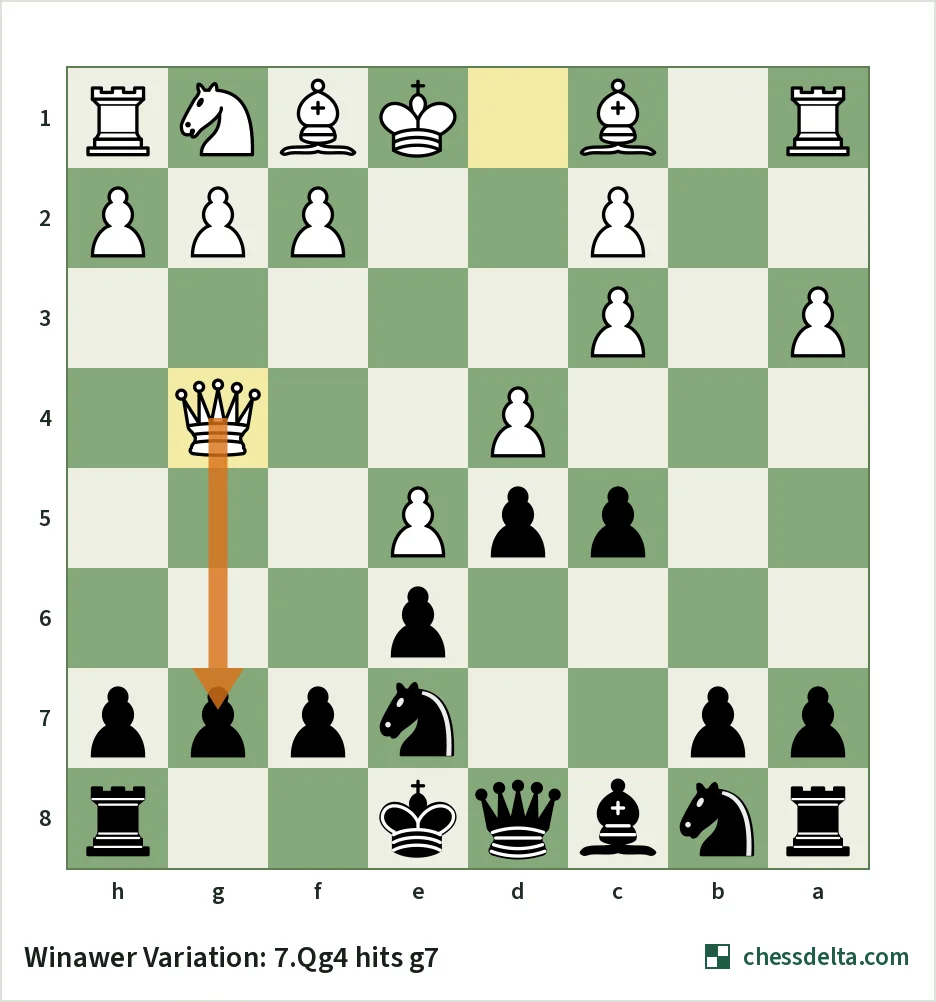
The Winawer Variation pins the c3 knight. The main line is 4.e5 c5 5.a3 Bxc3+ 6.bxc3 Ne7. You give up your dark-squared bishop, and in return White’s c-pawns are doubled.
White is slightly better. And with your dark-squared bishop gone, where does White strike first? The sharpest try is 7.Qg4, hitting g7.
You either castle or give up g7 with 7…Qc7 8.Qxg7 Rg8 9.Qxh7 cxd4. Then you counterattack in the center.
Classical Variation: 3.Nc3 Nf6
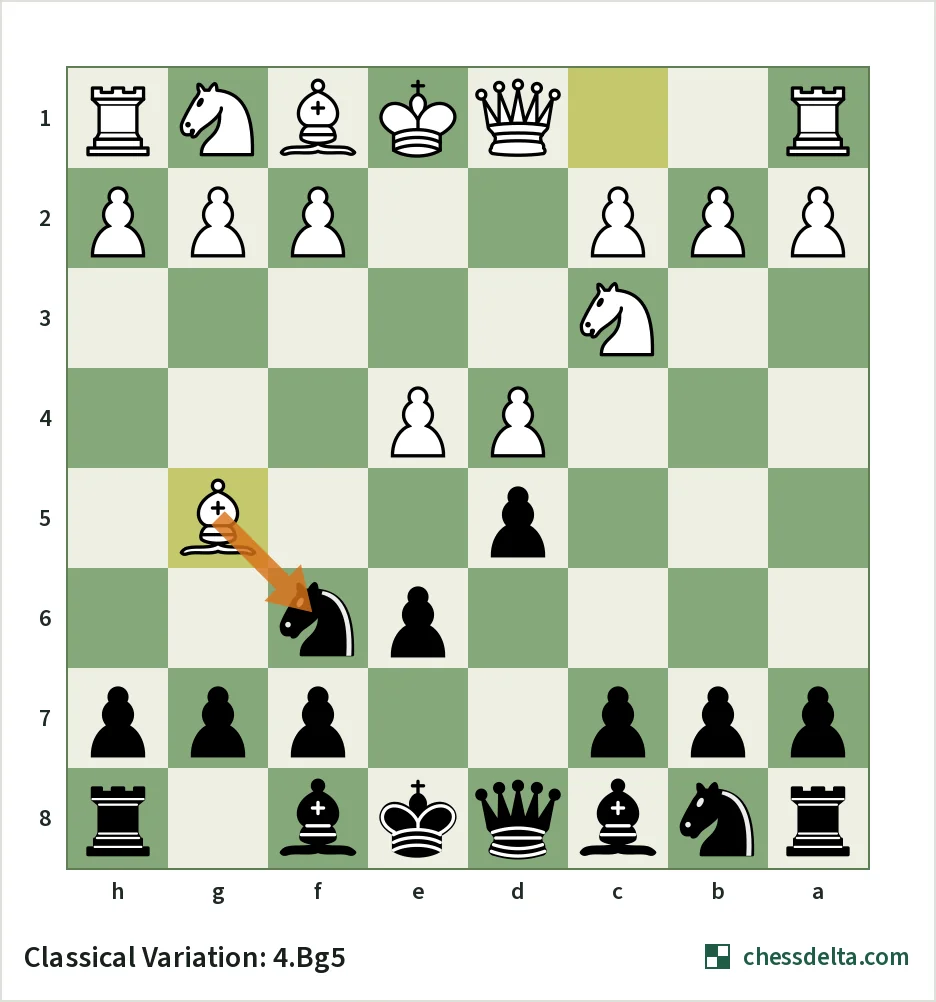
The Classical Variation develops a knight and hits e4 again. After 4.Bg5 Be7 5.e5 Nfd7 6.Bxe7 Qxe7 7.f4, White is slightly better. The Steinitz Variation, 4.e5 Nfd7 5.f4 c5 6.Nf3 Nc6 7.Be3, gives about the same picture.
In both lines you play …c5, then often castle queenside or leave the king in the center for a while. Why not castle short? Doing it early invites the Greek gift, the second trap below.
Tarrasch Variation: 3.Nd2
The Tarrasch Variation defends e4 with the knight and keeps c3 free for a pawn. It also dodges the Winawer pin. Your simplest reply is 3…c5, and the position is equal.
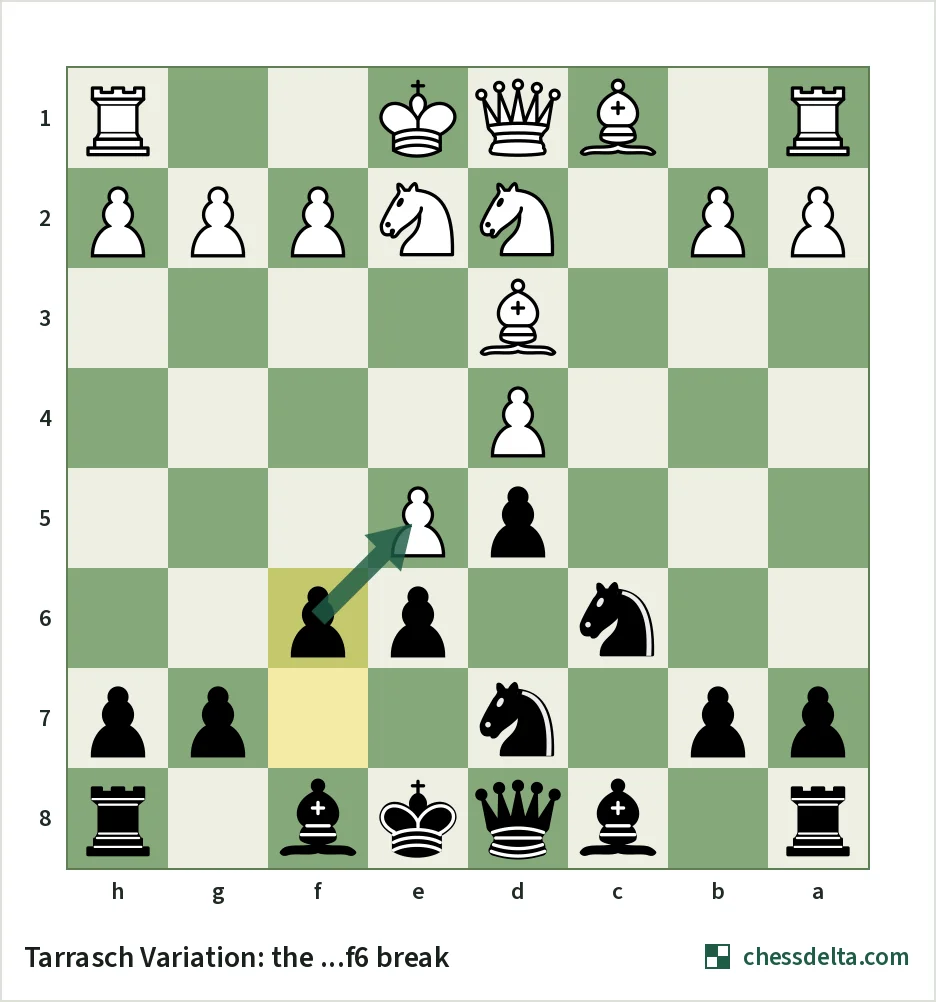
Want to hit the center harder? The other main reply is 3…Nf6 4.e5 Nfd7 5.Bd3 c5 6.c3 Nc6 7.Ne2 cxd4 8.cxd4 f6. You attack the e5 pawn at once, and White is slightly better.
Rubinstein Variation: 3.Nc3 dxe4
The Rubinstein Variation gives up the center for quick development: 4.Nxe4 Nd7 5.Nf3 Ngf6 6.Nxf6+ Nxf6. It’s the low-theory choice. The cost is a slightly better position for White.
Exchange Variation: 3.exd5 exd5
The French Defense Exchange Variation opens the e-file and frees your c8 bishop, so the bad bishop problem is gone. The pawns are symmetrical and the position is equal. You only need to develop and castle.
Typical plans in the middlegame
- The …c5 break. In the Advance Variation, keep hitting d4 with …Nc6, …Qb6 and …Nge7 to f5.
- The …f6 break. Once d4 is solid, hit e5. If White takes on f6, you get the open f-file and a center pawn on e6 that can advance.
- Locking with …c4. This shuts the queenside, so you can play …b5 and …b4 there.
Common traps in the French Defense
The Advance trap: 7…Nxd4??
In the Advance Variation, 1.e4 e6 2.d4 d5 3.e5 c5 4.c3 Nc6 5.Nf3 Qb6 6.Bd3 cxd4 7.cxd4, the d4 pawn looks free. It isn’t. 7…Nxd4?? 8.Nxd4 Qxd4 9.Bb5+ checks your king, and White’s queen takes the queen on d4.
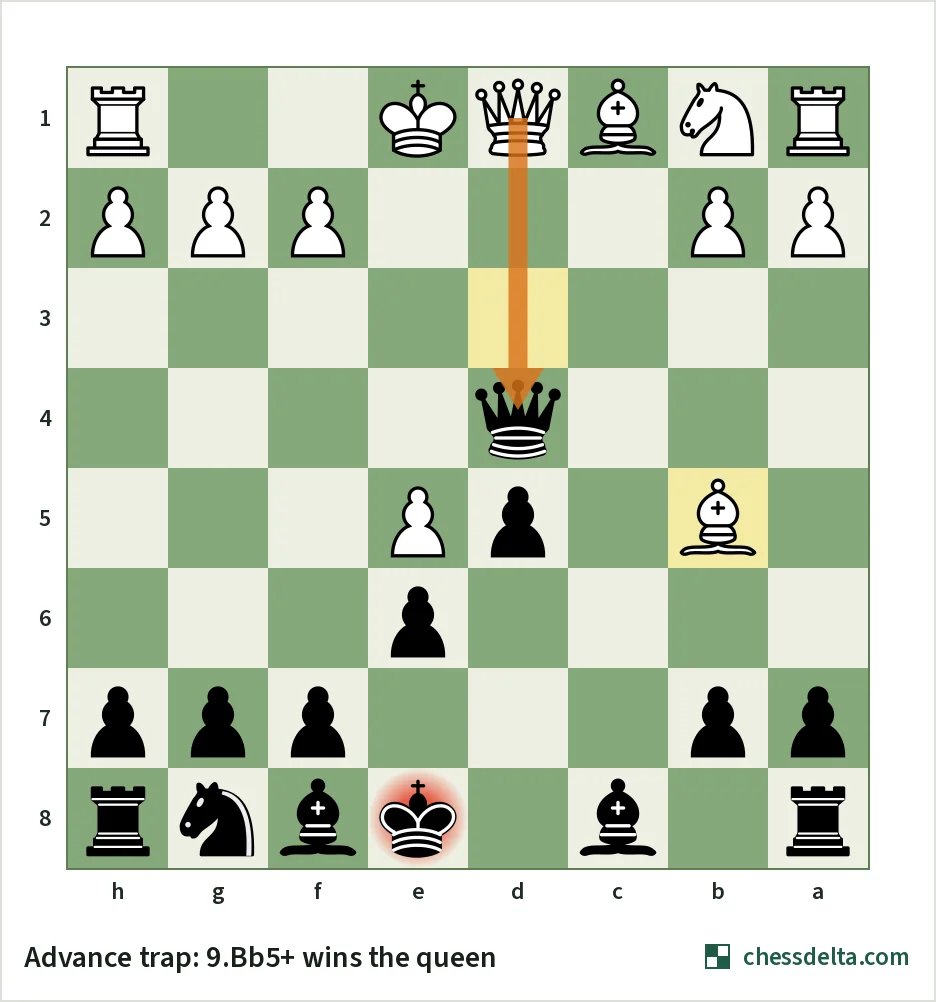
White wins the queen and is winning. The fix is one quiet move: play 7…Bd7 first, which covers b5, and the position is equal.
The Greek gift: 8…O-O?
In the Classical Variation, 1.e4 e6 2.d4 d5 3.Nc3 Nf6 4.e5 Nfd7 5.Nf3 c5 6.dxc5 Nc6 7.Bf4 Bxc5 8.Bd3, castling looks natural. But your knight has left f6, so h7 has no defender. After 8…O-O? 9.Bxh7+ Kxh7 10.Ng5+ Kg8 11.Qh5 White threatens Qh7#.
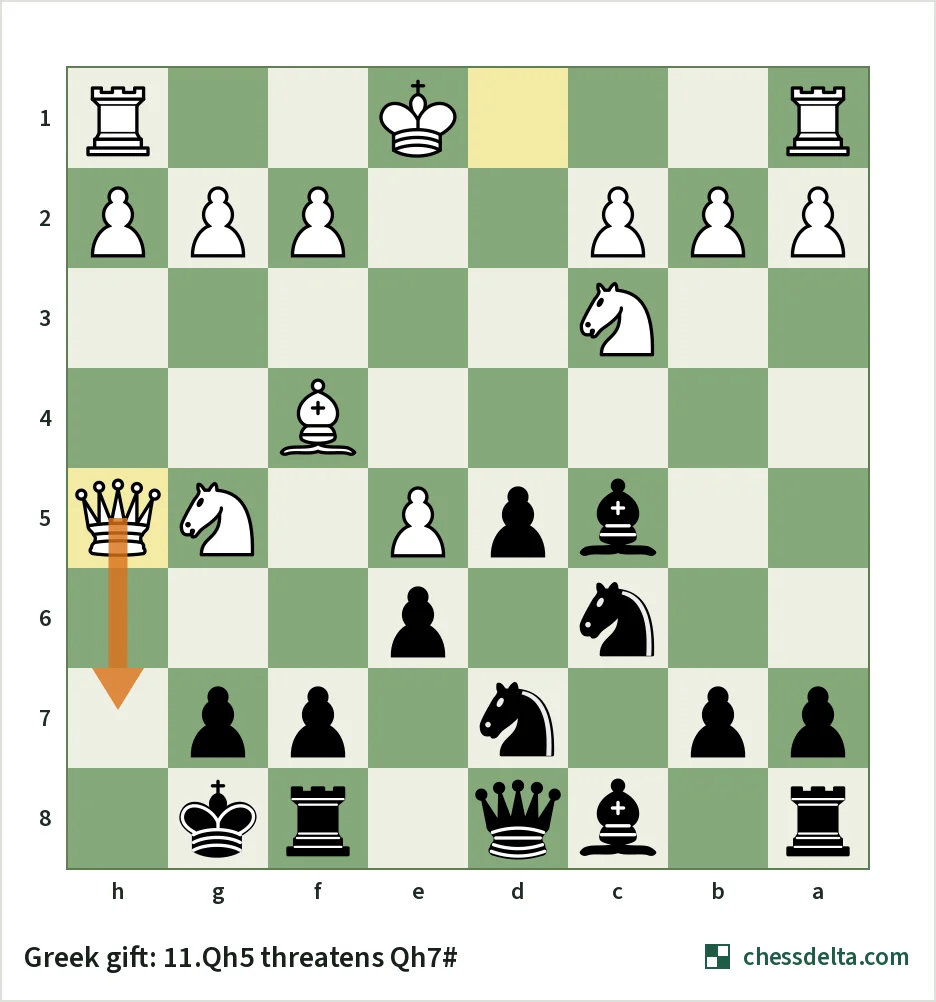
You have to give the queen for the knight, and White is winning. The king walk 10…Kg6 lasts longer, but White is still winning.
So what should you play instead of castling? Play 8…a6 and keep the king in the center for now. The position is equal.
How to play against the French Defense
Playing White against the French? Your choice comes down to how much theory you want to learn.
- Main line, 3.Nc3. White is slightly better. Learn the Winawer and the Classical Variation, the 2 most common replies.
- Advance Variation, 3.e5. A small edge for White. You get space and a clear plan: c3, Nf3, then a3 and b4.
- Tarrasch Variation, 3.Nd2. Close to equal. No Winawer pin, and Black’s …c5 often leaves an isolated d-pawn.
- Exchange Variation, 3.exd5. Close to equal. Easy to play, but the position is level enough that Black is rarely in danger.
- King’s Indian Attack, 2.d3. A setup with Nf3, g3 and Bg2 against everything. The position is equal.
Learn the French Defense in 5 moves
If you only remember 5 things as Black, make it these:
- Play 1…e6 and 2…d5. Against 3.e5, play 3…c5 at once.
- Against the Advance, pile up on d4 with …Nc6 and …Qb6, and don’t grab d4 with the knight while Bb5+ works.
- Against 3.Nc3, pick one line: 3…Bb4 for the Winawer or 3…Nf6 for the Classical.
- Against 3.Nd2, play 3…c5. Against 3.exd5, take back and develop.
- Don’t castle short while h7 is undefended. Play …c5 and …f6 first.
[Event "French Defense: Advance Variation starter line"]
[Result "*"]
1. e4 e6 2. d4 d5 3. e5 c5 4. c3 Nc6 5. Nf3 Qb6 6. a3 c4 7. Nbd2 Na5 *
[Event "French Defense: Classical Variation starter line"]
[Result "*"]
1. e4 e6 2. d4 d5 3. Nc3 Nf6 4. Bg5 Be7 5. e5 Nfd7 6. Bxe7 Qxe7 7. f4 O-O 8. Nf3 c5 *
Play both lines out on a board. Each one ends with White a little better at most.
FAQ
Is the French Defense good for beginners?
Yes, the French Defense is good for beginners. The pawn structure tells you the plan: hit d4 with …c5 and e5 with …f6. Learn the 2 traps above, then read the chess opening principles.
New to the game? Start with chess for beginners.
Why is the French bishop called bad?
The French bishop is called bad because its own pawns block it. The French Defense puts your pawns on e6 and d5, both light squares, and the c8 bishop moves on light squares too. Trade it or bring it out via d7 and b5.
What is the best response to the French Defense?
The best responses to the French Defense are 3.Nc3 and 3.e5. Both give White a small edge, with 3.Nc3 a touch more. Pick 3.e5 if you want a simple plan and less theory.
Is the French Defense better than the Caro-Kann?
The French Defense is not better than the Caro-Kann, and not worse either. White keeps a small edge after 2…d5 in both. So the real difference is the c8 bishop.
In the Caro-Kann Defense the bishop comes out before …e6. In the French it stays in, but you get …c5 in one move.
Is the French Defense passive?
No, the French Defense isn’t passive. You give up space, but …c5 and …f6 attack White’s center directly. In the Winawer, you even give up the g7 and h7 pawns to attack in the center.
Want a sharper start? See the Sicilian Defense.
Updated November 25, 2026.