Quick answer: Yes, but only if your opponent blunders. As White, play 1.d4 f5 2.Bg5 h6 3.Bh4 g5 4.e4, and if Black grabs the bishop with 4…gxh4??, then 5.Qh5 is checkmate. As Black, From’s Gambit can end 1.f4 e5 2.fxe5 d6 3.exd6 Bxd6 4.Nf3 g5 5.h3?? Bg3#. Want it even faster? Scholar’s Mate wins in 4 moves.
Part of our chess openings guide.
Can you really win chess in 5 moves?
Yes, you can win a chess game in 5 moves, but only if your opponent makes a big mistake. No opening forces it against good defense. The fastest mate of all, Fool’s Mate, takes 2 moves: see how to win chess in 2 moves.
So what do the 4 to 6 move mates in beginner games have in common? The king is still at home, and an early pawn move has opened a line toward it. The usual target is f7 (f2 for White), which only the king guards at the start.
How do you win chess in 4 moves with Scholar’s Mate?
Scholar’s Mate is the 4-move checkmate: 1.e4 e5 2.Bc4 Nc6 3.Qh5 Nf6?? 4.Qxf7#. White’s queen and bishop both hit f7, and the queen takes there with mate. Step through the move player below and watch the threat build.
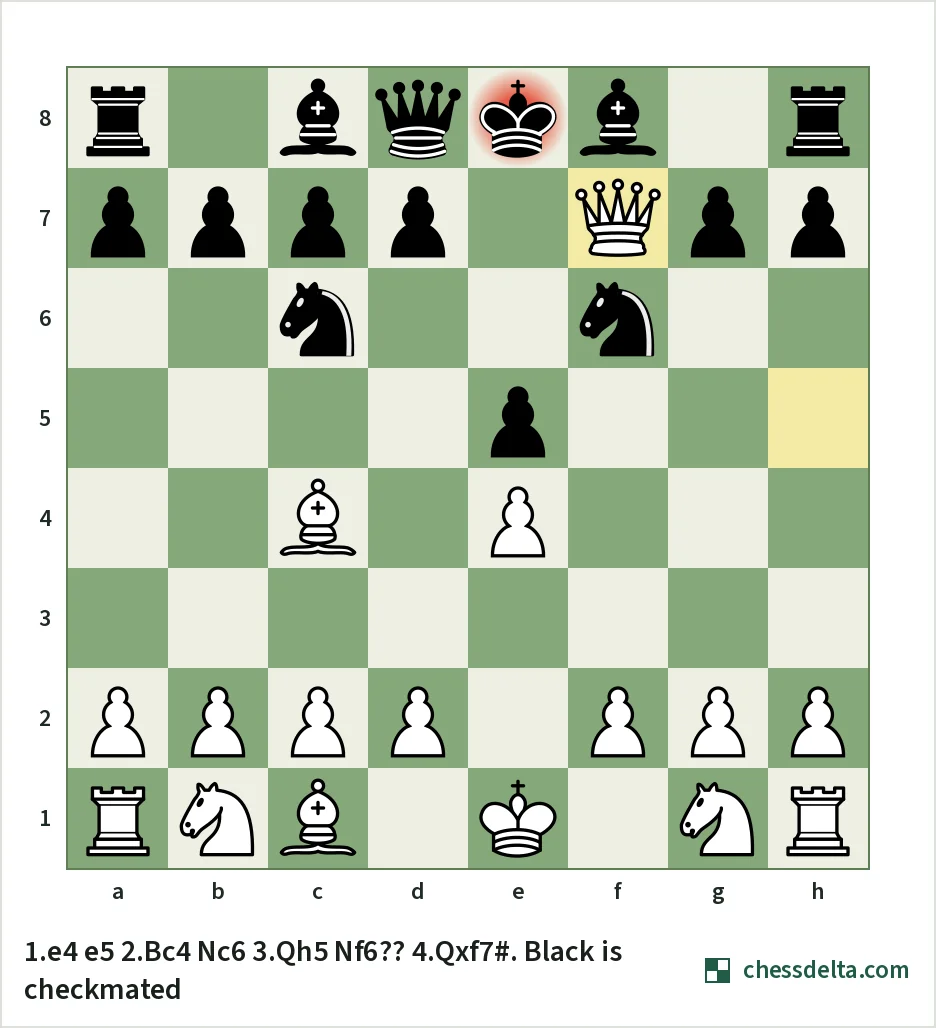
Don’t expect the exact same moves every time. White might bring the queen out first with 2.Qh5, or use Qf3 instead of Qh5. Look for the pattern: queen plus bishop, both aimed at f7.
So how do you stop it? Scholar’s Mate only works if Black ignores the threat. After 3.Qh5, the move 3…g6 blocks the queen’s path to f7 and attacks the queen.
What if White tries again with 4.Qf3? Then 4…Nf6 stops the mate a second time. Black is now slightly better, with pieces developed while White’s queen has moved twice.
Want to see that defense move by move? Our chess for beginners guide walks through it.
And this trick is old. Francis Beale named and described it in The Royall Game of Chesse-Play, a 1656 book based on the work of Gioachino Greco.
To learn more, read our full Scholar’s Mate guide, with the full defense and how to punish the early queen.
How does White win chess in 5 moves?
White can win in 5 moves against the Dutch Defense: 1.d4 f5 2.Bg5 h6 3.Bh4 g5 4.e4 gxh4?? 5.Qh5#. Black’s f-pawn and g-pawn have both left the king, so the queen mates on the e8-h5 diagonal.
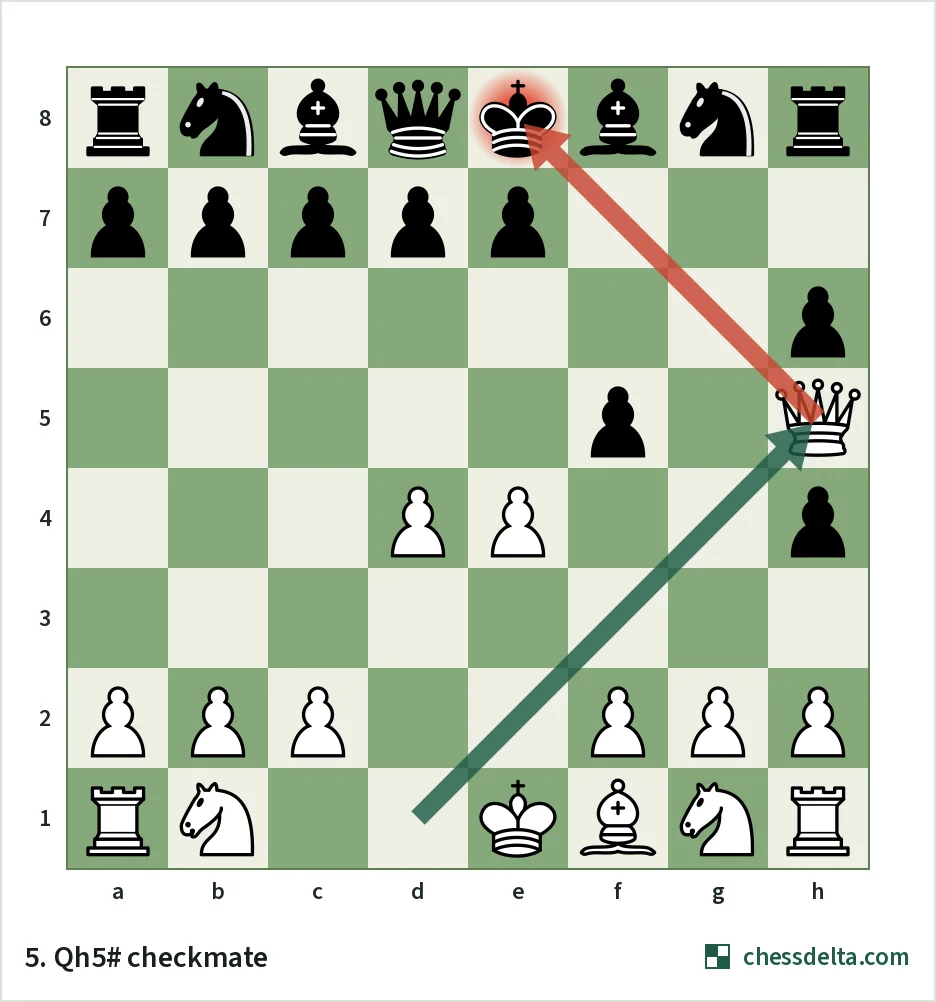
The key move is 4.e4. Why leave the bishop hanging on h4? Because 4.e4 opens the d1-h5 diagonal for the queen.
If Black takes the bishop, 5.Qh5 is mate. The g6 and f7 squares are empty, so nothing can block.
Taking the other pawn loses too: 4…fxe4?? 5.Qh5#. So which replies are safe? 4…Bg7 and 4…Nf6. 4…Bg7 is slightly stronger, and 4…Nf6 covers h5 and attacks the e4 pawn.
What makes this trap sneaky? It needs only 1 error from Black: taking the bishop.
In fact, 3…g5 is Black’s strongest move here, but it weakens the king. Follow it with 4…Bg7 or 4…Nf6, never 4…gxh4??.
How does Black win chess in 5 moves?
Black can win in 5 moves in From’s Gambit: 1.f4 e5 2.fxe5 d6 3.exd6 Bxd6 4.Nf3 g5 5.h3?? Bg3#. The culprit is White’s first move: 1.f4 opened the e1-h4 diagonal, and the bishop on d6 uses it.
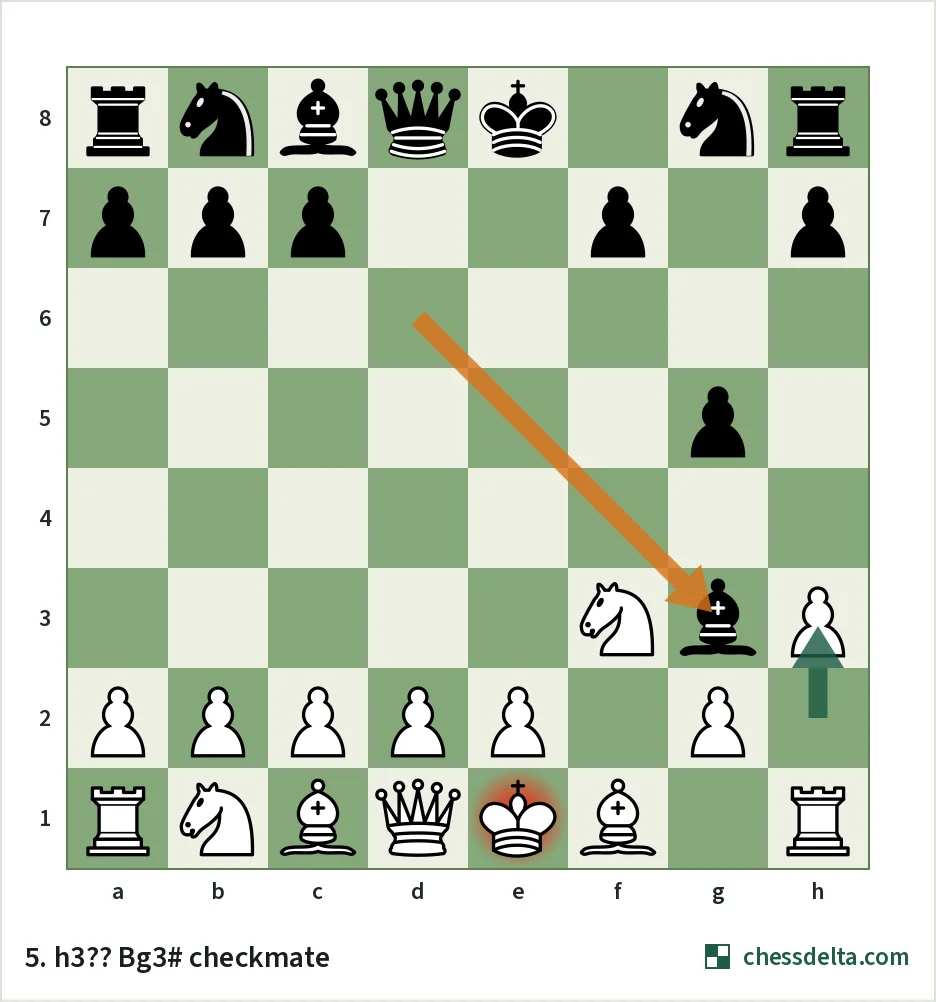
Why would Black give up 2 pawns this early? To open lines toward White’s king. The gambit is named after the Danish player Martin Severin From (1828 to 1895).
After 4…g5, Black threatens 5…g4 to push the knight off f3. So where does White go wrong? With 5.h3??, which moves the only pawn that guards g3.
Play 5.d4 or 5.g3 instead, and keep the h2 pawn at home.
What if White plays 4.Nc3 in From’s Gambit?
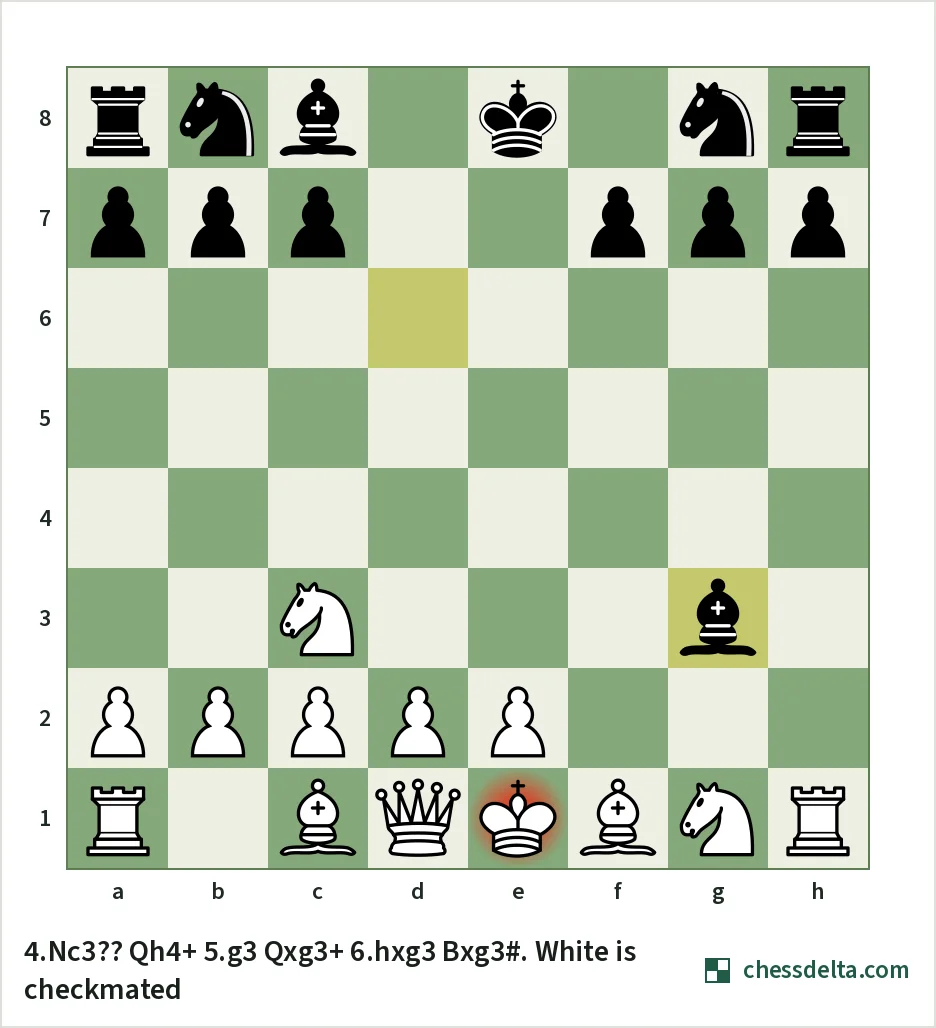
The move 4.Nc3?? loses at once: 1.f4 e5 2.fxe5 d6 3.exd6 Bxd6 4.Nc3?? Qh4+ 5.g3 Qxg3+ 6.hxg3 Bxg3#. A knight on f3 would stop …Qh4+, which is why 4.Nf3 is the move to remember.
Which other checkmates happen in about 5 moves?
Other checkmates that happen in about 5 moves include the Caro-Kann smothered mate, Legal’s Mate and the Blackburne Shilling Gambit. Here are the fast mates beginners meet most, from 2 to 7 moves.
Each one needs at least 1 blunder from the losing side. Check the mistake column: that’s the move to avoid in your own games.
| Mate | Moves | Winner | Mating move | The mistake |
|---|---|---|---|---|
| Fool’s Mate | 2 | Black | 2…Qh4# | White moves the f-pawn and g-pawn |
| 3-move mate | 3 | White | 3.Qh5# | Black moves the f-pawn and g-pawn 2 squares each |
| Scholar’s Mate | 4 | White | 4.Qxf7# | 3…Nf6?? ignores the threat to f7 |
| Dutch Defense trap | 5 | White | 5.Qh5# | 4…gxh4?? takes the bishop |
| From’s Gambit | 5 | Black | 5…Bg3# | 5.h3?? leaves g3 unguarded |
| Caro-Kann smothered mate | 6 | White | 6.Nd6# | 5…Ngf6?? walks into a pin |
| Legal’s Mate | 7 | White | 7.Nd5# | 5…Bxd1?? grabs the queen |
| Blackburne Shilling Gambit | 7 | Black | 7…Nf3# | 5.Nxf7?? grabs a second pawn |
The smothered mate in the Caro-Kann
The Caro-Kann has a 6-move trap: 1.e4 c6 2.d4 d5 3.Nc3 dxe4 4.Nxe4 Nd7 5.Qe2 Ngf6?? 6.Nd6#. The queen on e2 pins the e7 pawn to the king, so the pawn can’t take the knight. Every Black move before 5…Ngf6?? looks normal, which is why this one catches people.
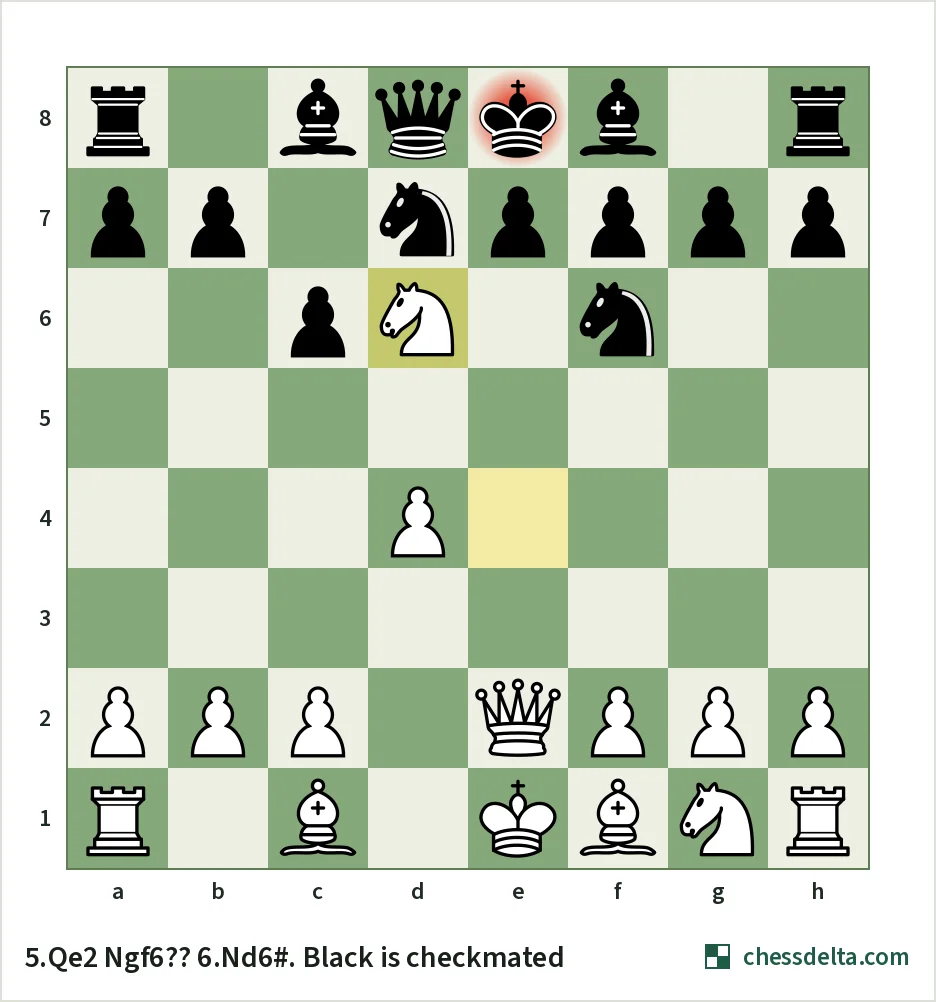
Why “smothered”? It’s a knight checkmate where the king’s own pieces block every escape square. Our chess terms glossary has the other mate names.
So how do you dodge it as Black? After 5.Qe2, play 5…Ndf6 instead. It frees d7 for the king, so Nd6+ is no longer mate.
Legal’s Mate and the Blackburne Shilling Gambit
Legal’s Mate and the Blackburne Shilling Gambit both take 7 moves, and both punish greed. In Legal’s Mate, White gives up the queen and mates with 3 minor pieces. In the Blackburne Shilling, Black punishes a white knight that grabs on e5 and f7.
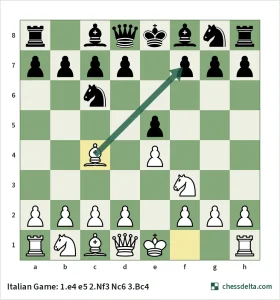
Both grow out of 1.e4 e5 2.Nf3 Nc6 3.Bc4 and its neighbors. To learn more, read our full Italian Game guide, which plays through both traps in the move player.
How do you stop fast checkmates?
You stop almost every fast checkmate with 4 habits. None of them needs memorized lines.
- Guard f7 (f2 as White). When a queen and bishop both aim at it, block the line or add a defender. Against Scholar’s Mate, 3…g6 or 3…Qe7 does it.
- Don’t push the f-pawn and g-pawn early in the same game. Together they open the diagonal from the enemy queen to your king. Fool’s Mate, the Dutch trap and From’s Gambit all work this way.
- Check what the queen can reach before you take a free piece. In the Dutch trap, 4…gxh4 wins a bishop and loses the game.
- Leave the pawns in front of your king alone. In From’s Gambit, the h2 pawn guards g3. Moving it with 5.h3 took away the last guard.
Castling early helps too: it takes the king away from f7 and the e8-h5 diagonal. All 4 habits come from the opening principles. To learn more, read our full guide to the chess opening principles.
Should you play for a 5-move checkmate?
No, you shouldn’t play for a 5-move checkmate as your main plan. Every trap here relies on a blunder. Against good defense, Scholar’s Mate leaves White with no advantage.
So is attacking f7 a bad idea? Not when it follows development. The Fried Liver Attack and the Two Knights Defense both fight over f7 with more pieces out.
And if you play Black? The Traxler Counterattack is Black’s sharp reply, aimed at f2.
Want openings that are sound and still set natural traps? Start with our picks of the best chess openings for White and the best chess openings for Black.
FAQ
What is the fastest checkmate in chess?
Fool’s Mate is the fastest checkmate in chess. White moves the f-pawn and g-pawn, and Black mates with the queen on h4 on move 2.
What is the 4-move checkmate called?
The 4-move checkmate is called Scholar’s Mate. White’s queen and bishop attack f7, and the queen captures there with mate on move 4.
Can you checkmate in 3 moves?
Yes, you can checkmate in 3 moves. If Black pushes both the f-pawn and the g-pawn 2 squares, White can mate with Qh5 on move 3. Think of it as Fool’s Mate with the colors reversed.
Does Scholar’s Mate work against good players?
No. One defending move such as 3…g6 stops it, and White’s queen has then come out early for nothing. Against new players, though, it still catches plenty.
Is checkmate the only way to win a chess game?
No. You also win when your opponent resigns or runs out of time, as long as you could still checkmate with some series of legal moves. To learn more, read our full guide to the chess rules, with every way a game can end.
Next step
- Chess openings: every opening guide in one place
- Italian Game: the opening behind most f7 traps
- Chess opening principles: the habits that stop fast mates
- How to win chess in 2 moves: Fool’s Mate and its versions
- Chess for beginners: what to learn first
Updated .