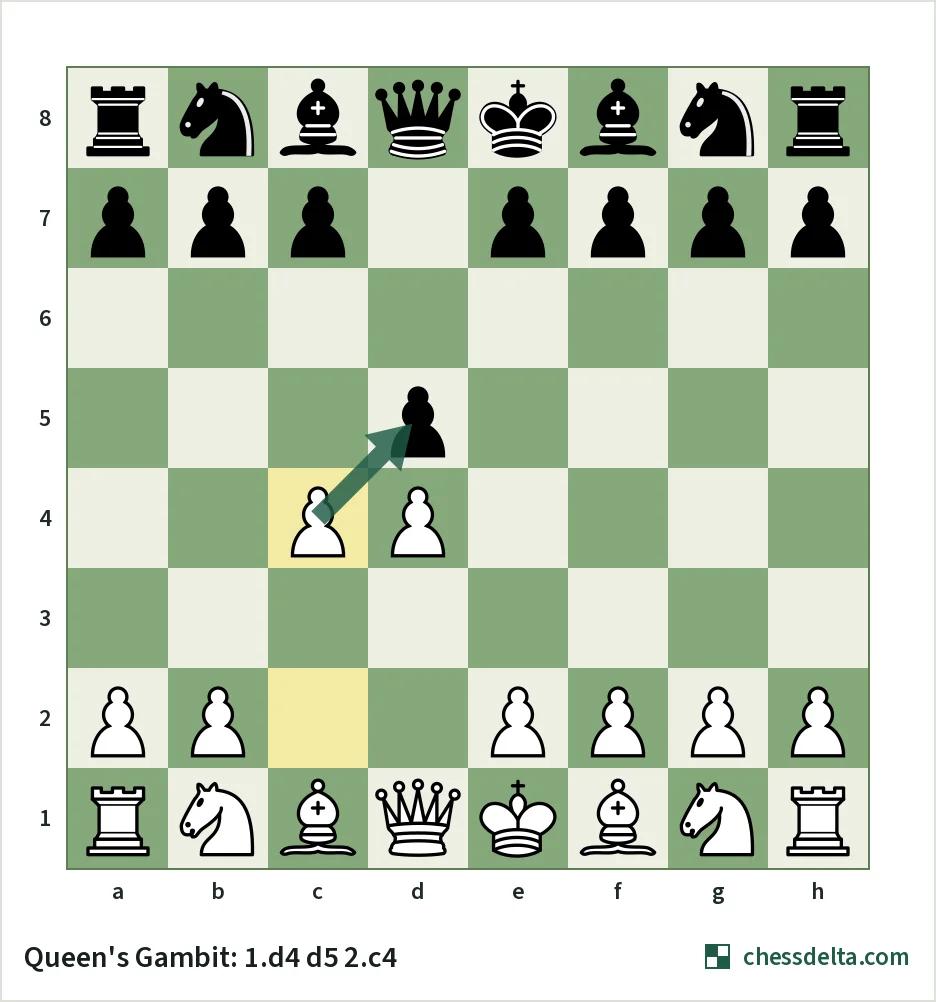
Quick answer: The Queen’s Gambit opening starts 1.d4 d5 2.c4. White offers the c4 pawn to pull Black’s d-pawn away from the center. Black can take with 2…dxc4 (Accepted), hold with 2…e6 (Declined) or play 2…c6 (Slav Defense). With best play the game is equal, but White gets easy, lasting pressure.
At a glance
- Moves: 1.d4 d5 2.c4.
- Type: Queen’s pawn opening. ECO codes D06 to D69.
- White’s idea: trade a wing pawn for Black’s center pawn, then build a big center with e4.
- Black’s main replies: 2…e6, 2…c6 and 2…dxc4.
- Good for: you, if you like a space edge and clear plans more than early tactics.
What is the Queen’s Gambit?
The Queen’s Gambit is the opening 1.d4 d5 2.c4, and this page covers the chess opening, not the TV series. Why hit d5 so early? Your c-pawn attacks it before Black can build a solid center.
The idea has lasted. It appears in the Göttingen manuscript of 1490, which makes it one of the oldest openings still played. In the 1927 World Championship match, Capablanca and Alekhine played it in 32 of their 34 games.
You’ll find it with the queen’s pawn openings in our chess openings directory.
Why is the Queen’s Gambit not a real gambit?
The Queen’s Gambit is not a real gambit because White gets the pawn back. Black can take on c4, but can’t keep the pawn without getting a worse game.
Want proof? Try 1.d4 d5 2.c4 dxc4 3.Qa4+. The queen checks, then takes back on c4 within a few moves, and the game is equal.
You don’t even need the queen. Most players prefer 3.e3 or 3.Nf3 and win the pawn back with Bxc4 a few moves later.
The main line: Queen’s Gambit Declined
The main line runs 1.d4 d5 2.c4 e6 3.Nc3 Nf6 4.Bg5 Be7 5.e3 O-O 6.Nf3. Opening databases call 2…e6 the Queen’s Gambit Declined, Black’s classical main reply. Step through it on the board below, one move at a time.
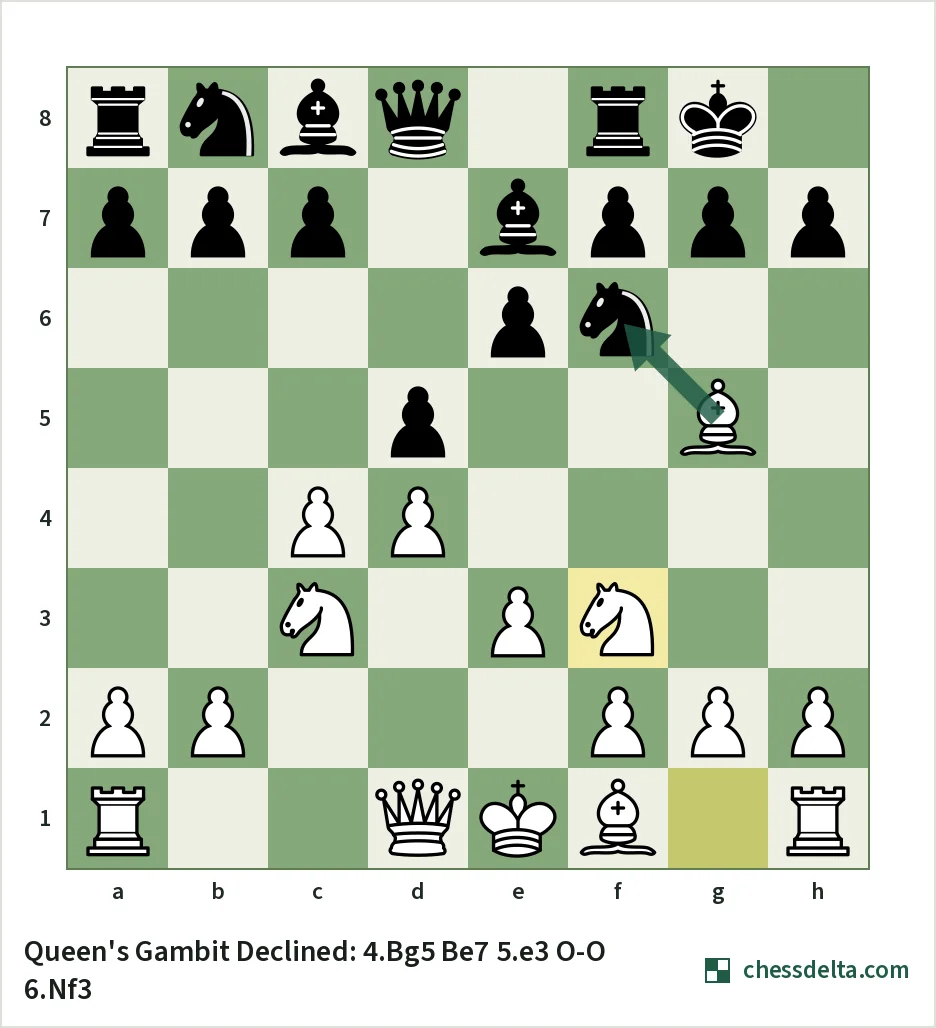
- 3.Nc3. The knight adds a second attacker to d5.
- 4.Bg5. The bishop pins the f6 knight, one of the d5 defenders.
- 5.e3 and 6.Nf3. White opens a path for the f1 bishop and gets ready to castle.
So who’s better after 6.Nf3? Nobody yet: the game is equal. Black’s position is solid, but the c8 bishop is shut in behind the e6 pawn.
Remember that bishop. Freeing it is a big part of Black’s plan below.
The ideas for both sides
White’s plan
- Keep pressure on d5 with c4, Nc3 and often cxd5.
- Push e4 when Black lets you. Then you have a full pawn center.
- Develop fast and castle kingside. After cxd5 exd5, use the half-open c-file.
Black’s plan
- Keep a pawn on d5, so White never gets e4 for free.
- Free your position later with …c5 or …e5.
- Find a good square for the c8 bishop. It’s your problem piece in the Declined.
Queen’s Gambit Accepted: 2…dxc4
In the Queen’s Gambit Accepted, 1.d4 d5 2.c4 dxc4, Black takes the pawn and gives up the center for a while. So can White get it back? Yes: all 3 main replies regain it.
- 3.e4. White takes the whole center at once. The game is equal, or slightly better for White.
- 3.Nf3. The most common reply. After 3…Nf6 4.e3 e6 5.Bxc4 c5 6.O-O the game is equal.
- 3.e3. Opens the f1 bishop to take on c4. Equal.
Why holding the pawn with …b5 fails
Defending c4 with …b5 is the classic beginner mistake. Why does it fail? After 1.d4 d5 2.c4 dxc4 3.e3 b5 4.a4, the a-pawn attacks b5, the pawn that holds c4.
White is already clearly better. And if Black keeps going with 4…c6 5.axb5 cxb5??, the long diagonal opens: 6.Qf3.
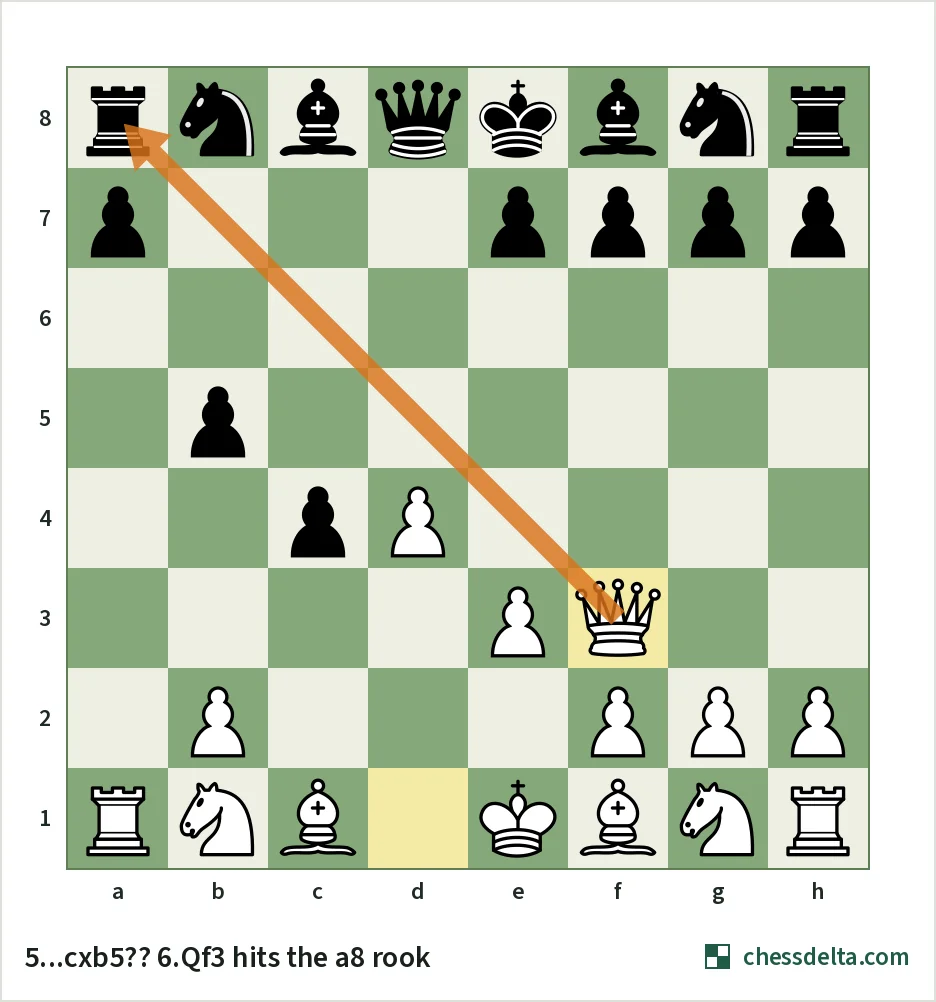
The queen hits the rook on a8, and you can’t save it. Block with 6…Nc6 and 7.Qxc6+ takes the knight instead. White wins material and is winning. Opening databases list 3.e3 as the Old Variation of the Accepted.
Queen’s Gambit Declined: 2…e6
In the Queen’s Gambit Declined, 1.d4 d5 2.c4 e6, Black defends d5 with a pawn and keeps a firm center. What’s the catch? The c8 bishop, which stays shut in behind the e6 pawn.
White has 2 good setups against it:
- 4.Bg5, the main line above. Equal, with lasting pressure on d5.
- The Exchange Variation, 4.cxd5 exd5 5.Bg5. Also equal. The pawn structure is fixed, which makes the plan easy to learn.
The minority attack
The minority attack is White’s plan in the Exchange Variation. Why attack with 2 pawns against 3? White pushes b4 and b5 to leave Black with a weak pawn on c6.
1.d4 d5 2.c4 e6 3.Nc3 Nf6 4.cxd5 exd5 5.Bg5 c6 6.e3 Be7 7.Bd3 O-O 8.Qc2 Nbd7 9.Nf3 Re8 10.O-O Nf8 11.Rab1
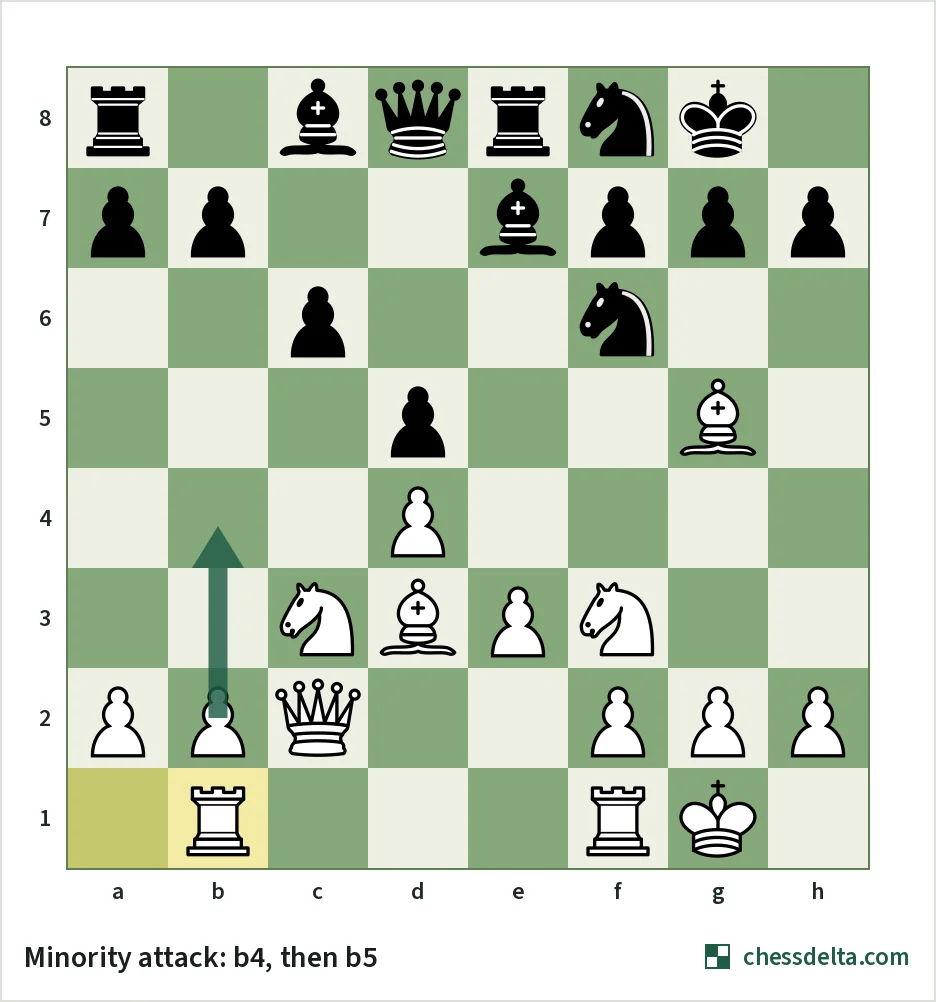
The rook backs up b4 and b5. After bxc6, Black is left with a weak pawn on c6 or d5. The game is still equal, but White has the clear plan, and Black has to defend.
Slav Defense: 2…c6
The Slav Defense, 1.d4 d5 2.c4 c6, protects d5 with the c-pawn instead of the e-pawn. Remember the shut-in bishop in the Declined? Here the c8 bishop stays free to come out to f5 or g4.
Play 3.Nf3 Nf6 4.Nc3, and the game is about equal. If Black takes with 4…dxc4, answer 5.a4 so …b5 can’t hold the pawn. After 5…Bf5 6.e3 e6 7.Bxc4 White has the pawn back and a small edge.
Want something quieter? The Exchange Variation, 3.cxd5 cxd5, also gives White a small edge.
Albin Countergambit: 2…e5
The Albin Countergambit, 1.d4 d5 2.c4 e5, is a real gambit by Black. After 3.dxe5 d4, the d4 pawn cramps White, and Black plays for an attack.
It is named after Adolf Albin, who played it against Emanuel Lasker in New York in 1893.
So how do you stay safe as White? Play 4.Nf3 Nc6 5.g3, then Bg2 and Nbd2. White comes out slightly better.
The Lasker Trap
The Lasker Trap punishes 4.e3. It runs 1.d4 d5 2.c4 e5 3.dxe5 d4 4.e3 Bb4+ 5.Bd2 dxe3 6.Bxb4?? exf2+ 7.Ke2 fxg1=N+.
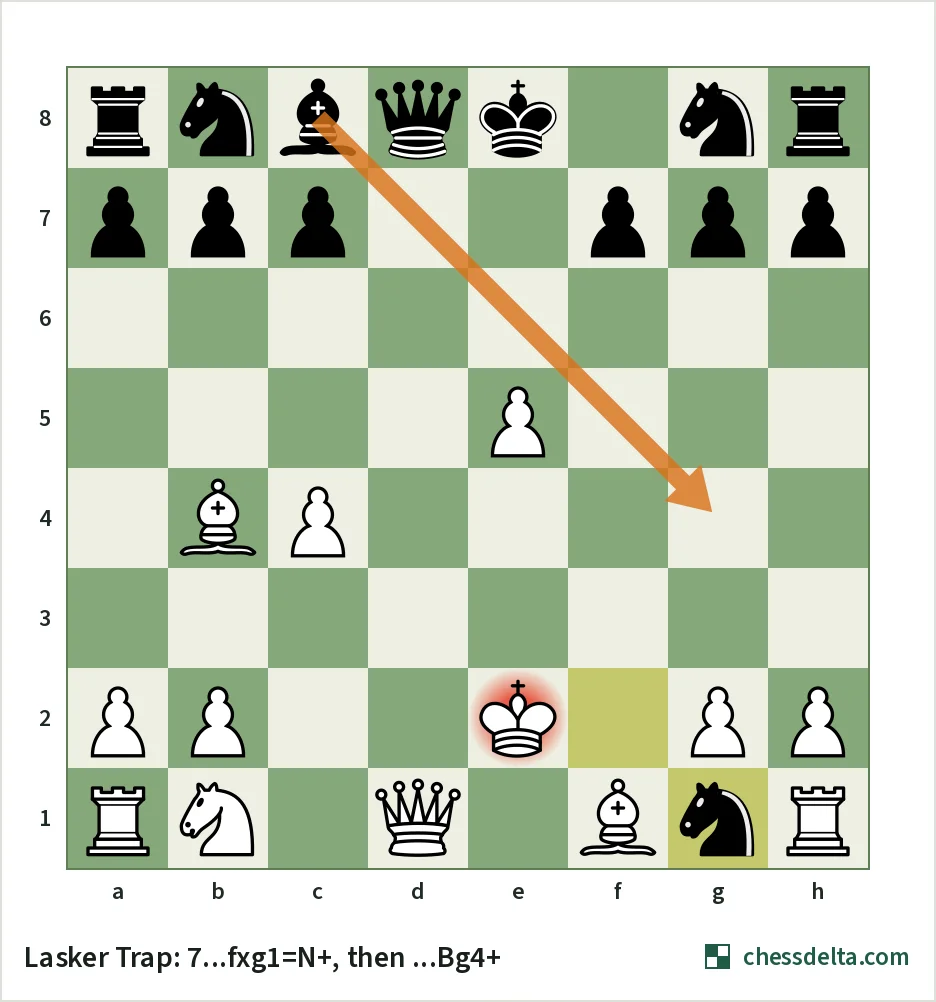
The pawn promotes to a knight with check, a rare underpromotion in a real game. After 8.Rxg1 Bg4+ the bishop skewers the king and the queen on d1, and Black is winning. 8.Ke1 Qh4+ is no better.
White had to play 6.fxe3, which keeps the game equal. Better still, play 4.Nf3 and the trap never happens.
Common traps in the Queen’s Gambit
The Elephant Trap
The Elephant Trap is a trap for White in the Queen’s Gambit Declined. It runs 1.d4 d5 2.c4 e6 3.Nc3 Nf6 4.Bg5 Nbd7 5.cxd5 exd5 6.Nxd5?? Nxd5 7.Bxd8 Bb4+.
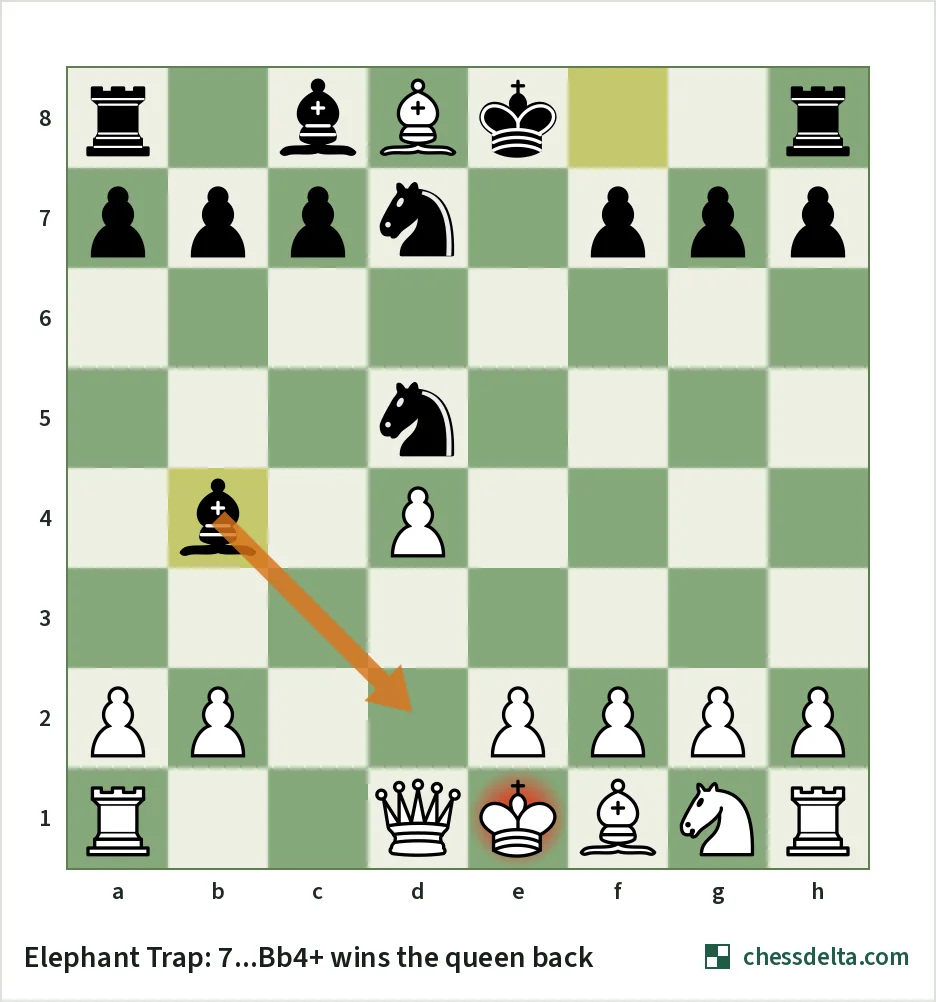
Why did White fall for it? The d5 pawn looked free because the f6 knight was pinned to the queen. It wasn’t.
After 6…Nxd5 Black gives up the queen, then 7…Bb4+ forces 8.Qd2 Bxd2+ 9.Kxd2 Kxd8. Black is a piece up for a pawn and winning.
So don’t take on d5 here. Play 5.e3 and develop, and the game stays equal.
The …b5 pawn grab
You saw the Queen’s Gambit Accepted trap 3.e3 b5? 4.a4 c6 5.axb5 cxb5?? 6.Qf3 above. Take the pattern with you: when Black’s c-pawn and b-pawn leave, Qf3 hits a8.
How should Black meet the Queen’s Gambit?
Black should meet the Queen’s Gambit with 2…e6 or 2…c6, and both keep the game equal. 2…dxc4 is equal too, as long as you give the pawn back. So pick the structure you like.
- 2…e6, Queen’s Gambit Declined. Solid and classical. Watch for the Elephant Trap pattern, and plan …c5 or …e5 to free the c8 bishop.
- 2…c6, Slav Defense. Develop the bishop to f5 before you play …e6.
- 2…dxc4, Queen’s Gambit Accepted. Give the pawn back, and use the time for …Nf6, …e6 and …c5.
- 2…e5, Albin Countergambit. Sharp, but slightly worse for Black against 4.Nf3 and 5.g3.
What about other replies? The Chigorin Defense (2…Nc6) and the Baltic Defense (2…Bf5) give White more. White is slightly better against the Chigorin and about a pawn better against the Baltic.
Learn the Queen’s Gambit in 5 moves
Short on time? Remember these 5 things:
- Play 1.d4 d5 2.c4, then Nc3, Nf3 and e3 or e4.
- Against 2…dxc4, don’t chase the pawn. Develop, and take back on c4 with the bishop.
- Against …b5, play a4. It attacks the pawn that holds c4.
- Against 2…e6, don’t grab d5 with Nxd5 while a knight sits on d7.
- Against 2…e5, play 4.Nf3, not 4.e3.
[Event "Queen's Gambit Declined: main line"]
[Result "*"]
1. d4 d5 2. c4 e6 3. Nc3 Nf6 4. Bg5 Be7 5. e3 O-O 6. Nf3 *
[Event "Queen's Gambit Accepted: 3.Nf3"]
[Result "*"]
1. d4 d5 2. c4 dxc4 3. Nf3 Nf6 4. e3 e6 5. Bxc4 c5 6. O-O *
FAQ
Is the Queen’s Gambit good for beginners?
Yes, the Queen’s Gambit is good for beginners. You develop every piece, castle and fight for the center, just as the chess opening principles ask. New to the game? Start with our chess for beginners guide.
Should Black accept the Queen’s Gambit?
Black can accept the Queen’s Gambit. 2…dxc4 is equal as long as you give the pawn back and develop. Try to hold it with …b5, though, and after 4.a4 White is clearly better.
Is the Queen’s Gambit better than the London System?
The Queen’s Gambit is not better than the London System: both give an equal game. The difference is style. The Queen’s Gambit fights for the center at once with 2.c4. The London System builds its setup first and asks for less theory.
What is the best response to the Queen’s Gambit?
The best response to the Queen’s Gambit is 2…e6 or 2…c6, the most popular replies. Both keep the game equal, and there is no refutation.
Read next
Updated November 25, 2026.