Quick answer: The Ponziani Opening starts 1.e4 e5 2.Nf3 Nc6 3.c3. White prepares d4 to build a big pawn center, and Qa4 is a common follow-up. Black’s best replies are 3…d5 and 3…Nf6, the Jaenisch Counterattack. With best play the game is equal, so treat it as a surprise weapon, not a route to an edge.
At a glance
- Moves: 1.e4 e5 2.Nf3 Nc6 3.c3
- Type: Open game (1.e4 e5). ECO code C44.
- White’s idea: play d4 next and take back on d4 with the c-pawn, keeping 2 pawns in the center.
- Black’s main replies: 3…Nf6 (Jaenisch Counterattack) and 3…d5. Rarer: 3…f5 (Ponziani Countergambit), 3…Be7 (Romanishin Variation) and 3…Nge7 (Réti Variation).
- Good for: 1.e4 players who want a sideline with few lines to learn and some early traps.
What is the Ponziani Opening?
The Ponziani Opening is White’s 3.c3 after 1.e4 e5 2.Nf3 Nc6. It’s far older than it looks. Lucena’s book discussed it as early as 1497, Domenico Ponziani analyzed it in 1769, and Howard Staunton promoted it in 1847. That’s why it was long called Staunton’s Opening or the English Knight’s Game.
You’ll mostly see it from White’s side here, with a section on how to meet it as Black. For other ways to start the game, see our guide to chess openings.
The move order
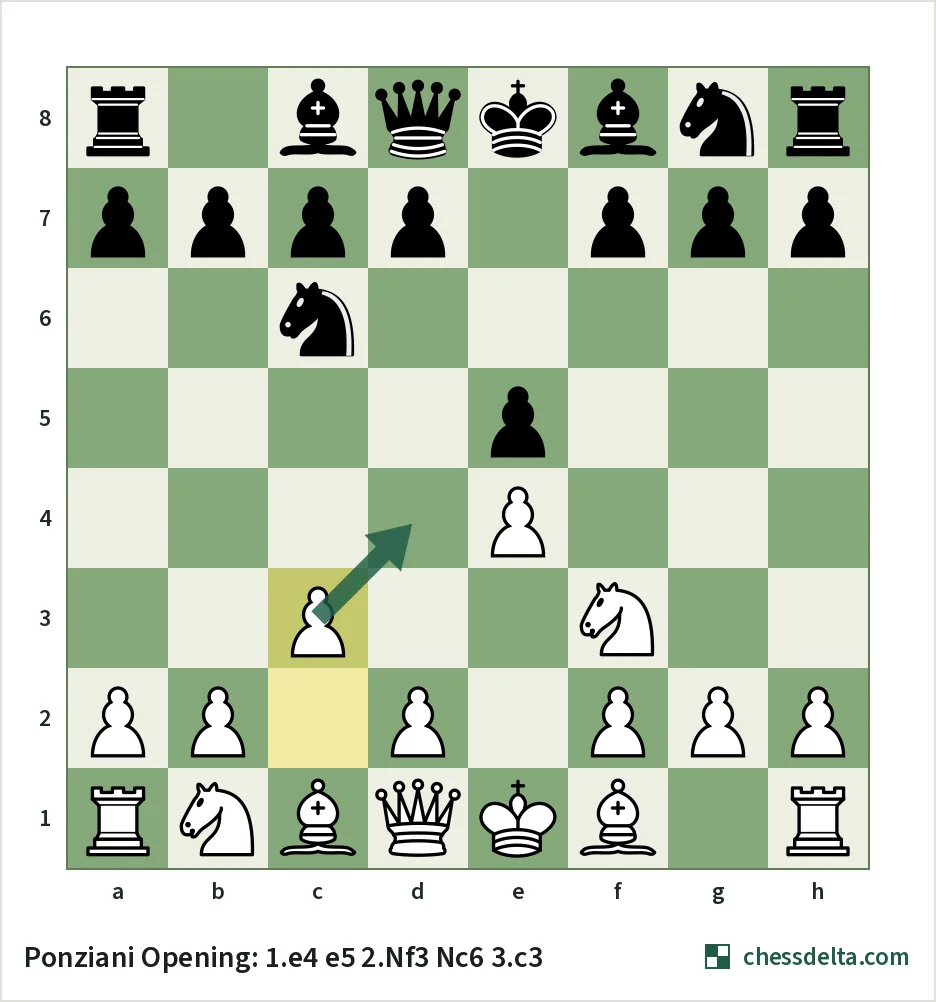
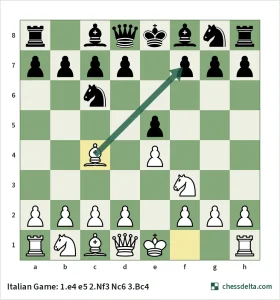
- 1.e4 e5. Both sides claim the center.
- 2.Nf3 Nc6. White attacks e5 and Black defends it.
- 3.c3. Why c3? The pawn covers d4. If Black does nothing, 4.d4 follows and you recapture on d4 with the c-pawn.
So what does 3.c3 cost you? Time. The pawn takes the best square from your queen’s knight, and you’ve developed only 1 piece. That’s why Black can hit back at once with …d5 or …Nf6.
The ideas for both sides
White’s plan
- Play d4 on move 4. If Black takes, take back with the c-pawn.
- Bring the queen out early. After …d5, Qa4 pins the c6 knight to Black’s king, so the knight stops guarding e5.
- When Black grabs e4, push d5 to kick the c6 knight. It’s the key idea in the Jaenisch Counterattack.
Black’s plan
- Strike at e4 before White plays d4. Both 3…d5 and 3…Nf6 do this.
- Develop fast. White’s queen’s knight is stuck behind c3 for a while.
- Watch the a4-e8 diagonal. White’s Qa4 and Bb5+ both use it, and the traps below show what happens if you forget.
The main branches of the Ponziani Opening
Jaenisch Counterattack: 3…Nf6
The Jaenisch Counterattack, 3…Nf6, attacks e4 at once. Do you defend the pawn? No. The main line goes 4.d4 Nxe4 5.d5, kicking the c6 knight, and 4.d4 keeps the game equal.
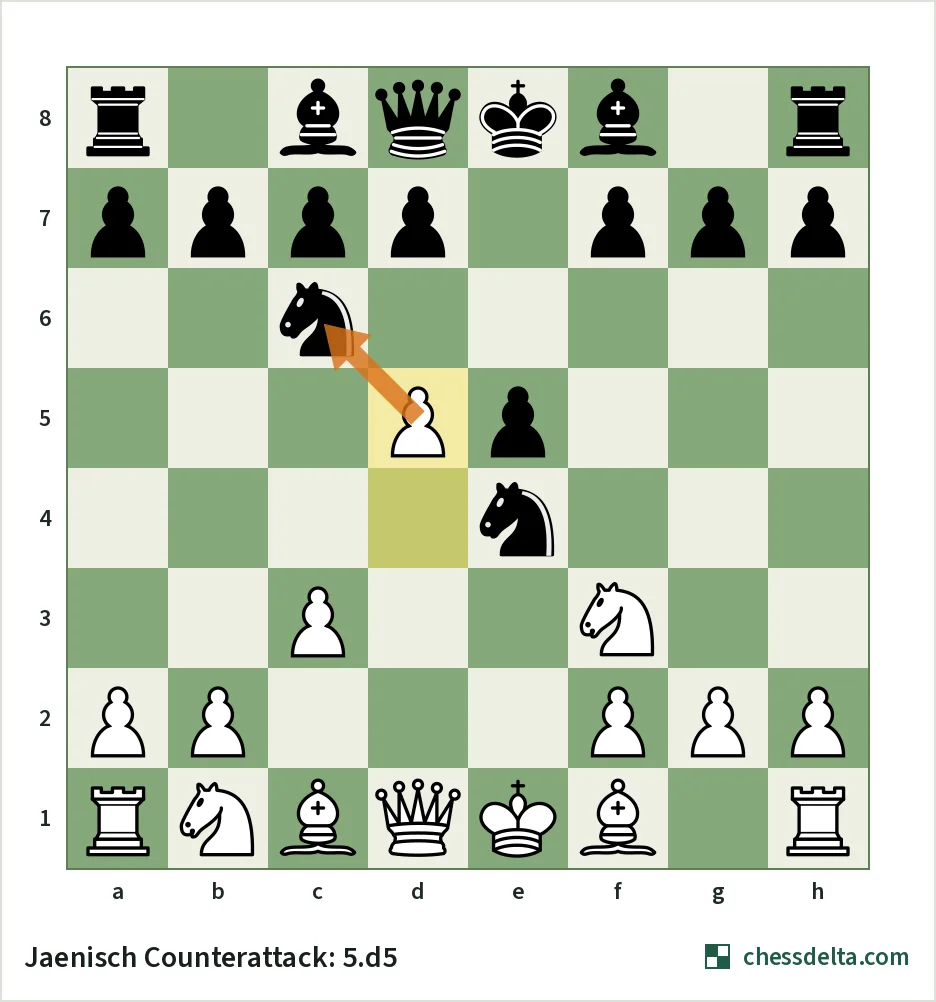
Now the knight on c6 has to decide. Black has 3 answers:
- 5…Ne7, the traditional line. 6.Nxe5 Ng6 follows. The old main line 7.Qd4 is equal. The stronger 7.Nxg6 hxg6 8.Qe2 leaves White slightly better.
- 5…Nb8, the retreat. The knight goes home, and after 6.Nxe5 the game is about equal.
- 5…Bc5, the Vukovic Gambit (also called the Fraser Defense). Black gives a piece for an attack on White’s king.
Want a calmer game? 5.Bd3 is the most accurate move at move 5, and it’s equal. After 5…d5 6.Nxe5 you’ve won the pawn back.
Black can also play 4…exd4 5.e5 Nd5, which is equal. Don’t be surprised to reach it from the Göring Gambit too.
Vukovic Gambit: 5…Bc5
The Vukovic Gambit is the sharpest answer to 5.d5. Black ignores the attacked knight: 6.dxc6 Bxf2+ 7.Ke2 Bb6 8.Qd5 Nf2 9.Rg1 O-O 10.cxb7 Bxb7 11.Qxb7 Qf6.
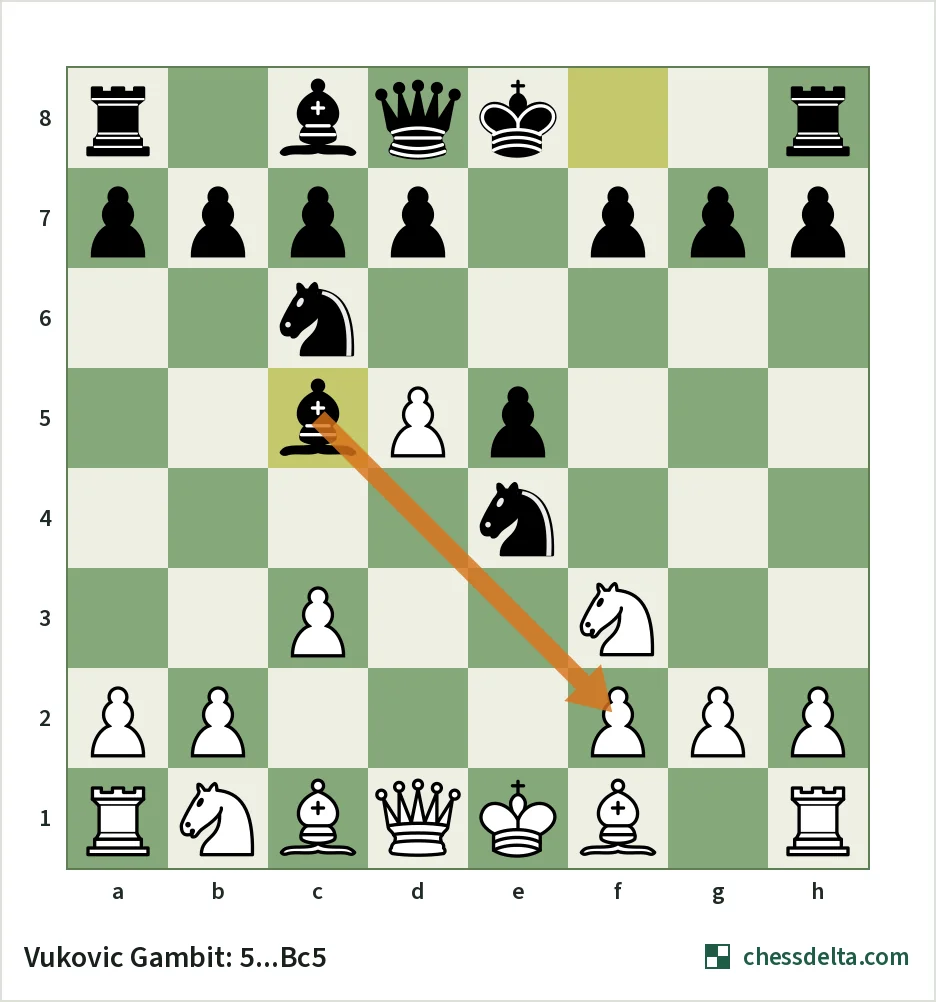
How can Black be a knight and a bishop down for 2 pawns and still be fine? White’s king is stuck on e2. In fact, 5…Bc5 is Black’s strongest move and leaves Black slightly better, and the main line ends about equal.
As White, you must find 6.dxc6. Other moves, such as 6.Be3? or 6.Qe2?, leave Black clearly better or winning. Step through the line in the move player to see how exposed White’s king gets.
3…d5 and 4.Qa4
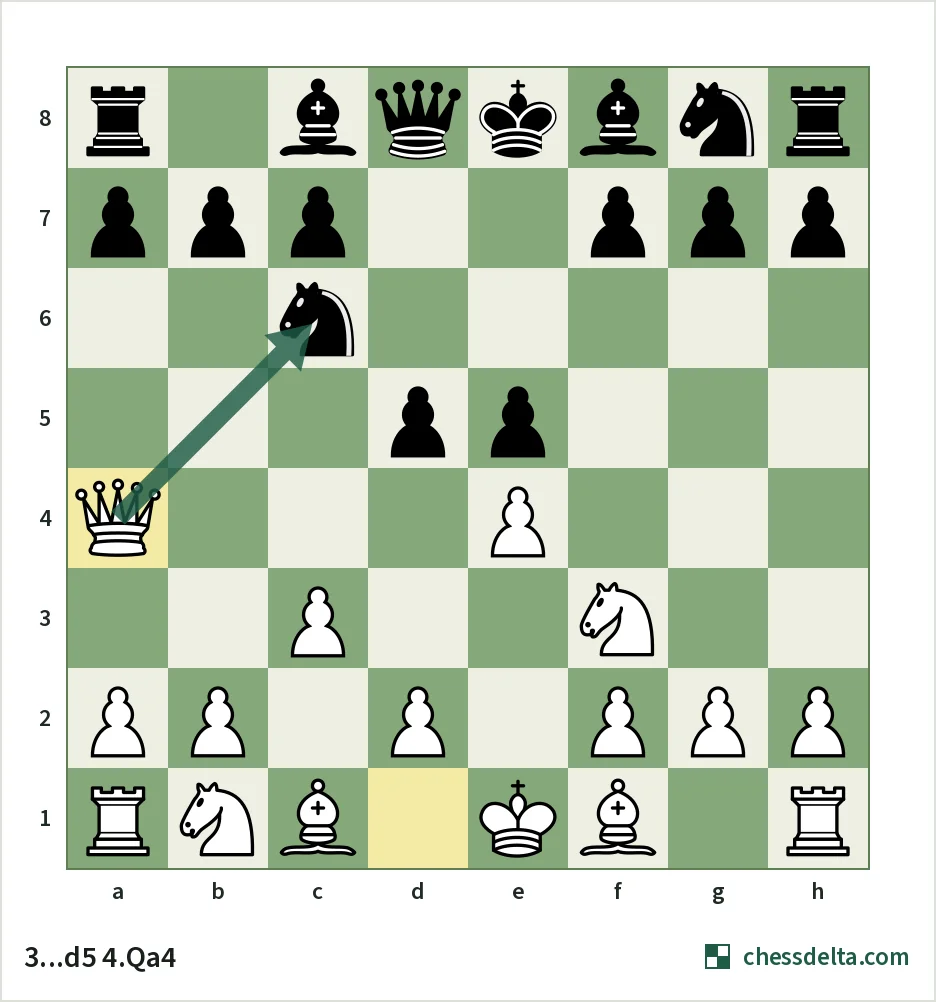
3…d5 is Black’s most accurate reply to the Ponziani, and the game stays equal. Your main answer is 4.Qa4. The queen pins the c6 knight to Black’s king, so 5.Nxe5 becomes a threat. Black has 3 main choices:
- 4…f6, the Steinitz Variation. Solid, and equal.
- 4…Nf6, the Leonhardt Variation. Black lets e5 go: 5.Nxe5 Bd6 is about equal.
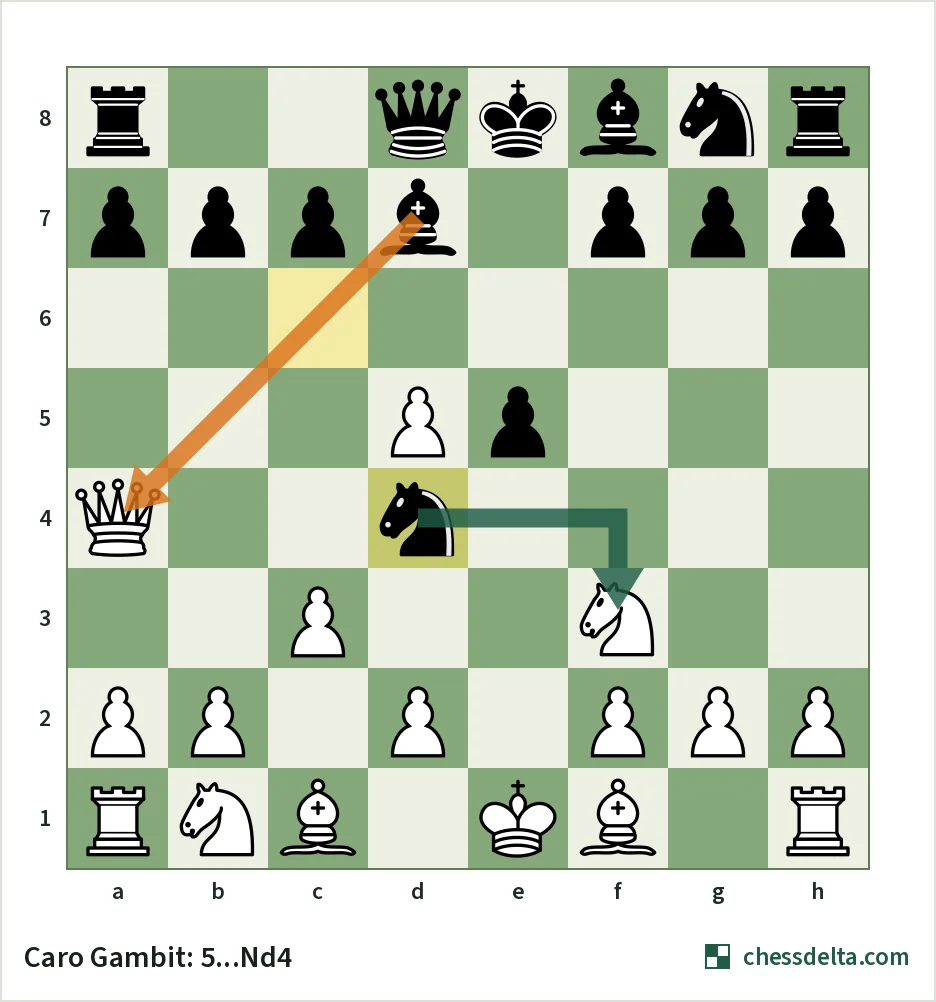
- 4…Bd7, the Caro Gambit. 5.exd5 Nd4 opens the bishop onto the queen. White must play 6.Qd1, and the game is equal.
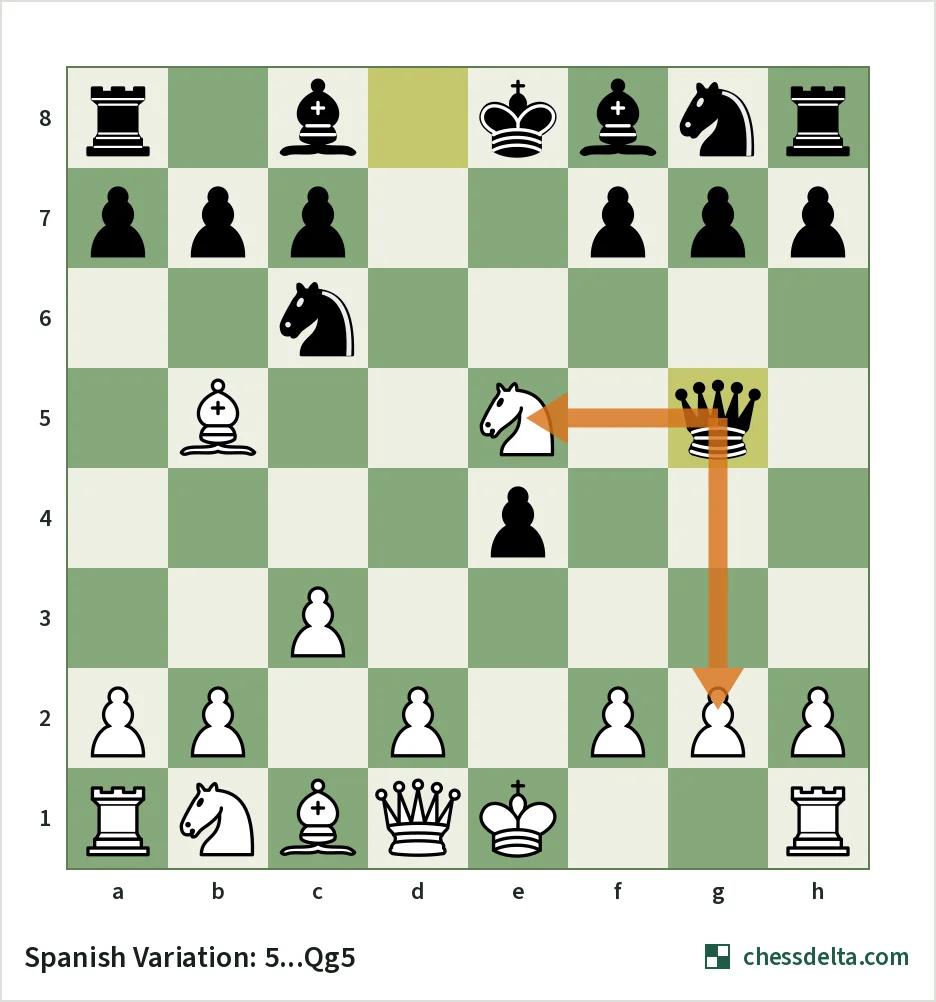
Avoid the Spanish Variation, 4.Bb5. It looks natural, but after 4…dxe4 5.Nxe5 Qg5 Black is clearly better (see the traps below).
Ponziani Countergambit: 3…f5
The Ponziani Countergambit hits e4 with the f-pawn. You have 2 good answers: 4.exf5 is the most accurate, and 4.d4 also keeps it equal.
Romanishin Variation and Réti Variation
The Romanishin Variation, 3…Be7, is too slow: 4.d4 makes White slightly better. The Réti Variation, 3…Nge7, is met by 4.Bc4, and White is slightly better there too.
Typical plans in the middlegame
- The d4-d5 squeeze. In the 5.d5 lines White gains space, and Black’s knights run short of squares. White’s queen often comes to d4 or e2 to hit a knight on e4.
- Fast development after the queen moves. White plays Bd3 or Bc4, castles, and brings the b1 knight out via d2.
- Black’s counterplay on f2. In the Vukovic Gambit, Black’s pieces swarm f2 and e2 while White’s king can’t castle.
Common traps in the Ponziani Opening
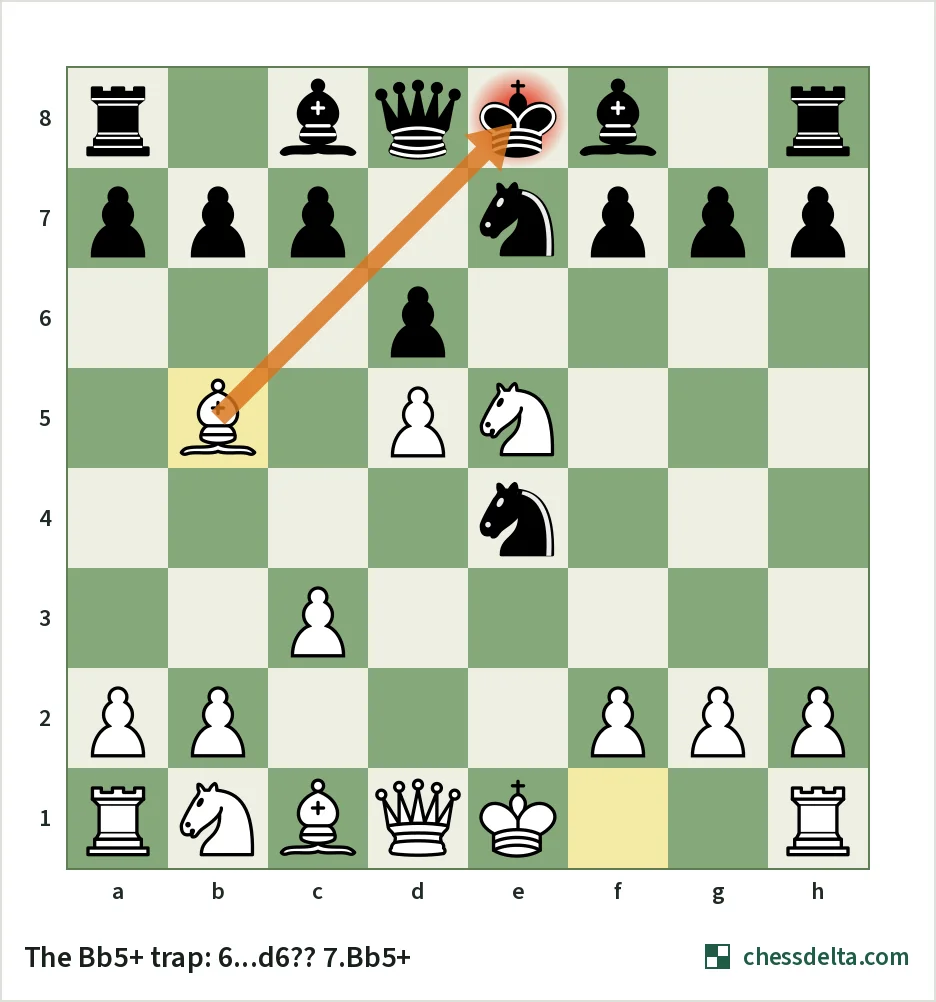
The Bb5+ trap: 6…d6??
In the traditional Jaenisch line, 3…Nf6 4.d4 Nxe4 5.d5 Ne7 6.Nxe5, Black must play 6…Ng6. The natural 6…d6?? loses material to 7.Bb5+. Why? The d-pawn no longer guards the e8-a4 diagonal, so Black must block.
After 7…c6 8.dxc6 bxc6 9.Nxc6, the knight hits the queen. When it moves again, the bishop gives a discovered check. Every reply to 7.Bb5+ leaves White winning.
The Caro Gambit trap: 6.cxd4??
After 3…d5 4.Qa4 Bd7 5.exd5 Nd4, the knight jumps off c6 and the bishop on d7 now attacks your queen. The greedy 6.cxd4?? loses the queen to 6…Bxa4, and Black is winning. Play 6.Qd1 instead. After 6…Nxf3+ 7.Qxf3 the game is equal.
The Spanish Variation trap: 5…Qg5
After 3…d5 4.Bb5 dxe4 5.Nxe5, White hopes to win material on c6. But 5…Qg5 attacks the knight on e5 and the g2 pawn at once. Even after 6.Qa4 Qxg2, Black is still clearly better.
How to play against the Ponziani Opening as Black
As Black, hit e4 on move 3, before White gets d4 in. You have 2 good choices:
- 3…d5. The most accurate move. After 4.Qa4, play 4…f6 or 4…Bd7. After 4.Bb5, take with 4…dxe4.
- 3…Nf6. After 4.d4 Nxe4 5.d5, choose 5…Ne7 for a normal game or 5…Bc5 for the Vukovic Gambit. After 5…Ne7 6.Nxe5, always play 6…Ng6, never 6…d6??.
Skip 3…Be7 and other slow moves. They hand White pawns on e4 and d4 for free.
Learn the Ponziani Opening in 5 moves
If you only remember 5 things as White:
- Learn the moves: 1.e4 e5 2.Nf3 Nc6 3.c3. Then d4 next move.
- Against 3…Nf6, play 4.d4 Nxe4 5.d5. After 5…Ne7 6.Nxe5 Ng6, play 7.Nxg6 hxg6 8.Qe2.
- Against 3…d5, play 4.Qa4. Never 4.Bb5.
- Against 5…Bc5, play 6.dxc6. Other moves are much worse.
- Use the a4-e8 diagonal. Qa4 and Bb5+ both work along it.
[Event "Ponziani Opening: Jaenisch traditional line starter"]
[Result "*"]
1. e4 e5 2. Nf3 Nc6 3. c3 Nf6 4. d4 Nxe4 5. d5 Ne7 6. Nxe5 Ng6 7. Nxg6 hxg6 8. Qe2 *
[Event "Ponziani Opening: 3...d5 starter"]
[Result "*"]
1. e4 e5 2. Nf3 Nc6 3. c3 d5 4. Qa4 f6 5. d3 *
Play through both a few times. The first line leaves White slightly better, and the second is equal.
FAQ
Is the Ponziani Opening good?
The Ponziani Opening is good enough to play, but it won’t give you an edge. 3.c3 leads to an equal game. The Italian Game and the Ruy Lopez score a little better for White, though both are also close to equal.
Is the Ponziani Opening good for beginners?
Yes, the Ponziani Opening is good for beginners who learn the 2 main replies. The ideas are simple: c3, d4, then develop. Learn the chess opening principles first, because 3.c3 delays your development.
Who plays the Ponziani Opening?
Howard Staunton favored the Ponziani Opening in the 1800s, and Magnus Carlsen won a game with it in 2013.
What is the best response to the Ponziani Opening?
The best responses to the Ponziani Opening are 3…d5 and 3…Nf6, with 3…d5 slightly more accurate. Both hit e4 before White can play d4.
Read next
Updated November 25, 2026.