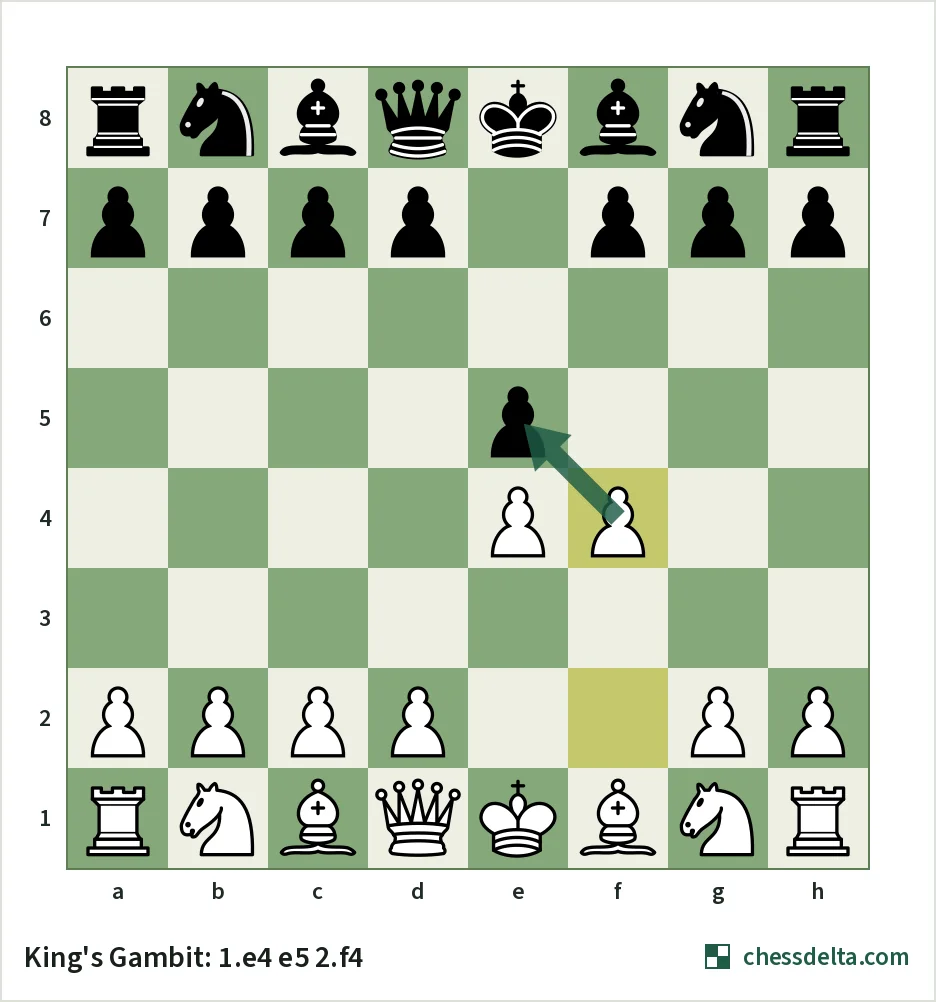
Quick answer: The King’s Gambit starts 1.e4 e5 2.f4. You offer the f-pawn to pull Black’s e-pawn away and open the f-file for an attack. Black can take with 2…exf4 (Accepted) or decline with 2…Bc5 or 2…d5. With best play Black is slightly better, but 2.f4 is far from refuted.
At a glance
- Moves: 1.e4 e5 2.f4.
- Type: Open game, king’s pawn gambit. ECO codes C30 to C39.
- White’s idea: trade the f-pawn for Black’s e-pawn, build a center with d4 and attack down the f-file.
- Black’s main replies: 2…exf4, 2…d5 and 2…Bc5.
- Verdict: slightly better for Black, playable at club level.
- Good for: attacking players who know a few sharp lines and don’t mind a loose king.
What is the King’s Gambit?
The King’s Gambit is the opening 1.e4 e5 2.f4. Why push a pawn next to your own king? Because it hits e5 at once. If Black takes, you get the center with d4 and a half-open f-file for your rook.
It’s one of the oldest documented openings, and it was one of the most popular until the late 19th century, the era of Romantic chess. You’ll find it with the open games in our chess openings directory.
Is the King’s Gambit sound?
The King’s Gambit is not refuted, but it isn’t free either. With best play Black is slightly better after 2.f4. That’s a small edge, not a refutation.
So what does the pawn really cost you? Your king’s cover. The f-pawn used to shield it, and now the e1 to h4 diagonal is open for a black queen check. In return you get fast development and open lines.
King’s Gambit Accepted: 2…exf4
In the King’s Gambit Accepted, 1.e4 e5 2.f4 exf4, Black takes the pawn. Black keeps a small edge, and you have 2 main ways to go on: 3.Nf3 and 3.Bc4.
3.Nf3, the King’s Knight’s Gambit
3.Nf3 is the most popular move, and the reason is h4. With the knight guarding it, …Qh4+ would just lose the queen. The knight also supports d4 later.
So how does Black hold on to the pawn, or give it back? 4 main answers:
- 3…g5. Black holds the f4 pawn with the g-pawn. Black is slightly better.
- 3…d6, the Fischer Defense. A waiting move that prepares …g5. Black is slightly better here too.
- 3…d5, the Modern Defense. Black gives the pawn back for free play. After 4.exd5 Nf6 the game is equal.
- 3…Nf6, the Schallopp Defense. Answer 4.Nc3 and develop. Black keeps a small edge.
3…g5 4.h4: the Kieseritzky Gambit
The Kieseritzky Gambit is 1.e4 e5 2.f4 exf4 3.Nf3 g5 4.h4 g4 5.Ne5. Why h4? It attacks Black’s pawn chain from the side. Then your knight jumps to e5, where it hits g4 and f7.
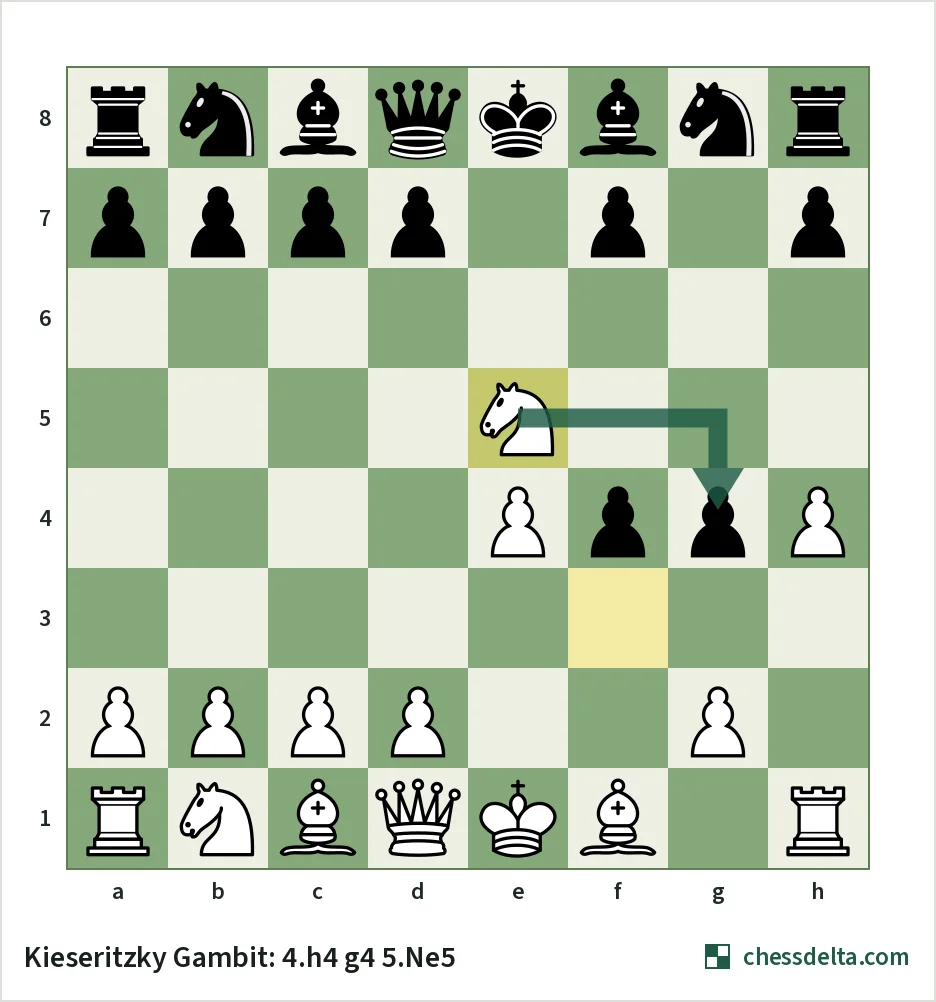
4.h4 is one of the top choices here. After 5.Ne5 the position is equal to slightly better for Black, and those g-pawns are loose. You often win one back with Nxg4. Lionel Kieseritzky popularized the line in the 1840s.
The Muzio Gambit: a whole knight
The Muzio Gambit is 1.e4 e5 2.f4 exf4 3.Nf3 g5 4.Bc4 g4 5.O-O. Your knight is attacked, and you just castle. After 5…gxf3 6.Qxf3 you’re a whole piece down. What do you get for it? Your queen hits f4, your bishop hits f7 and your rook waits on f1.
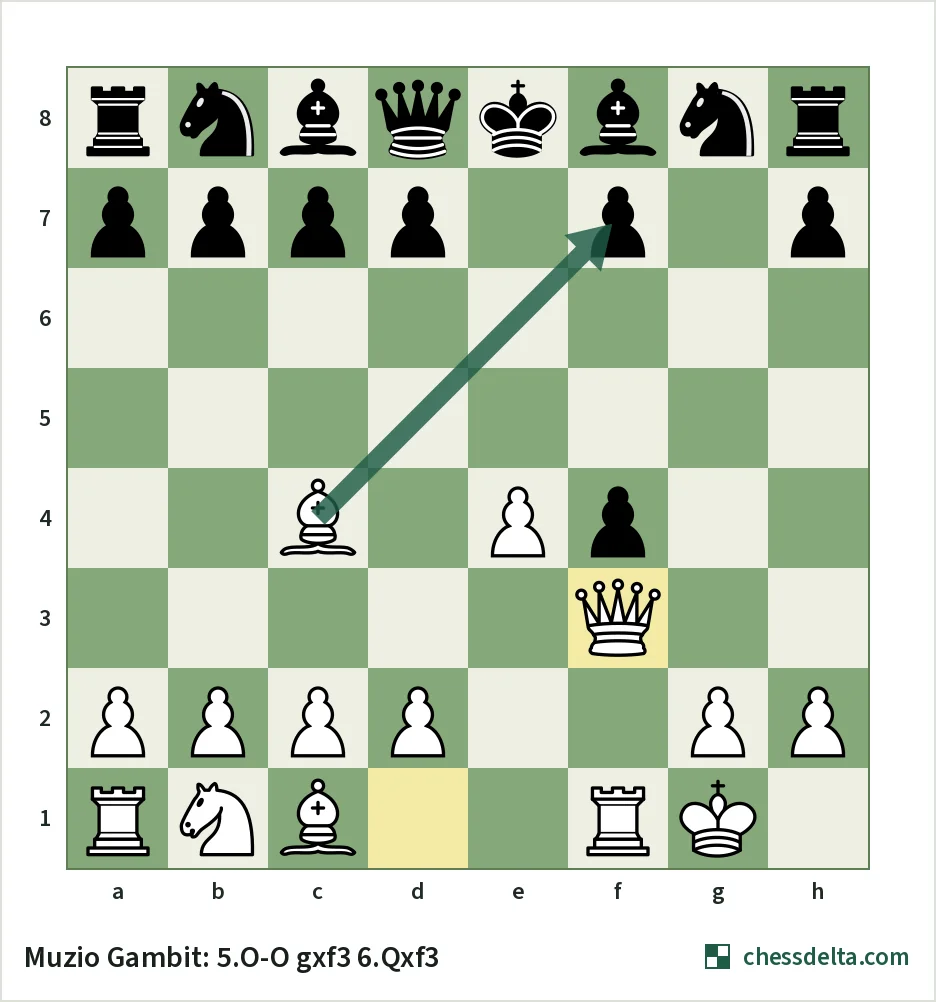
It’s fun to play and scary to face. But with best play Black is clearly better after 6.Qxf3. So save the Muzio for blitz, not for a game that matters.
3…d6: the Fischer Defense
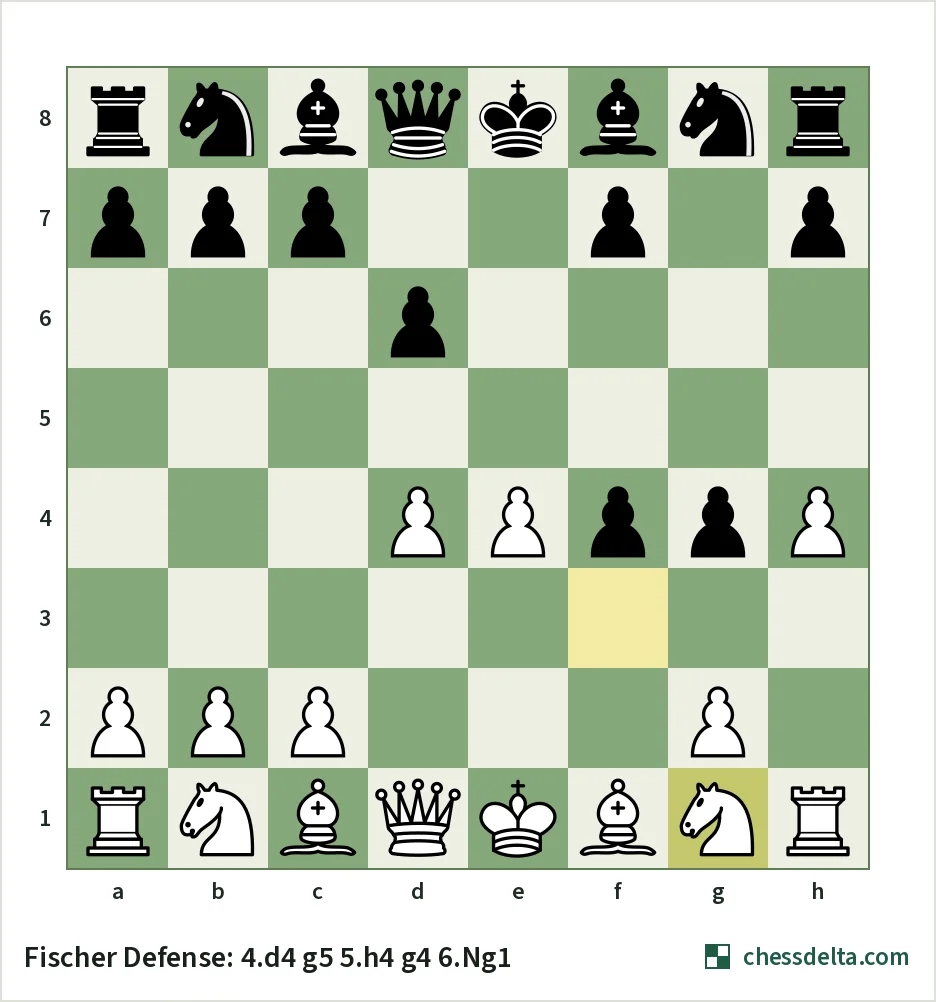
The Fischer Defense, 1.e4 e5 2.f4 exf4 3.Nf3 d6, takes e5 away from your knight before …g5 arrives. Bobby Fischer’s 1961 article “A Bust to the King’s Gambit” called 3…d6 “a high-class waiting move”.
Why does that matter? Look at the sharp main line, 4.d4 g5 5.h4 g4 6.Ng1. With e5 covered, the knight has nowhere else to go, and Black is slightly better. The calmer 4.Bc4 also leaves Black slightly better.
3.Bc4: the Bishop’s Gambit
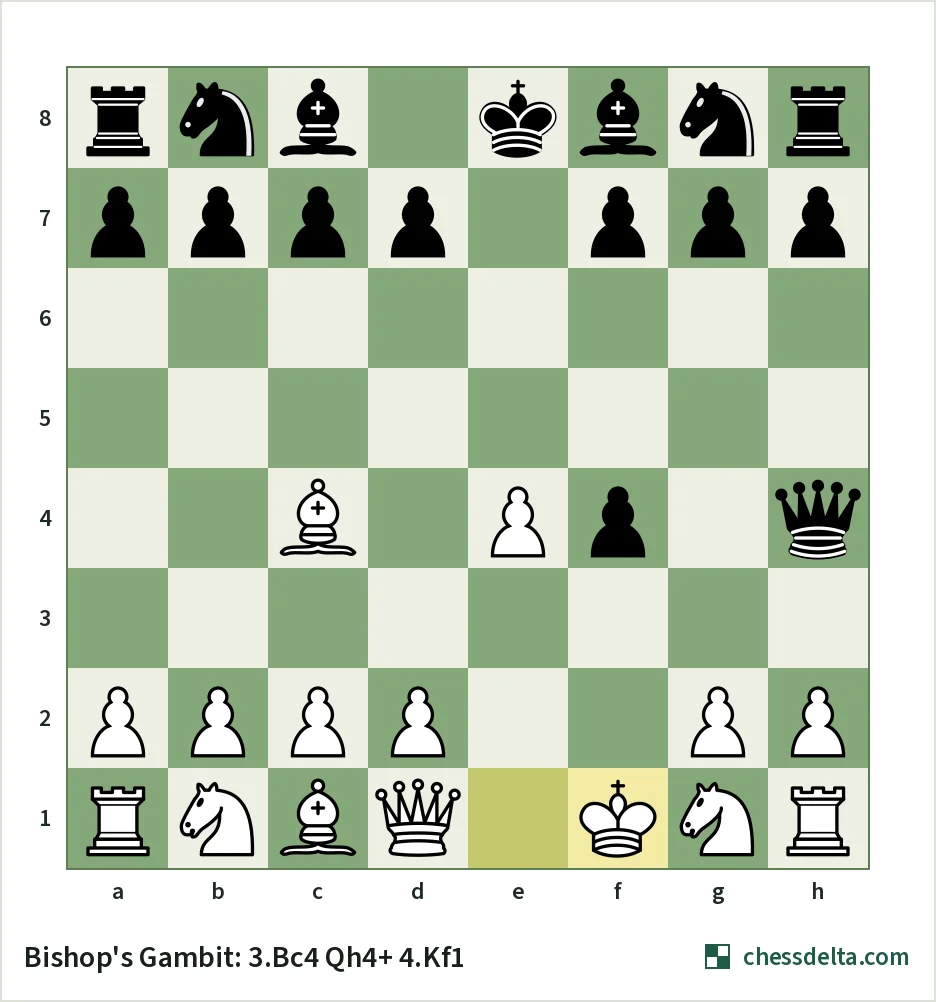
The Bishop’s Gambit, 1.e4 e5 2.f4 exf4 3.Bc4, is the main alternative to 3.Nf3. Here you let Black check on h4. After 3…Qh4+ 4.Kf1 your king can’t castle, but the queen on h4 becomes a target for Nf3. Black is slightly better, about the same as after 3.Nf3.
King’s Gambit Declined: 2…Bc5 and 2…d5
Black doesn’t have to take the pawn. The 2 main ways to decline are 2…Bc5, which opening databases call the Classical Variation, and 2…d5, the Falkbeer Countergambit.
The Classical Variation, 2…Bc5
The Classical Variation, 1.e4 e5 2.f4 Bc5, puts the bishop on the g1 to a7 diagonal. While it eyes g1, your king can’t castle kingside. A good reply is 3.Nf3 d6 4.c3, preparing d4 to blunt the bishop. The position is equal.
So whatever you do, don’t take on e5 at once. 3.fxe5?? loses to 3…Qh4+, the trap below.
The Falkbeer Countergambit, 2…d5
The Falkbeer Countergambit, 1.e4 e5 2.f4 d5, hits back in the center. It’s named after the 19th-century Austrian master Ernst Falkbeer. After 3.exd5 Black has 2 choices:
- 3…exf4. Black takes the f-pawn after all. It’s equal to slightly better for Black. Play 4.Nf3 Nf6 5.c4 and develop.
- 3…e4. The pawn cramps you. Answer 4.d3 to break it up, and it’s equal to slightly better for White.
Common traps in the King’s Gambit
The 2…Bc5 3.fxe5?? Qh4+ trap
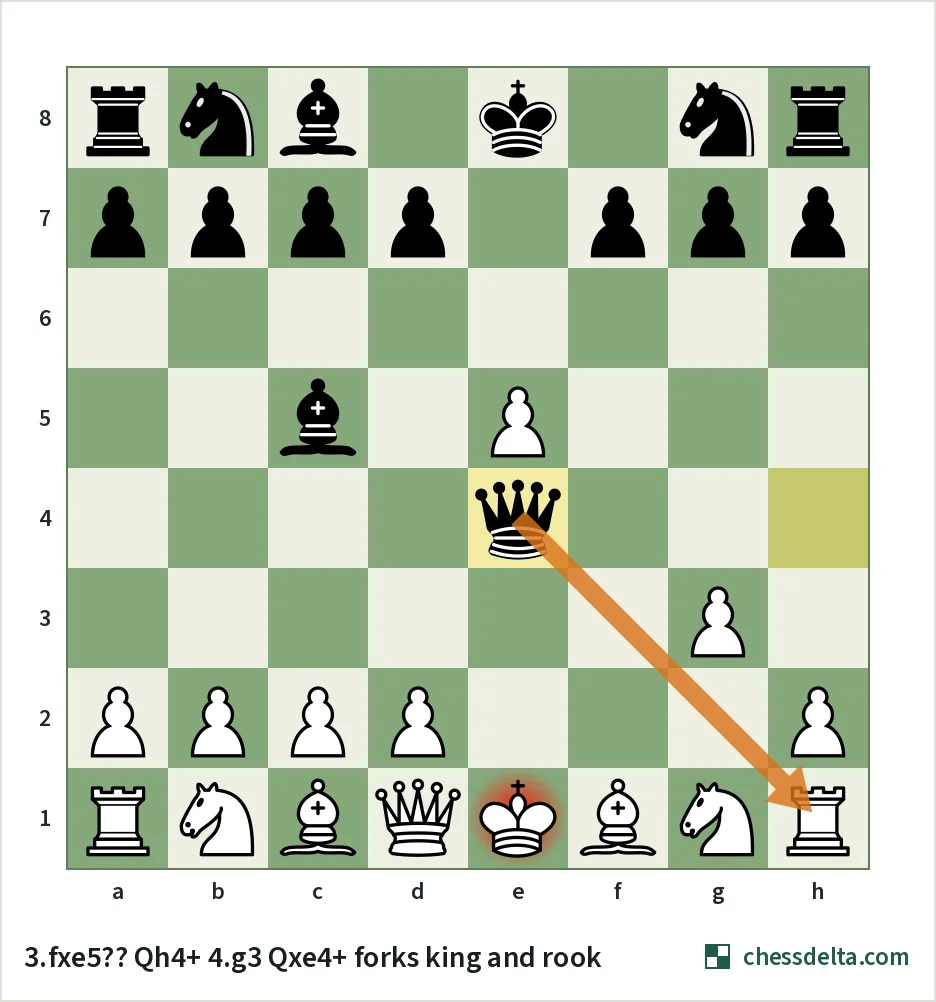
The classic King’s Gambit trap catches White, not Black. It runs 1.e4 e5 2.f4 Bc5 3.fxe5?? Qh4+.
So how does White get out? It can’t. White has 2 replies, and both lose. 4.Ke2 Qxe4# is checkmate. 4.g3 Qxe4+ forks the king and the rook on h1, and after 5.Qe2 Qxh1 Black is a rook up and winning.
The same check one move later
The Qh4+ trick still works after 2…Bc5 3.Nf3 d6. Taking with 4.fxe5 is fine, and the game stays equal. Grabbing a second pawn is not: 1.e4 e5 2.f4 Bc5 3.Nf3 d6 4.fxe5 dxe5 5.Nxe5?? Qh4+.
Why does the check work again? The knight left f3, so h4 is open.
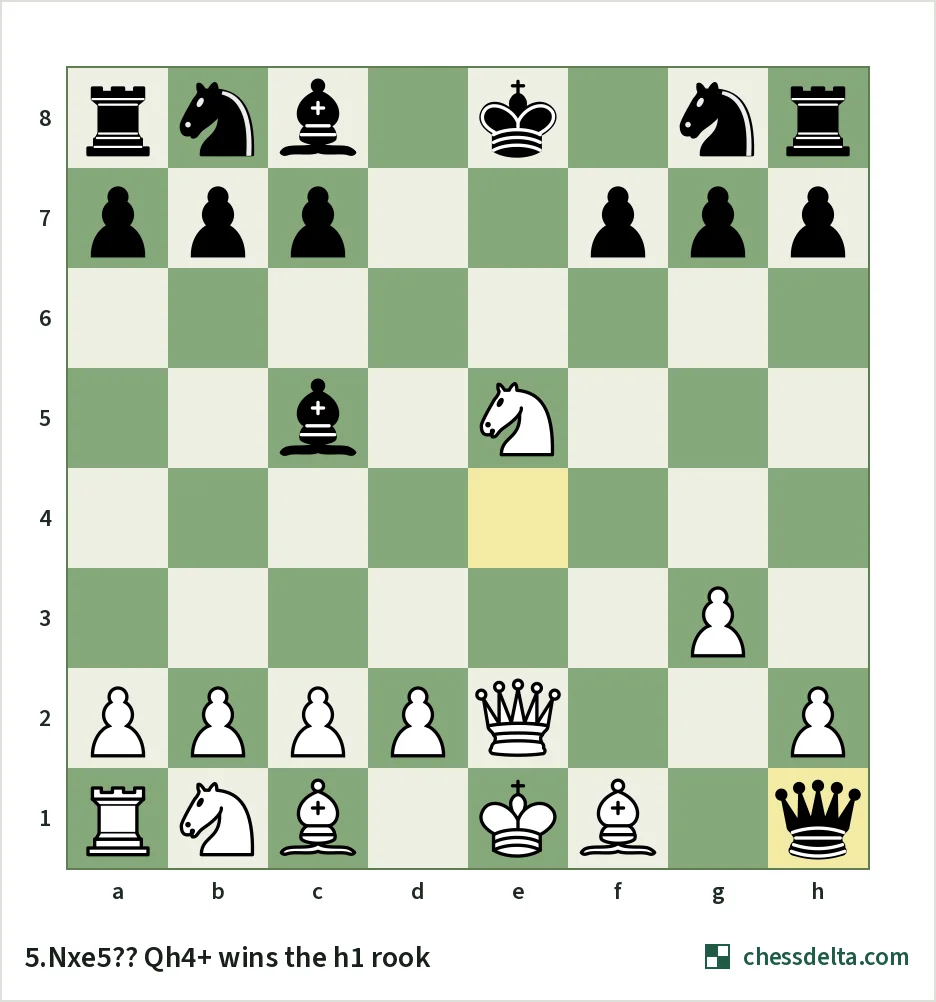
After 6.g3 Qxe4+ 7.Qe2 Qxh1 Black wins the rook and is winning. Keep your knight on f3 until your king is safe.
How should Black meet the King’s Gambit?
Black can meet the King’s Gambit by simply taking: 2…exf4 leaves Black slightly better. 2…d5 is equal to slightly better for Black, and 2…Bc5 is equal. So pick the one that suits your style.
- 2…exf4 3.Nf3 d6. Fischer’s choice. Develop with …Nf6 and …Be7, and give the pawn back when it suits you.
- 2…exf4 3.Nf3 d5. The simplest route. You return the pawn, develop fast, and the game is equal.
- 2…d5, the Falkbeer Countergambit. Fight for the center at once, then take on f4 after 3.exd5.
- 2…Bc5. Calm and solid. Keep the bishop on the g1 to a7 diagonal.
Whatever you choose, don’t rush the queen to h4 while a knight on f3 can take it. After 2…exf4 3.Nf3, the check 3…Qh4+?? just drops the queen to 4.Nxh4.
Learn the King’s Gambit in 5 moves
Short on time? Remember these 5 things:
- Play 1.e4 e5 2.f4, then 3.Nf3 against 2…exf4.
- Against 3…g5, play 4.h4. Break up the pawns before they cramp you.
- Against 3…d6, develop with 4.Bc4 and castle.
- Against 2…Bc5, play 3.Nf3, never 3.fxe5.
- Your king is loose. Castle early, or tuck it on f1 in the Bishop’s Gambit.
[Event "King's Gambit Accepted: Kieseritzky Gambit"]
[Result "*"]
1. e4 e5 2. f4 exf4 3. Nf3 g5 4. h4 g4 5. Ne5 *
[Event "King's Gambit Declined: Classical Variation"]
[Result "*"]
1. e4 e5 2. f4 Bc5 3. Nf3 d6 4. c3 *
FAQ
Is the King’s Gambit good for beginners?
The King’s Gambit is good for beginners once they castle early by habit. It teaches fast development and attack, but it breaks the “keep your king safe” rule from the chess opening principles. If you’re new, start with our chess for beginners guide.
Is the King’s Gambit refuted?
No, the King’s Gambit is not refuted. With best play Black is slightly better after 2.f4, not winning. And you get real attacking chances for the pawn.
Should Black accept the King’s Gambit?
Yes, Black can accept the King’s Gambit. After 2…exf4 Black keeps a small edge. The key is to give the pawn back at the right time instead of clinging to it.
What is the best response to the King’s Gambit?
One of the best responses to the King’s Gambit is 2…exf4, which leaves Black slightly better. 2…d5 is a good second choice. After 2…exf4 3.Nf3, both 3…d6 and 3…g5 keep a small edge for Black.
Is the King’s Gambit better than the Italian Game?
No, the King’s Gambit is not better than the Italian Game with best play. The Italian Game keeps your king safe and gives up no material. The King’s Gambit trades a pawn and some king safety for a faster attack.
Read next
Updated November 25, 2026.