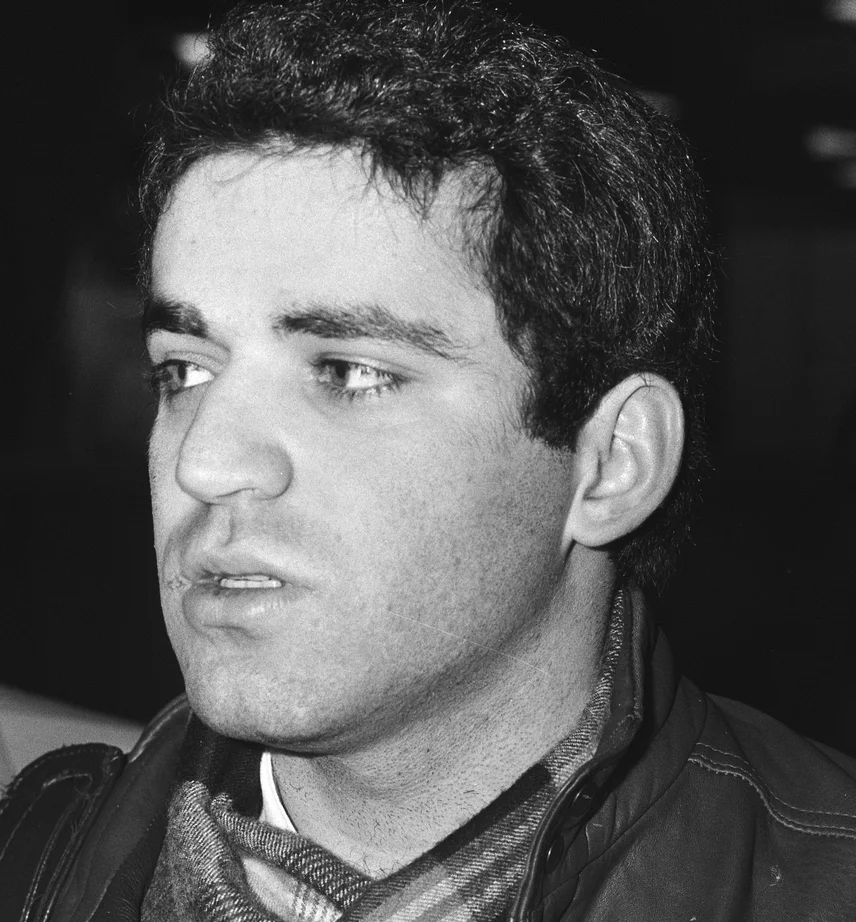
New York, May 4, 1997. Game 2 of the rematch between world champion Garry Kasparov and IBM’s supercomputer Deep Blue. After Deep Blue’s 45th move, Kasparov resigned.
He had lost the game to a machine. Then he found out he might not have needed to.
What move did Kasparov miss?
Kasparov missed 45…Qe3. Here is the final position from his side of the board, with Black to move. Press ▶ to play the line his team found.
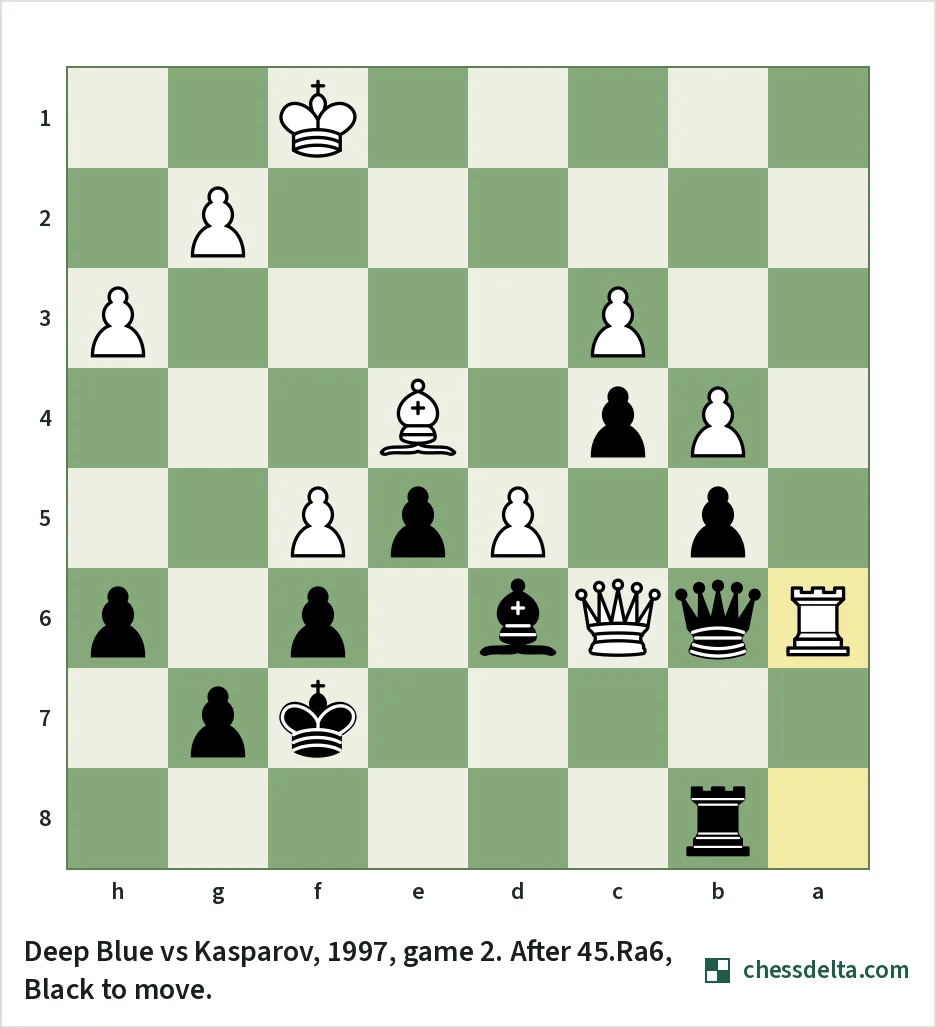
The key is 46…Re8, a rook move nobody in Kasparov’s camp had checked. Then 47…h5 shuts the door on White’s king. From there Black’s queen checks on c1, d2, f4 and e3, and White’s king can’t find a square to hide.
So why would the strongest player in the world give up a position like that?
Why did Kasparov resign?
Kasparov resigned because of a move Deep Blue played 8 moves earlier. On move 36 the machine could have grabbed material with its queen on b6. The programs Kasparov’s team used, Fritz and Hiarcs, both wanted to play exactly that.
Deep Blue didn’t. It played 36.axb5 axb5 37.Be4, a bishop move that took nothing and shut down Black’s counterplay. Grandmaster John Nunn called 37.Be4 “a cruel move”.
To Kasparov, it didn’t look like a computer move at all. And a machine that played that patiently, he reasoned, would never leave him a perpetual check. So when 45.Ra6 came, he didn’t look hard for one.
What did his team show him the next morning?
That night, Kasparov’s computer adviser Frederic Friedel sat up with the final position. The first analysis was bad news: an email from ChessBase in Hamburg showed a pretty win for White.
Then, at about 2 a.m., his program suggested 47…h5. Suddenly Friedel couldn’t find a win for White anymore.
The next morning he showed it to Kasparov’s second, Yuri Dokhoian. Dokhoian drew a sharp breath at 46…Re8. “We didn’t look at this move,” he said.
Now someone had to tell Kasparov. Dokhoian broke the news on the walk to breakfast. Friedel wrote that Kasparov clutched his head and froze in the middle of Fifth Avenue.
At the table, after minutes of silence, Kasparov looked up. “Re8, h4, h5 that was all? I was so impressed by the deep positional play of the computer that I didn’t think there was any escape.”
What happened after game 2?
Kasparov didn’t let it go. He couldn’t understand how a machine that found 37.Be4 could then miss a simple perpetual check.
He suggested a human grandmaster had been behind Deep Blue’s play and asked IBM for the computer’s printouts. IBM denied any interference.
The match was level at 2.5 each going into the last game. In game 6, on May 11, Kasparov lost in just 19 moves. Deep Blue won the match 3.5 to 2.5.
Kasparov wanted a rematch. IBM said no and retired Deep Blue instead. It never played a match again.
Was the position really a draw?
In the line on the board above, yes. Once 47…h5 is in, White’s king can’t get away from the checks.
The argument is about White’s other choices at move 47. Analysts in 1997 were sure Kasparov had resigned a drawn game. Some players who have dug into it since think White had better tries than 47.h4, so the question has never been fully settled.
What isn’t in doubt is the lesson. Before you resign, look at every check you have, even against an opponent who seems to see everything.
Read next
- Ruy Lopez: the opening Deep Blue chose in game 2, with its main lines and plans.
- Daily chess puzzle: a new position every day, to train the habit Kasparov skipped that night: looking at every check.
- Why chess players resign: when giving up is right, and when it’s too soon.
Updated .