Chess players offer draws when neither side can checkmate by any series of legal moves, or when the game is heading that way. Some also offer a draw when they’re tired.
So why do strong players agree to draws so often, when one side looks fine? Because they can see the end of the game long before you can. Prefer to watch? Here’s our short video, or read on.
Chess Players Offer A Draw When The Position Is Really A Draw
Chess players offer a draw when the position is really a draw. If you’re new to chess, all those draws can look strange. Why not just play on?
Start with how you win. You checkmate the king: it’s in check and has no legal way out. Read our 7 Checkmate Rules Every Chess Player Should Know for the details.
You also win if your opponent resigns. Our guide to the 5 Reasons Why Chess Players Resign explains when and why they do.
But in some positions, nobody can checkmate, whatever either side tries. The kings just chase each other around the board.
So how does a game end up drawn? Here are the ways it can happen.
Stalemate:
Stalemate happens when the player to move isn’t in check but has no legal move.
That sounds odd at first. If your king isn’t in check, surely you just keep playing?
Not in a stalemate, because there’s no move to play. The king is boxed in. Look at the diagram below and try to find a move for Black.
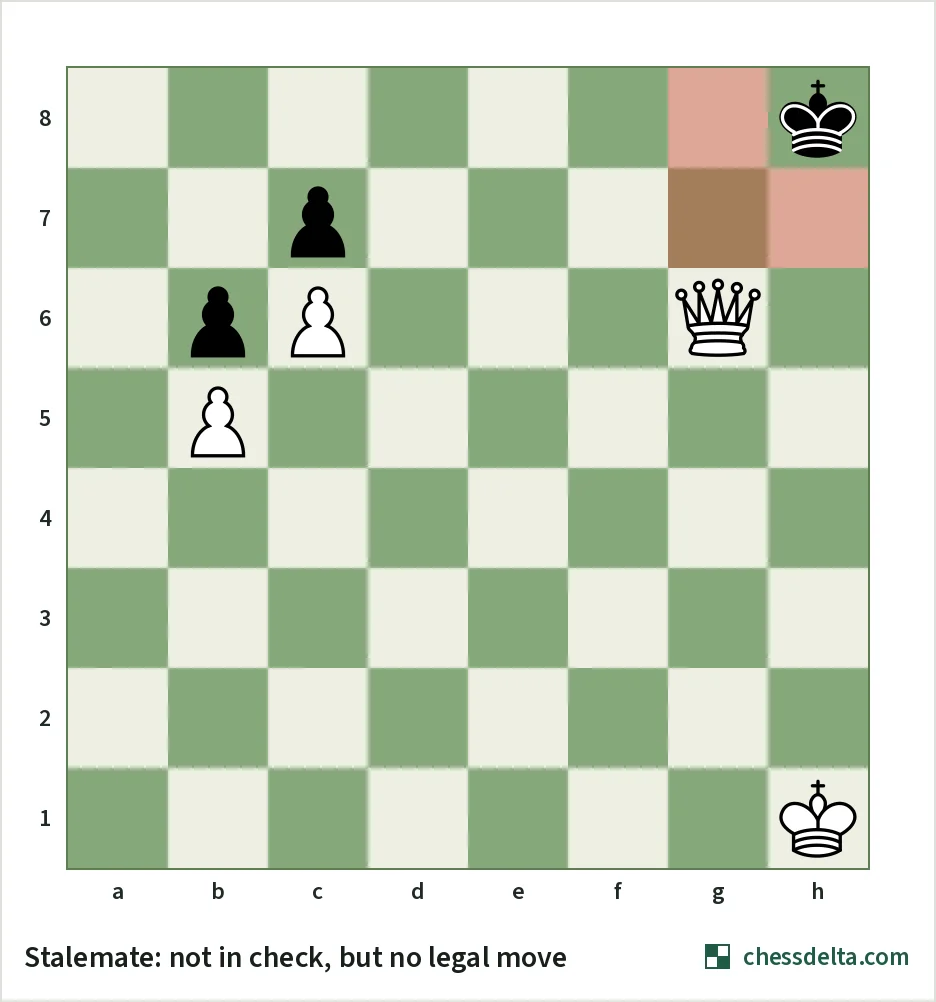
Every king move walks into check, which is illegal. And the other pieces are either blocked or already gone.
To learn more, read our full guide to the Difference Between Stalemate And Draw [Simplified], with more examples.
Whenever stalemate happens, the game ends in a draw.
Having Insufficient Mating Material:
Insufficient mating material means there aren’t enough pieces left to checkmate.
Say you and a friend trade off every piece until you’re both left with only the king. Can either of you win?
No. A king can’t capture or check another king. See why in our guide Can A King Kill A King In Chess? (Explained)
Neither of you has the material to checkmate. And it isn’t only king vs king. These endings are drawn too:
- King And A Knight vs King,
- King and A Bishop vs King.
In each of these, the game is drawn.
Now here’s the real reason players offer draws. Why keep playing if you already know where the game is heading?
Experienced players see these endings coming several moves ahead. So they offer the draw before the board gets there.
Want the exact procedure and the best moments to offer? Read our full guide on How To Offer And Accept A Draw In Chess: Helpful Guide
Threefold Repetition Rule:
When the same position appears for the 3rd time, the player to move can claim a draw.
Also read: Can You Repeat Moves In Chess?
50 move Rule:
If each player has made 50 moves with no pawn move and no capture, the player to move can claim a draw.
Fivefold Repetition Rule:
When the same position appears for the 5th time, the game is drawn. Nobody needs to claim it.
75 move Rule:
If each player has made 75 moves with no pawn move and no capture, the game is drawn.
When players sense the game drifting toward any of these, they often offer a draw instead of playing it out.
Chess Players Offer A Draw When They Are Tired
Chess players also offer a draw when they’re tired. Picture a day with several serious games, where one slip costs you the game.
Some games run so long that you’re drained by the end. And then the next round starts.
Could you play that one as sharply as the first?
That’s why players offer a draw when the game looks drawish and a draw won’t cost them much.
It saves time and energy. And it gives them more rest before the next game.
Why Do Grandmasters Draw So Much?
Grandmasters draw so much because they read positions better than other players. When they see a game heading for a draw, they agree to it early. Sometimes they’re simply tired.
Final Words
Curious about the other habits you see at the board? These guides explain them.